The Government Bought the Data. Its Users Still Couldn’t Reliably Use It.
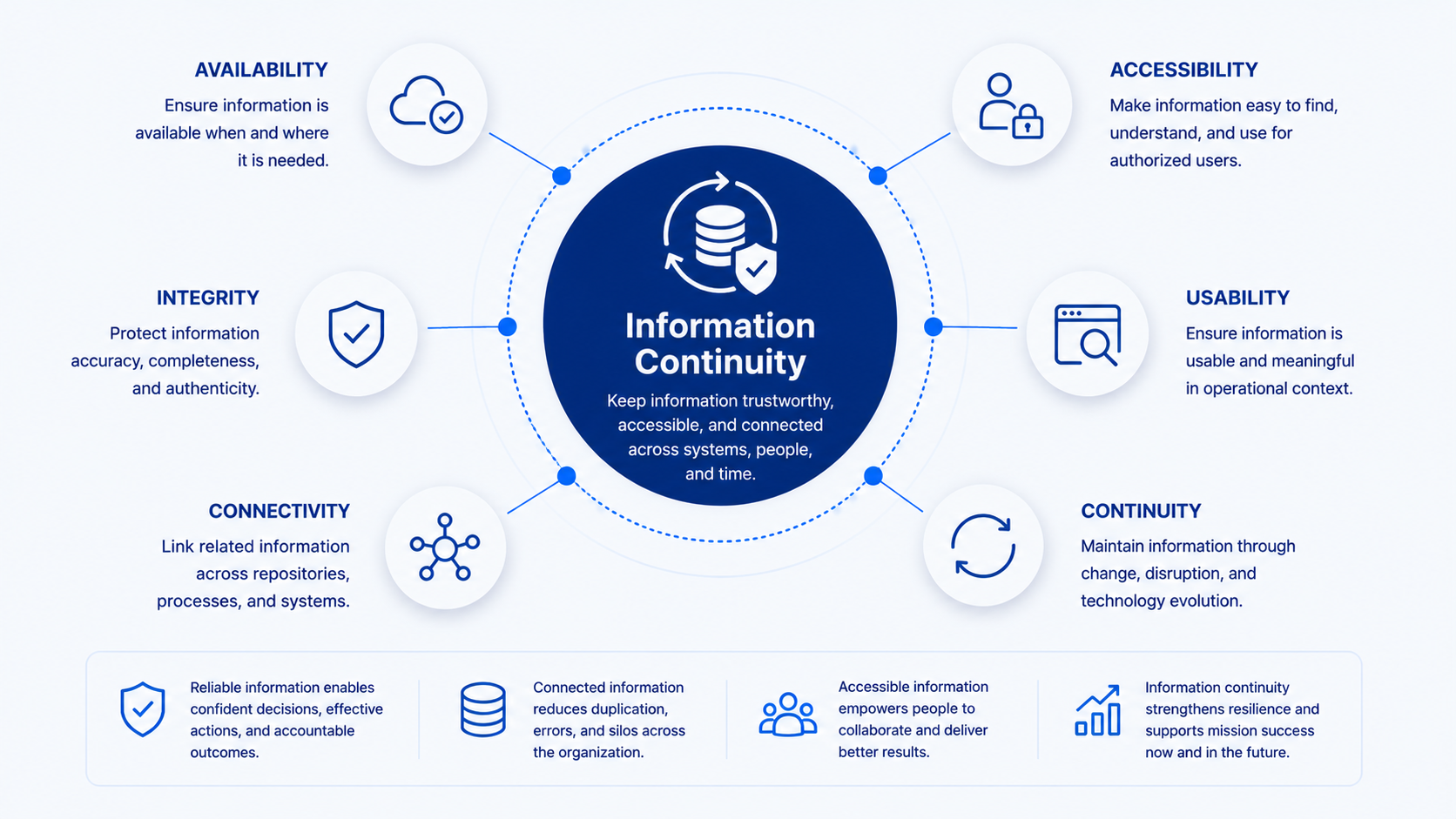

An institution can buy information, store information, and still fail to make that information reliably usable.
An August 2026 Government Accountability Office review of the Department of Defense's use of commercial space data provides a clear example. DOD organizations had purchased commercial data and services for national-security missions, including tens of millions of dollars in spending through the Global Data Marketplace. Yet GAO found that some Space Force officials hesitated to use commercial data because of licensing costs, perceived use restrictions, and concerns about long-term access. A cross-government working group existed to coordinate commercial-data purchases, but relevant officials were not participating and awareness of the mechanism was limited.
The data existed. The government had paid for it. The continuity required for dependable reuse did not travel with it.
Possession Is Not Information Continuity
Organizations often measure information capability through acquisition and access. Did we buy the dataset? Is it stored somewhere? Can an authorized user retrieve it?
Those questions matter, but they are incomplete. Operational use also depends on whether users know that the information exists, understand the rights attached to it, can determine what uses are permitted, know how long access will remain available, and can connect the information to the mission context in which it is useful.
That is the difference between possessing information and preserving Information Continuity.
Access Rights Are Part of the Knowledge
Commercial information carries conditions. Licenses may constrain redistribution, derivative use, retention, transfer, or access by particular organizations. Those conditions are not administrative details outside the information object. They determine what the institution is authorized to do with the information.
In the GovKM Continuity Topology, the relevant path begins Source → Evidence → Authority → Context → Decision → Action. A commercial dataset is a Source. Its contents may become Evidence. Contractual and licensing terms establish part of the Authority governing use. Mission circumstances establish Context. Only then can personnel determine whether and how the information may support a Decision or Action.
If access rights, licensing conditions, provenance, and mission applicability are stored elsewhere or remain known only to a small group, retrieval of the data does not reconstruct the institutional permission to use it.
Future Reuse Begins at Acquisition
The GAO finding also exposes a lifecycle problem. Long-term access was itself a concern. That means continuity cannot be designed only for today's analyst.
A future user may need to know whether the government still possesses rights to the information, whether a license changed, whether a dataset was superseded, whether redistribution is permitted, and whether an earlier analysis depended on access that no longer exists.
This extends the continuity path through Record → Institutional Memory → Future Reuse.
An acquisition record showing that the government paid for data is not enough. The institution needs a durable relationship among the purchased information, applicable rights, responsible organizations, versions, mission uses, resulting decisions, and conditions governing later reuse.
Coordination Mechanisms Are Continuity Infrastructure
GAO also found that a cross-government working group existed to coordinate purchases and could address many of the barriers, but awareness and participation were incomplete.
This demonstrates another common continuity failure: the institution creates a mechanism for shared understanding, but that mechanism does not become part of the operating context of everyone who needs it.
A working group, catalog, data marketplace, governance board, or repository can exist without becoming Institutional Memory. It becomes continuity infrastructure only when affected users can reliably discover it, understand its authority, and use it to recover the relationships needed for action.
Why AI Does Not Automatically Solve This
AI can improve discovery across large information environments. It can help identify datasets, summarize content, compare sources, and make previously obscure information easier to locate.
But retrieval is not the whole problem in this case.
An AI system might find the commercial dataset faster than a human analyst and still fail to know whether a particular organization may use it, whether the license permits the intended transformation, whether the information can be retained, or whether it remains available for future validation.
The more capable the retrieval layer becomes, the more important it is that authority and lifecycle conditions remain attached to what is retrieved.
Information Continuity requires the institution to preserve not only the information, but the relationships that determine who can use it, for what purpose, under which conditions, and whether that use remains reconstructable later.
The GovKM Proposition
The DOD case illustrates a broader principle applicable to government and enterprise information acquisition.
Buying data does not create organizational knowledge. Storing data does not create future reuse. Making data searchable does not establish authority.
The institutional asset is the connected package: the source, evidence, rights, context, decisions, actions, records, and reuse conditions that allow information to remain trustworthy and operational across time.
If those relationships are missing, an organization can spend heavily acquiring information and still leave future users unable to determine whether they can safely and legitimately use what the institution already owns.
Continue Exploring

When Government Systems Are Replaced, What Happens to Their Authority?
The Practice Form Failed. The Agent Used the Real One.