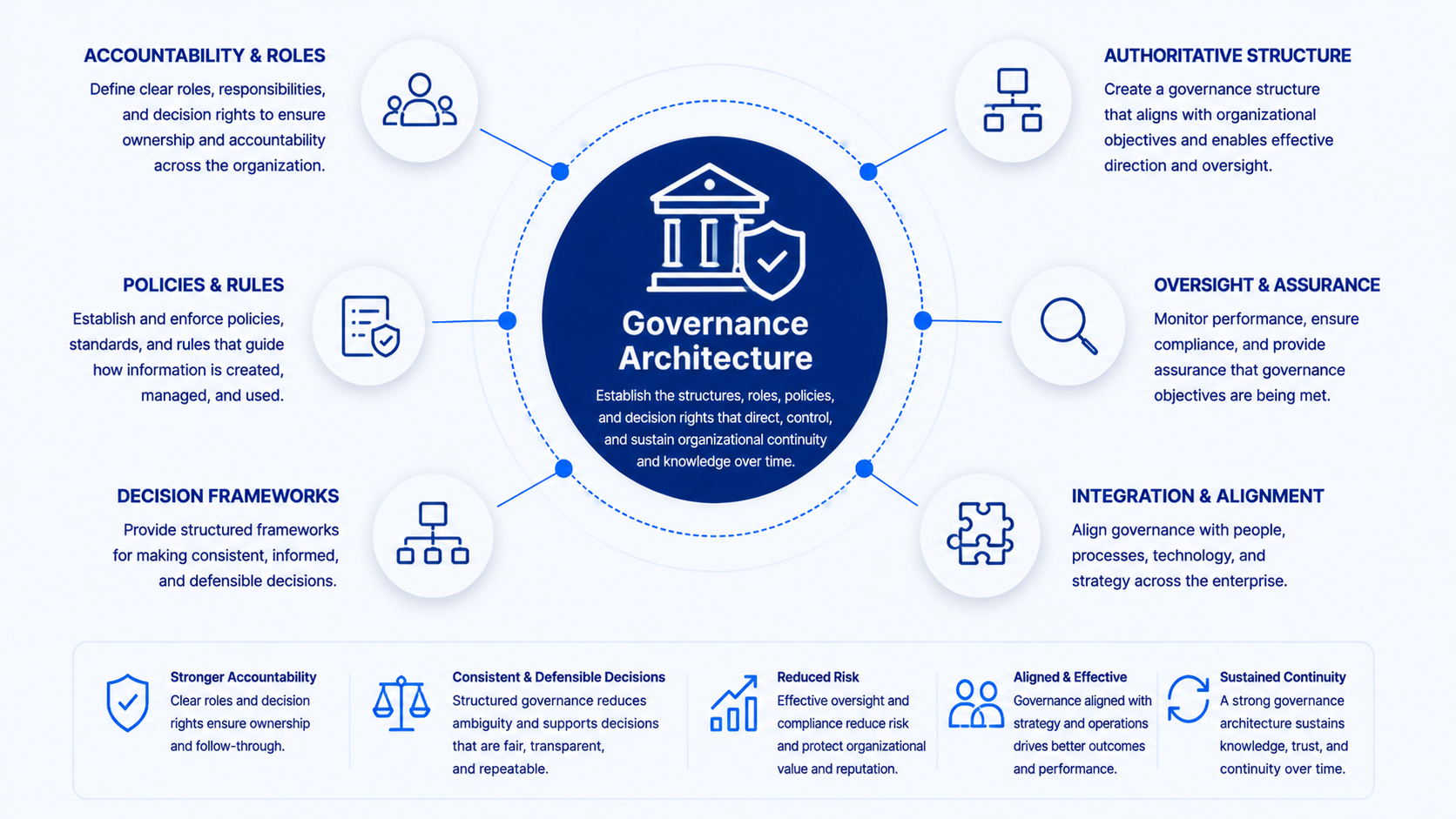
The Information Existed. The Decision Process Still Didn’t See It.

Government information can exist in the right system and still fail to reach the decision that depends on it.
On September 9, 2026, the U.S. General Services Administration Office of Inspector General reported that the Public Buildings Service was not consistently following its own Building Assessment Tool guidance. The audit found that surveyors and approvers did not consistently review building-maintenance liability information already contained in the IRIS Project Action Request and Work Item modules. In the OIG sample, 79 of 196 surveys understated repair and alteration liabilities by a combined $73 million.
The report also identified an authority-control problem. GSA OIG recommended requiring a separate surveyor and approver for each BAT survey and controls that prevent the same person from performing both roles. The risk is compounded by a longer information-refresh cycle: BAT surveys that had previously been performed every two years are now required every five years following staffing reductions and reorganization.
The continuity failure was not storage
The relevant information was present. The break occurred in the relationship that should have carried it from source system into evidence and context for the BAT assessment. In GovKM terms, this is a cross-system continuity failure: Source → Evidence → Context → Decision → Record was not reliably preserved.
The approval issue exposes a second break. Authority is not simply a field that says “approved.” It is a governed relationship between an authorized actor and a consequential decision. When the same person can create and approve the assessment, the institution loses an important separation-of-duties relationship that helps establish grounded trust.
Why this matters beyond facilities
Modern organizations routinely distribute relevant information across operational systems. A system can be accurate locally while the institution remains wrong globally if the information does not propagate into the workflows that depend on it. That pattern appears in financial reporting, cybersecurity, healthcare, acquisition, AI retrieval, and records management.
GovKM interprets this audit as evidence for a broader continuity proposition: availability is not continuity. Information becomes institutionally useful only when the relationships required to admit it as evidence, place it in the correct context, apply authority, and preserve the resulting decision remain intact.
Source
U.S. General Services Administration Office of Inspector General, “PBS Is Not Consistently Complying with Its Internal Guidance for the Building Assessment Tool, Resulting in Underreported Liabilities and Increasing the Risk of Errors,” issued September 9, 2026.
Continue Exploring
A Decision Memorandum Is Not Decision Provenance.
Aggregation Is Not Continuity.