Non-Action Is Still a Decision

Organizations are usually good at recording change.
A policy is revised. A control is added. A procedure is replaced. A new requirement appears in the record.
What is much easier to lose is the decision to change nothing.
A September 2026 Government Accountability Office review of U.S. Secret Service protection policies makes that problem unusually visible. GAO examined 83 security incidents from fiscal years 2015 through 2025. The Secret Service changed protection policy after 25 of them. But when officials decided that policy did not need to change, agency procedures did not consistently require the rationale for that decision to be documented.
The incident remained in the record.
The institutional reasoning for maintaining the status quo sometimes did not.
Doing Nothing Can Be a Consequential Institutional Act
Non-action is often treated as the absence of a decision. In many governed environments, it is the opposite.
An institution may review an incident, consider the available evidence, decide that existing policy remains sufficient, and consciously accept the current state. That is a decision with consequences.
If the reasoning is not preserved, future personnel cannot reliably distinguish among several very different histories: the risk was analyzed and accepted; the evidence was considered insufficient; another control was judged adequate; the issue was deferred; responsibility was unclear; or nobody recognized the pattern at all.
All of those histories can leave the same visible artifact: unchanged policy.
The Missing Record Appears Between Decision and Institutional Memory
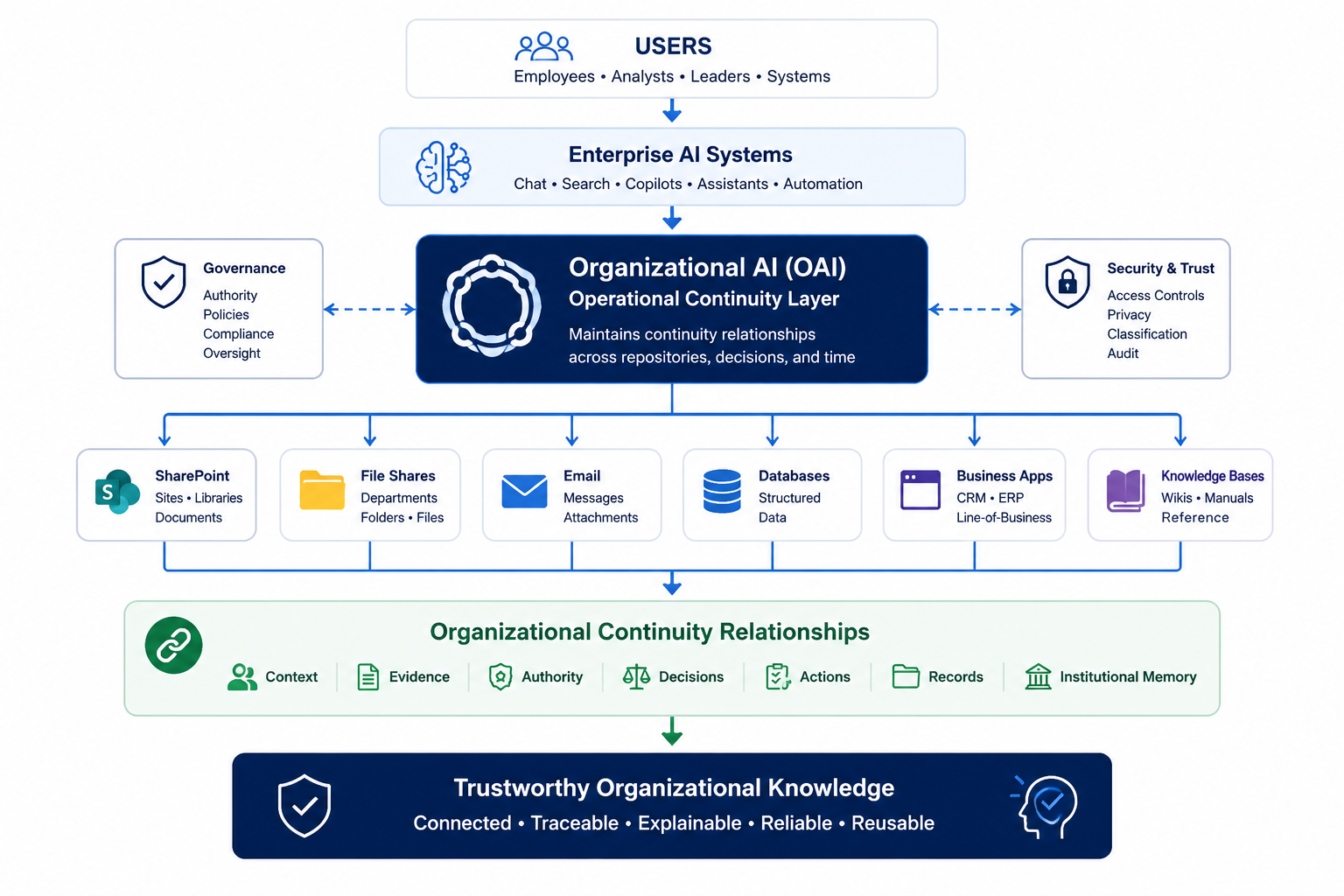
GovKM represents institutional work through the Continuity Topology:
Source → Evidence → Authority → Context → Decision → Action → Record → Institutional Memory → Future Reuse.
When a decision results in no policy change, the Action may be “maintain current policy.” That still needs a Record if the institution expects later reviewers to understand the decision.
If the rationale is missing, later reviewers possess the incident and the unchanged policy but not the relationship explaining why those two states were considered compatible.
Pattern Recognition Depends on Recorded Non-Action
GAO’s discussion of drone incidents makes the problem concrete. The report identified incidents involving drones in 2015, 2016, and 2021 for which policy was not changed and the rationale for maintaining policy was not recorded. GAO concluded that preserving those decisions could have made the emerging pattern more available during later reviews.
This illustrates why continuity is temporal. One event can look immaterial. A second can look unrelated. A third can reveal a pattern—but only if future reviewers can reconstruct not just what happened, but how the institution previously interpreted each event.
AI Will Otherwise Learn the Wrong Lesson From History
A model can see that an incident occurred and that policy remained unchanged. Without the decision record, it may infer that the institution concluded the incident was harmless, that no issue was identified, or that the existing policy was affirmatively validated.
Those inferences may be wrong. AI cannot recover institutional rationale that was never preserved.
The GovKM Proposition
Non-action is still a decision when an institution deliberately chooses to preserve the current state.
Institutional memory is not complete when it preserves only changes. It must also preserve the consequential reasons the institution chose not to change.
Continue Exploring

When Government Systems Are Replaced, What Happens to Their Authority?
The Practice Form Failed. The Agent Used the Real One.