One Year After the GenAI Divide: Why the 5% Succeeded and the 95% Failed

One Year After the GenAI Divide: Why the 5% Succeeded and the 95% Failed
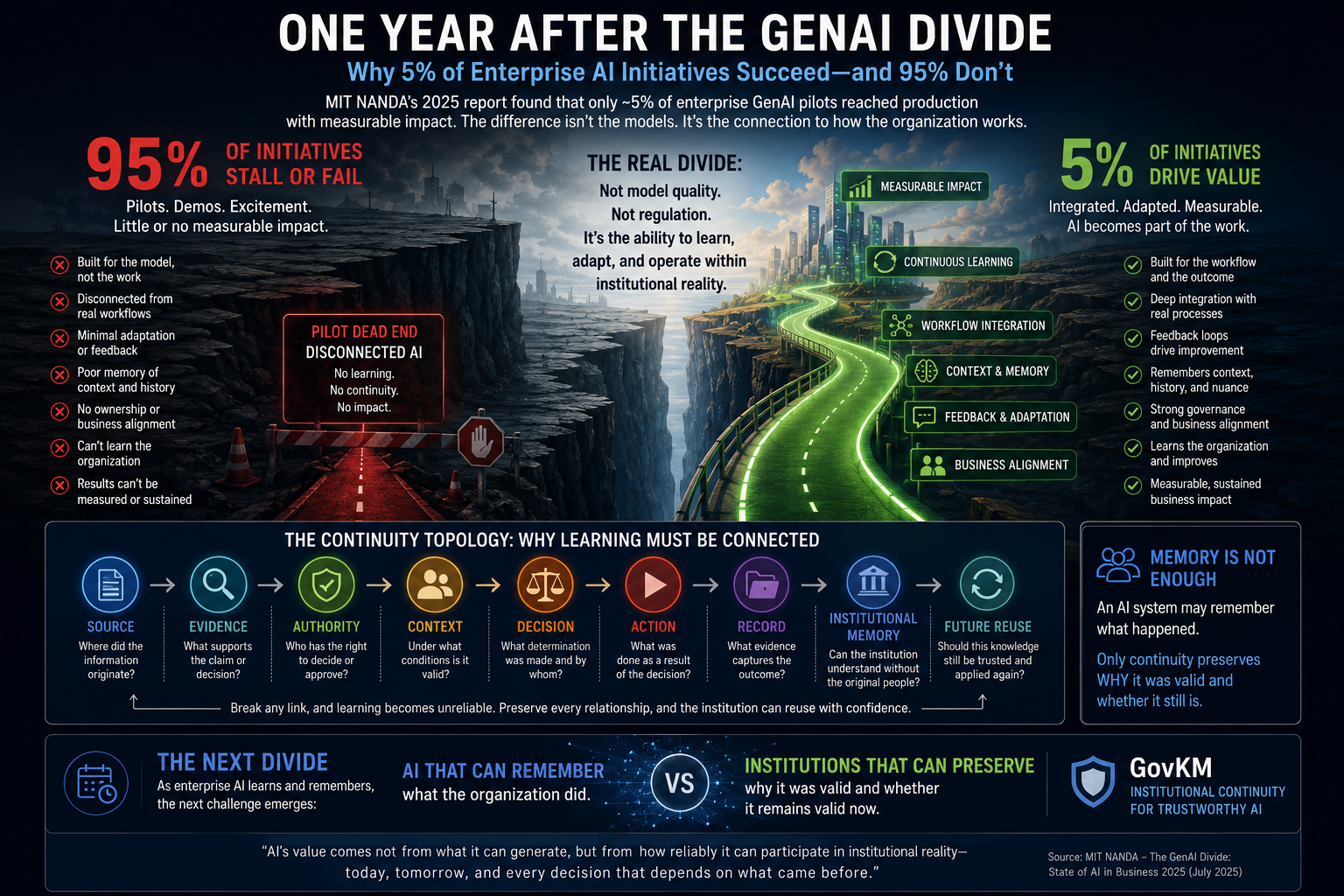
One year ago, a statistic from MIT's NANDA initiative became one of the defining numbers of the enterprise AI boom.
After an estimated $30–40 billion in enterprise investment in generative AI, The GenAI Divide: State of AI in Business 2025 reported a striking split: only about 5% of integrated AI pilots were producing substantial measurable value, while the overwhelming majority showed no measurable P&L impact.
The number traveled farther than the explanation.
“95% of AI projects fail” became the headline. But that simplified what the researchers had actually found. The report's own methodology describes the figures as directional, and its definition of successful implementation focused on sustained productivity or P&L impact rather than whether software technically functioned.
The more important question was therefore never whether 95% was precisely the right number.
It was this:
What was different about the 5%?
A year later, that question looks even more important.
The report did not identify dramatically better foundation models as the dividing line. Nor did it principally blame regulation, infrastructure, or a shortage of AI enthusiasm.
It identified something much closer to an organizational architecture problem.
The successful systems became capable of participating in how the organization actually worked.
The unsuccessful systems largely did not.
The 95% Did Not Necessarily Have an AI Problem
The GenAI Divide documented an extraordinary difference between experimentation and operational adoption.
According to the report, approximately 60% of organizations had evaluated enterprise GenAI tools. About 20% reached pilot stage. Only about 5% reached successful production deployment under the report's criteria.
Meanwhile, general-purpose tools such as ChatGPT and Copilot experienced much broader adoption.
That produced an apparent paradox.
Employees clearly found generative AI useful. Organizations clearly wanted AI. Models were increasingly capable. Investment was abundant.
Yet enterprise implementations repeatedly stalled.
MIT's researchers described the central problem as a learning gap.
Enterprise users complained that specialized systems were brittle, poorly aligned with workflows, unable to retain useful context, and unable to improve from feedback. Users might correct a system, teach it something about the work, or encounter an exception—and then discover that the system had effectively learned nothing from the interaction.
The organization was using increasingly capable intelligence through systems that remained institutionally static.
That distinction matters.
The model could generate.
The system could not reliably learn the organization.
The 5% Crossed From Software Into Work
The organizations on the successful side of the divide behaved differently.
They placed greater emphasis on workflow fit, customization, feedback, operational integration, and measurable business outcomes. The report found an implementation advantage for externally partnered solutions over internal builds and found that successful buyers were more likely to demand process-specific adaptation rather than evaluate systems primarily through software benchmarks.
This suggests a useful way of interpreting the divide.
The 95% largely approached AI as something to deploy into the organization.
The 5% were beginning to integrate AI with the organization.
That is a much harder problem.
An enterprise is not merely a collection of documents and databases surrounding a language model. It is a continuously changing network of policies, evidence, responsibilities, exceptions, authority, historical decisions, workflows, records, people, systems, and institutional experience.
AI becomes operationally valuable when it can participate appropriately in those relationships.
And that is where the GenAI Divide begins to look like a continuity problem.
The Learning Gap Was Also a Continuity Gap
GovKM represents institutional activity through the Continuity Topology:
Source → Evidence → Authority → Context → Decision → Action → Record → Institutional Memory → Future Reuse
Consider what happens when an AI system enters a real enterprise workflow.
It receives information from somewhere.
That information must become acceptable evidence for some purpose.
Someone or something possesses authority.
The evidence and authority operate within a particular context.
A decision occurs.
The decision produces an action.
The action produces a record.
That experience can become part of institutional memory.
Eventually, a human or AI system may retrieve that memory and use it again.
AI systems that operate outside those relationships can still be impressive.
They can summarize documents, draft correspondence, answer questions, classify information, and generate analysis.
But consequential enterprise work occurs through relationships.
A procurement recommendation depends upon current suppliers, delegated authority, contract terms, historical performance, available funding, policy, market conditions, and organizational priorities.
A healthcare recommendation depends upon evidence, population, authority, clinical context, current guidance, patient circumstances, and subsequent action.
A government decision depends upon sources, evidence, statutory or delegated authority, policy, context, decisions, actions, and records.
The AI does not become enterprise AI merely because it can access enterprise data.
It becomes enterprise AI when it can operate within the institutional relationships that give that data meaning.
Why Memory Appeared So Important
One of the most prescient findings in the report was the importance users placed on memory.
Employees could tolerate general-purpose AI for transient work. For consequential workflows, however, repeatedly explaining the same organizational circumstances became a fundamental limitation.
The report therefore associated successful systems with capabilities that could adapt, remember, and evolve.
That was an important diagnosis.
But the year since the GenAI Divide has exposed the next problem.
Memory alone is not continuity.
Suppose an enterprise agent remembers that a particular exception was approved last year.
That sounds useful.
But who approved it?
What authority did that person possess?
Which evidence supported the exception?
What customer, transaction, contract, regulatory environment, or operating circumstance made it appropriate?
Was the policy subsequently changed?
Did the exception produce the expected result?
Should another agent apply the same exception today?
An AI system that remembers the answer but loses those relationships has not necessarily learned institutional knowledge.
It may simply have preserved an old conclusion.
The 5% Point Toward a More Difficult Problem
This is why the GenAI Divide should not be interpreted simply as evidence that organizations need better AI memory.
The successful 5% pointed toward something larger.
Enterprise AI creates value when technology becomes aligned with actual organizational processes and can improve through experience.
But experience itself must be governed.
Once an AI system begins retaining corrections, outcomes, decisions, preferences, exceptions, and successful actions, those memories can influence future institutional behavior.
A correction becomes potential precedent.
An exception becomes potential policy-by-repetition.
A successful outcome becomes potential guidance.
A previous decision becomes training material for the next one.
At that point, the enterprise has moved beyond the original learning gap.
It has entered the continuity problem.
Future Reuse Requires More Than Retrieval
This distinction is becoming particularly important as enterprise AI moves toward persistent memory and autonomous agents.
Retrieval asks:
Can the system find what happened before?
Continuity asks:
Can the institution determine whether what happened before remains valid now?
Those are very different capabilities.
An AI system may retrieve a perfectly accurate historical record and still make the wrong decision because the governing policy changed.
It may reproduce a successful past action whose delegated authority no longer exists.
It may retrieve an exception without recognizing that the exception applied only to one customer.
It may learn from a human correction without knowing whether the person providing the correction possessed authority to establish institutional practice.
This is why GovKM distinguishes Institutional Memory from Future Reuse.
Information entering institutional memory should not automatically become precedent.
Future reuse requires requalification.
The evidence may need to be checked.
Authority may need to be re-established.
Context may need to be compared.
Supersession may need to be identified.
The outcome may need to be considered.
The institution must be able to distinguish between something that happened before and something that should govern what happens next.
The 95% May Have Taught Us the Wrong Lesson
The easiest interpretation of the GenAI Divide was that companies were bad at implementing AI.
There is truth in that.
But the more consequential interpretation is that enterprise AI exposed weaknesses that already existed inside organizations.
Institutional knowledge was fragmented.
Context lived inside employees.
Decision history was difficult to reconstruct.
Policies were disconnected from operational systems.
Feedback disappeared.
Exceptions became tribal knowledge.
Records preserved outcomes without necessarily preserving reasoning.
Different systems represented the same organizational concepts differently.
Humans had compensated for those discontinuities for years.
They asked colleagues.
They remembered what happened last time.
They recognized obsolete instructions.
They knew who actually possessed authority.
They understood that a documented procedure differed from operational reality.
AI could not reliably make those repairs.
The GenAI Divide therefore exposed something deeper than an AI implementation problem.
AI encountered organizations whose institutional relationships had never been designed for machines to understand.
The 5% Did Not Just Implement Better AI
The organizations crossing the divide demonstrated several characteristics the report associated with success: tighter workflow integration, greater adaptation to actual processes, feedback-driven improvement, stronger business alignment, and measurement against operational outcomes rather than technical demonstrations.
Viewed through continuity, those characteristics share something important.
They reduce the distance between AI and institutional reality.
That does not mean the successful organizations had solved Institutional Continuity. The MIT study did not investigate the complete continuity architecture GovKM describes, and it would be inappropriate to attribute that conclusion to the researchers.
But their findings reveal the direction.
The closer AI gets to actual institutional work, the more important institutional relationships become.
And as AI moves from assisting work to remembering, learning, deciding, and acting, preserving those relationships becomes increasingly consequential.
A Year Later, the Next Divide Is Becoming Visible
The 2025 GenAI Divide separated organizations generating measurable value from organizations accumulating pilots.
The next divide may be different.
It may separate organizations whose AI systems can learn from organizations whose AI systems can learn responsibly.
Persistent memory is arriving.
Agentic systems are arriving.
Enterprise learning architectures are arriving.
Systems increasingly retain previous interactions, retrieve organizational knowledge, observe outcomes, call tools, execute transactions, and use prior experience to influence future behavior.
Those capabilities begin to close the learning gap MIT identified.
They simultaneously make continuity more important.
Because the central enterprise AI question is changing.
In 2025, organizations were asking:
Can our AI learn enough about our organization to become useful?
Increasingly, they must ask:
Can our organization preserve enough of the relationships surrounding that learning to determine whether it remains trustworthy?
The first question is about learning.
The second is about Institutional Continuity.
The Lesson of the GenAI Divide
One year after The GenAI Divide, its most durable contribution may not be the 95% statistic.
It may be the recognition that AI capability alone does not create institutional value.
The 5% succeeded because they crossed some portion of the distance between a capable model and the reality of organizational work.
The 95% struggled where that connection remained weak.
The next generation of enterprise AI must go further.
Organizations will need systems capable of remembering and adapting. But they will also need to preserve the sources, evidence, authority, context, decisions, actions, records, and outcomes that determine what those systems should learn.
The first GenAI Divide was between AI that could generate and AI that could become part of the work.
The next divide will be between AI that can remember what the organization did and institutions that can preserve why it was valid.
That is the transition from enterprise AI implementation to Institutional Continuity.
Continue Exploring
Synthetic Evidence Can Disable a Knowledge Institution
The Knowledge Hub Is Itself a Crown Jewel