Parliament Preserved the Citation. The Study Never Existed.

An institution can preserve false information perfectly.
That does not make the information true.
An August 2026 Guardian Australia investigation into submissions made to Australian parliamentary inquiries found at least 39 submissions containing apparently hallucinated references and more than 100 papers carrying ChatGPT-related URL metadata. Some contained isolated errors. In others, the investigation found that every cited reference appeared not to exist.
That is already a serious evidence problem.
But the more important continuity problem begins after the erroneous material enters the institutional record.
A False Citation Can Acquire Real Provenance
Once a submission is accepted and preserved on an official parliamentary website, the document becomes a genuine institutional object.
The URL is real. The parliamentary repository is real. The submission is real. Search systems can retrieve it accurately.
The study cited inside it may still never have existed.
The Guardian investigation found examples in which AI search summaries treated fabricated references as real and could cite parliamentary submissions containing those references. That creates a recursive provenance problem:
AI-generated false evidence → institutional record → future retrieval → apparent authoritative source.
The false claim gains provenance because its container gained provenance.
Truth did not improve. The appearance of authority did.
Records Preserve Claims, Not Their Truth
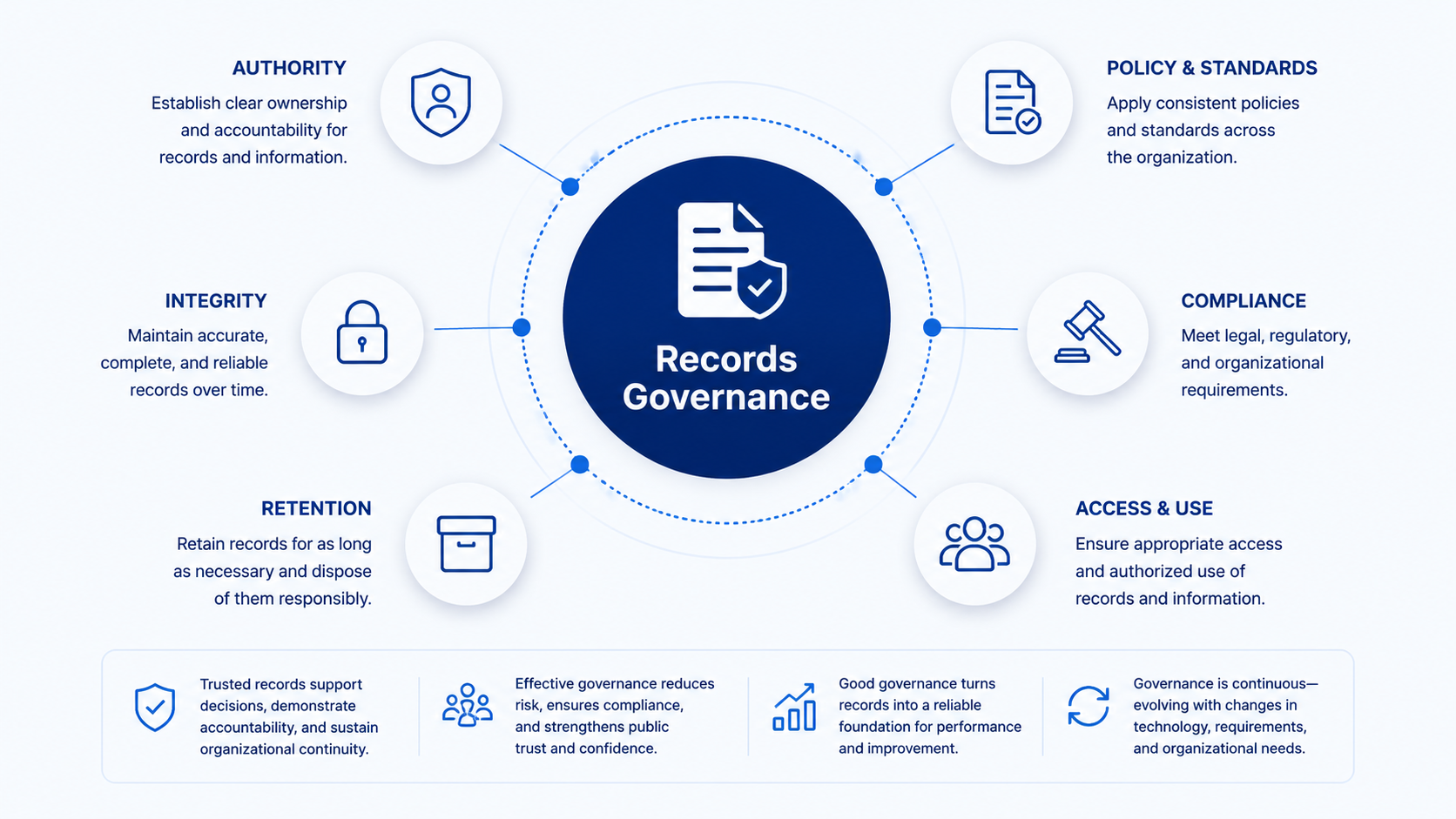
Records governance is designed to preserve authentic evidence of institutional activity.
If Parliament received a submission containing a fabricated citation, the authentic record may correctly preserve the fact that the submission was received exactly as submitted.
That is records integrity.
It is not evidence validation.
This distinction is essential for AI systems. A retrieval system may correctly identify an official parliamentary record. A language model may accurately quote the submission. A citation generator may produce the correct parliamentary URL.
Every technical step can be correct while the underlying Source → Evidence relationship remains false.
The Continuity Topology Shows the Loop
GovKM represents institutional information through:
Source → Evidence → Authority → Context → Decision → Action → Record → Institutional Memory → Future Reuse.
Ordinary hallucination breaks near the beginning:
Source ✕ → Evidence.
Institutional preservation can then carry the defective evidence downstream:
invalid Evidence → Record → Institutional Memory → Future Reuse.
When future AI retrieves that record and treats the preserved claim as evidence, the topology loops:
Future Reuse → new apparent Source → new Evidence.
The institution has not merely retained an error. It has created conditions under which the error can acquire additional apparent legitimacy every time it is reused.
Provenance Cannot Be Inferred From Location
This is why GovKM distinguishes the authority of a container from the authority of the content relationships inside it.
An official website can authentically host a third-party assertion. A court docket can authentically contain a filing with a false citation. An agency repository can authentically preserve an outdated policy. A peer-reviewed article can accurately describe an allegation without proving the allegation true.
Retrieval location therefore cannot substitute for evidence lineage.
AI needs to know not only where information was found but what institutional role the object plays: submission, finding, allegation, decision, source evidence, superseded guidance, public comment, draft, authoritative policy, or historical record.
Institutional Publication Can Launder Authority Accidentally
Nothing in this pattern requires malicious conduct by the institution.
Public bodies often have legitimate reasons to preserve submissions without independently validating every factual assertion. Courts preserve party filings. Archives preserve historical documents. Public-comment systems preserve citizen input.
The continuity weakness appears when downstream systems forget that distinction.
If retrieval strips away the object’s evidentiary role, a preserved assertion can be promoted into institutional evidence merely because it sits inside an institutional repository.
This is provenance laundering through context.
AI Makes the Loop Faster
Before generative AI, a fabricated citation in a public submission might remain obscure. Search engines could index it, but a human researcher would often encounter friction: opening the document, following the citation, failing to locate the study, and recognizing the discrepancy.
Generative retrieval can compress those steps. A model may synthesize multiple documents, repeat the false reference, and cite the official record that preserved it.
The resulting answer can look better sourced than the original hallucination.
That makes relationship-level verification increasingly important.
Evidence Needs a Contestable State
Institutions do not need to erase erroneous submissions from the historical record. In many cases they should not.
They do need ways to preserve corrections, challenges, evidentiary status, and lineage alongside the record so future systems can distinguish:
what was submitted; what was verified; what was disputed; what was corrected; what remains unsubstantiated; and what later institutional action relied upon it.
That is how an institution can preserve historical authenticity without converting every preserved claim into future authority.
The GovKM Proposition
Institutional provenance does not repair broken evidentiary provenance.
A record can be authentic while a claim inside it is false. Retrieval can be accurate while the retrieved evidence is invalid. AI can cite an authoritative repository while reproducing a source that never existed.
Continuity therefore requires provenance at the relationship level—not merely the document level.
Parliament preserved the citation.
The study still never existed.
Continue Exploring

When Government Systems Are Replaced, What Happens to Their Authority?
The Practice Form Failed. The Agent Used the Real One.