
Preserving the original record is necessary. It is not sufficient.
Mem++: Non-Destructive Memory for Long-Term Organizational LLM Agents proposes a memory architecture that stores every organizational document whole, with author and event date, rather than compressing it into generated facts or graph edges at write time. Earlier versions are retained rather than overwritten, and selection is deferred until a question is asked.
On the synthetic OrgMemBench benchmark, Mem++ outperformed the strongest structured-memory baseline by 8.0 to 13.1 points across two answering models. With GPT-4.1-mini, it also exceeded conventional RAG overall. The result provides controlled support for a core continuity principle: destructive write-time compression can eliminate evidence before anyone knows which future question will require it.
The continuity gain
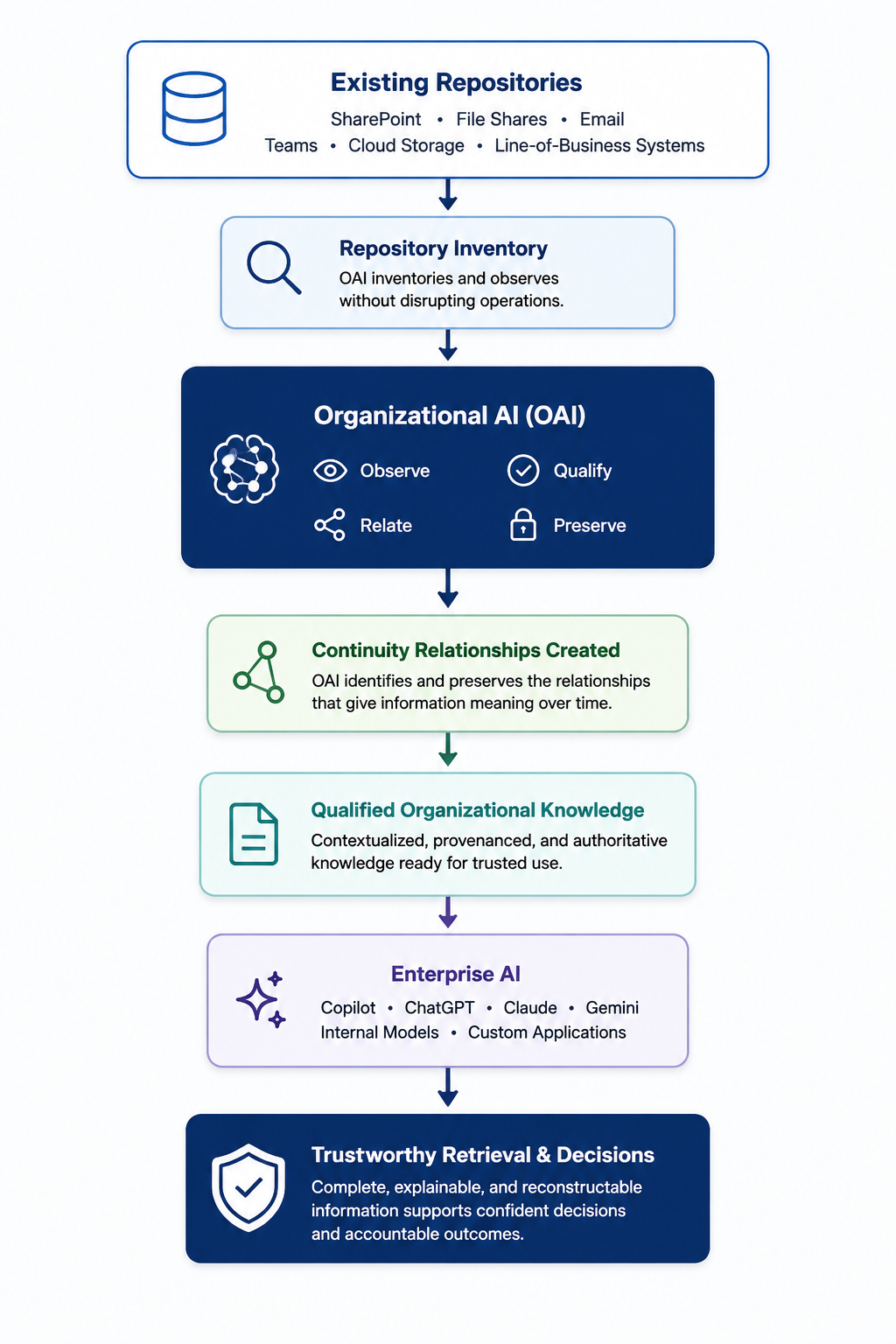
The preserved chain is:
Source / complete organizational document → Record / immutable artifact with author and date → Institutional Memory / retained version history → Future Reuse / query-time selection.
That architecture protects information that would otherwise disappear when a memory writer decides, prematurely, which details are important.
But preservation is not adjudication
The benchmark also shows why raw preservation cannot be the entire continuity architecture. Mem++ performs particularly well on supersession and audit replay, but conventional RAG remains competitive or stronger on some contradiction, decision-provenance, and bi-temporal questions. Every tested system struggles with justification chains.
The missing function is the connective layer: which later record supersedes which earlier decision, under what authority, for which scope, and during which effective period?
This complements GovKM’s article The Evidence Was All There. The Retriever Never Reassembled It. Complete source preservation prevents evidence destruction; provenance-aware relationships help reconstruct which evidence belongs together and what currently governs.
The GovKM interpretation
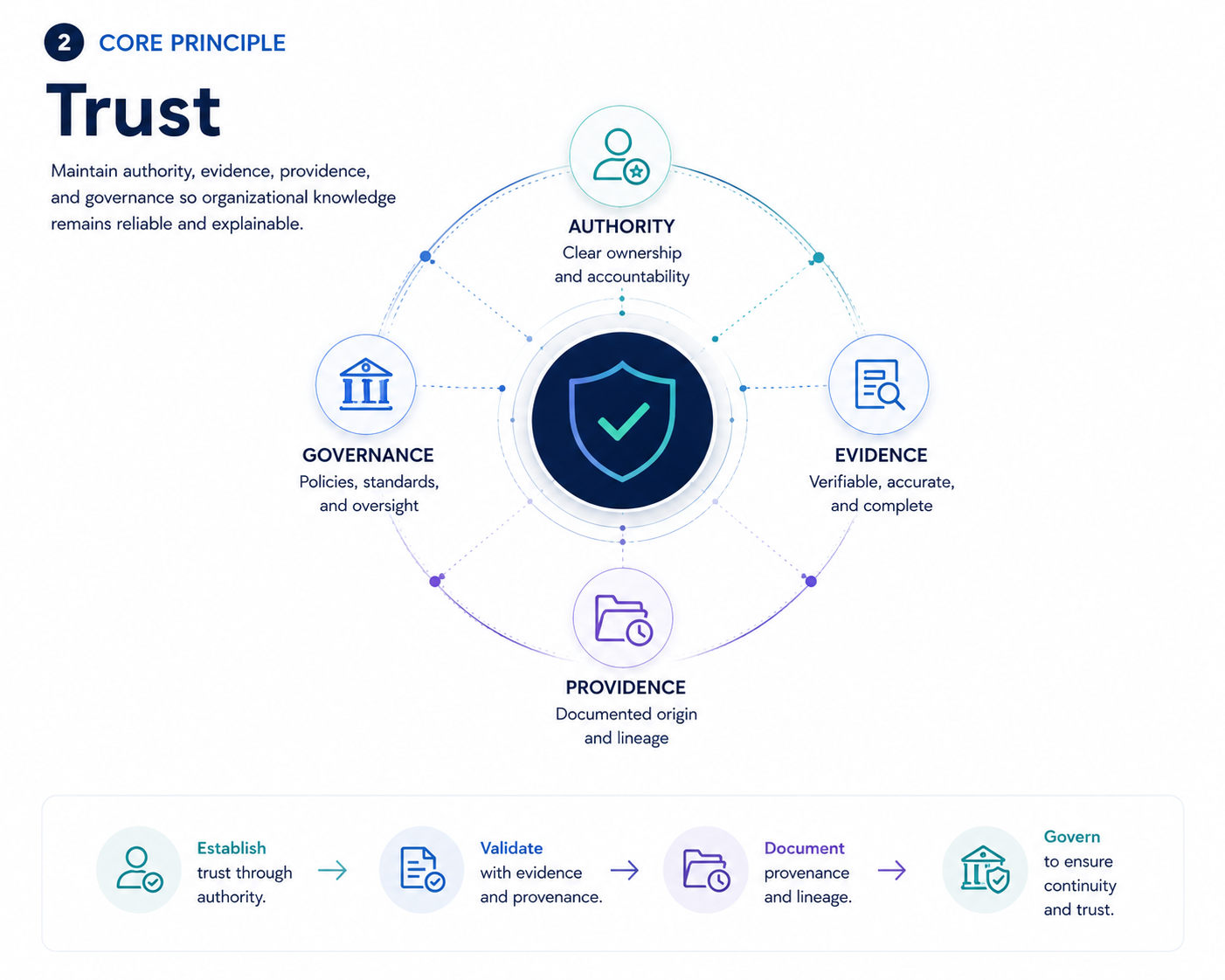
An AIL should not replace the source artifact with a summary. It should preserve the source and add explicit derivations: author, date, authority, supersession, scope, contradiction, decision basis, and disposition. Structured memory should therefore be additive rather than destructive.
The desired architecture is:
Immutable source artifact → provenance-bound derivation → explicit authority and supersession relationships → query-time continuity qualification.
That separation matters because a derived memory is a claim about the source, not the source itself. If the derivation is later shown to be incomplete, the institution must still have the original evidence needed to reconstruct a different answer.
Continuity path: Source → Evidence / complete document → Authority / author and decision owner → Context / revision state → Decision → Action → Record / retained version → Institutional Memory / non-destructive corpus plus relationships → Future Reuse.
Source
Ahmad Yehia et al., Mem++: Non-Destructive Memory for Long-Term Organizational LLM Agents, arXiv:2610.02002, October 1, 2026. https://arxiv.org/abs/2610.02002
Code and benchmark evaluation: https://github.com/AIDAChip-Inc/mem-plus-plus
Continue Exploring
The Answer Was Correct. The Evidence Could Not Prove It.
The Model Hadn't Answered Yet. Its Memory Was Already Wrong.