
A system can preserve every version and still answer from the wrong state.
DSV-Mem: Evaluating Multimodal Memory in Professional Workflows for MLLM Agents introduces a benchmark for dense, stateful professional memory. It contains expert-reviewed scenarios and 1,000 questions covering current state, past state, derived state, change history, and conflict or refusal. The artifacts are information-dense and evolve through repeated revisions, closer to engineering, product, research, and business workflows than ordinary conversational memory tests.
Across 27 configurations spanning frontier and open-weight models and memory-management methods, the strongest baseline scored below 45%. The authors found that the number of governing updates—not raw conversation length, OCR, arithmetic, or information density alone—was the dominant tested factor. Models also frequently failed to verify a user’s premise against prior state updates before answering.
The continuity failure
The evidence may still exist. The failure occurs when the system does not promote the currently governing update into the context that drives the answer.
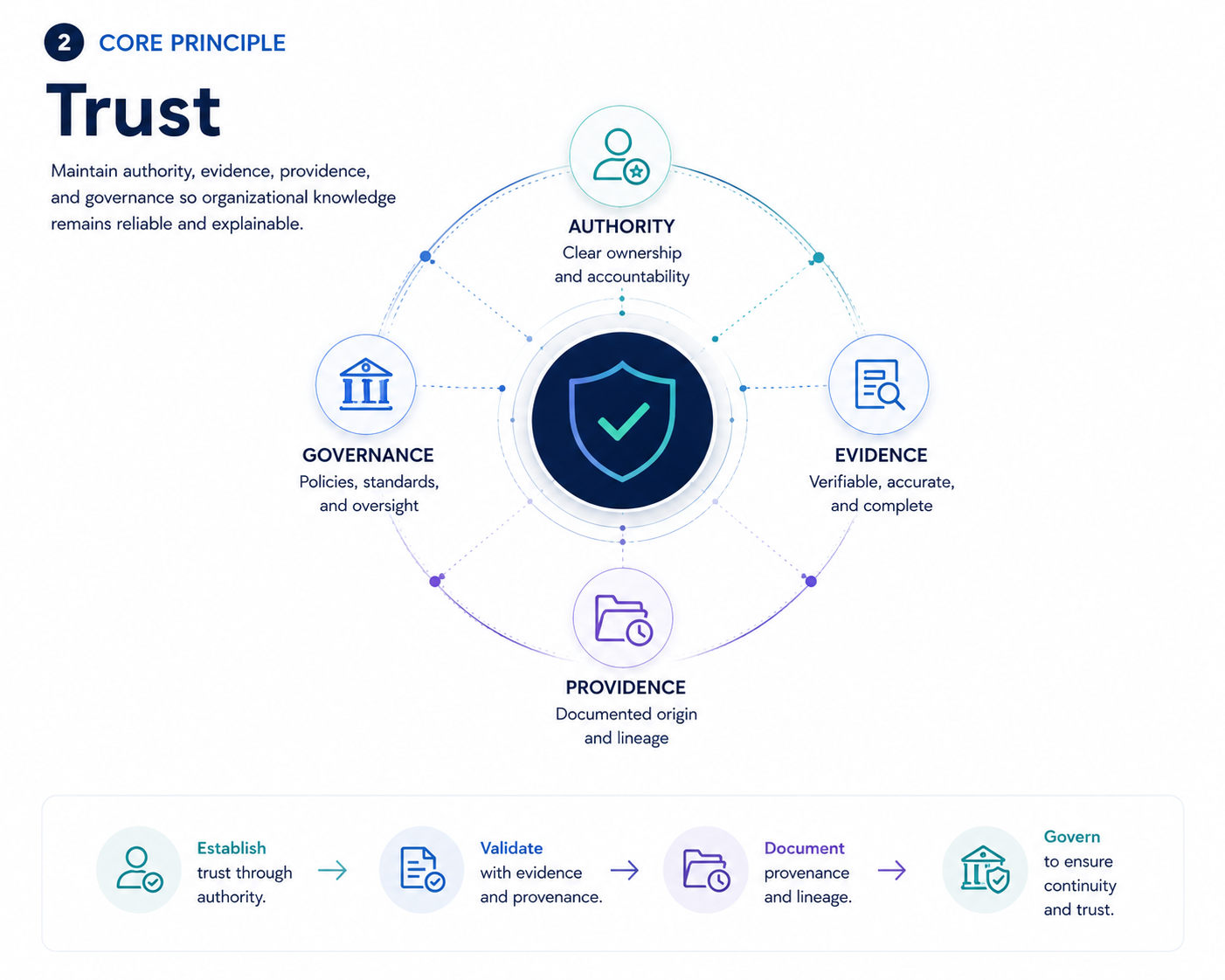
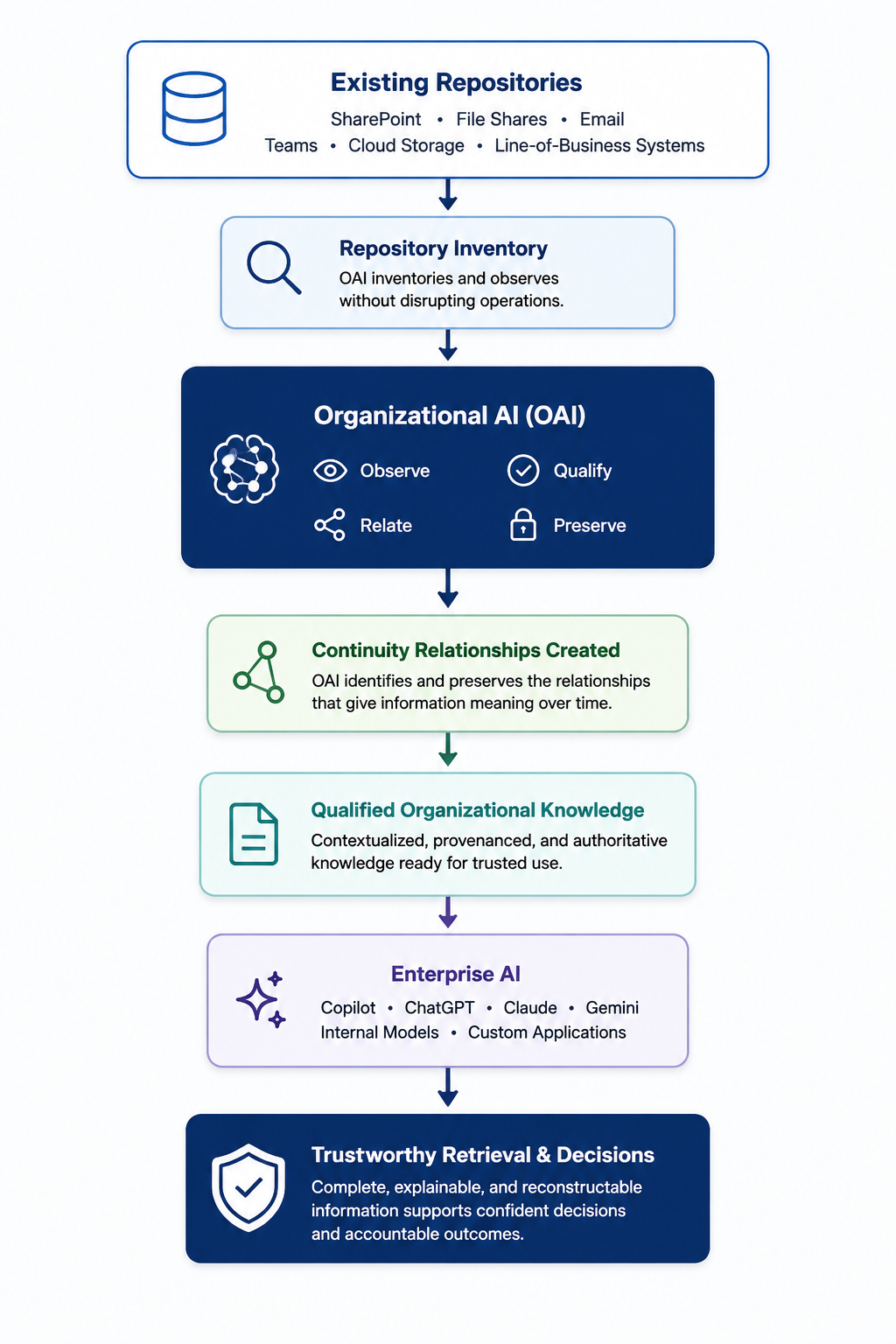
Record / version history → Institutional Memory / preserved artifacts → Authority / governing update ✕→ Context / answer state → Decision / response.
A prior version remains historically authentic. It simply no longer governs the present question.
Why this advances GovKM research
GovKM’s recent analysis of non-destructive organizational memory argues that source records should survive before structured derivation. DSV-Mem adds an important qualification: preservation alone cannot establish which retained version is operative.
State evolution becomes a governance problem. A later update may supersede one field but not another, apply only to a subset of objects, take effect at a future time, or revoke an earlier instruction. If those relationships are not explicit, the answering model must infer authority from a pile of authentic records.
The GovKM interpretation
Institutional memory should represent supersession and effective state as first-class relationships rather than relying on recency or similarity. Each revision needs a link identifying what it changes, what remains unchanged, when it becomes effective, which authority issued it, and whether an older state remains relevant historically.
The benchmark’s premise-verification finding is especially important. A user can ask a question containing a stale assumption. The assistant should not simply retrieve supporting text; it should test that premise against governing updates and abstain or correct the premise when continuity cannot be established.
Continuity path: Source / evolving professional artifact → Evidence / individual revisions → Authority / issuer and governing update → Context / state at question time → Decision / answer → Record / response → Institutional Memory / preserved state transitions → Future Reuse.
Source
Jike Zhong et al., DSV-Mem: Evaluating Multimodal Memory in Professional Workflows for MLLM Agents, arXiv:2610.08102, October 6, 2026. https://arxiv.org/abs/2610.08102
DOI: https://doi.org/10.48550/arXiv.2610.08102
Continue Exploring
The Answer Was Correct. The Evidence Could Not Prove It.
The Model Hadn't Answered Yet. Its Memory Was Already Wrong.