When Foster Care Changes, Does the Right Payee Information Follow?

GovKM Practical Continuity Implementation Series | Government and Public Administration
The verified government challenge
GAO-27-108035, Social Security Administration: Actions Needed to Improve Data Exchanges for Beneficiaries in Foster Care (November 9, 2026) reports that 25 states were submitting monthly data as of July 2026. More than 50,000 alerts were generated in fiscal year 2025, many without a corresponding need to change payees. Staff in four selected field offices cited limited alert details and extra research. Seven recommendations remained open at publication; concurrence is not implemented action. These interviews illuminate challenges but are not statistically representative of every office.
The GovKM continuity interpretation
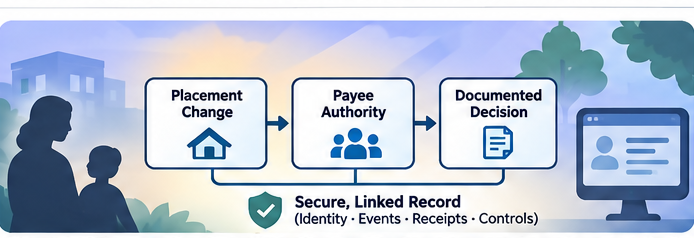
The organizational problem is not simply moving a file between a state and a federal system. A child's placement event, source identity, receipt date, current representative-payee authority, decision record and privacy constraints must remain connected without confusing a placement change with an automatic payee change. GovKM proposes a governed, secure knowledge corpus that can preserve this chain for human decisions and carefully bounded AI-assisted analysis.
1. Inventory state-to-federal information exchange
Identify approved agreement terms, state source fields, file delivery schedule, originating authority, SSA receipt, alert creation, field-office ownership and gaps for nonparticipating states. Deliverable: approved interagency data map and completeness register.
2. Separate events, dates and authority
Distinguish when a placement changed from when the state learned of it, transmitted it, SSA received it and a payee decision became effective. A placement event is a signal to assess—not proof that a new payee must be assigned. Deliverable: event-to-decision chronology and effective-dated authority model.
3. Validate source data and triage alerts
Test record identity, duplicates, incomplete fields, contradictory updates, delayed files and mismatched beneficiary/payee references. Use explicit exception states and seek frontline input about useful data elements and triage practices. Deliverable: validation rules, quality dashboard and resolution log.
4. Protect beneficiary privacy and records
Apply the actual federal/SSA program rules, approved data sharing agreements, access/security requirements, records schedules and applicable privacy restrictions. Collect only necessary information and distinguish permissible historical retention from active access. Deliverable: agreement-to-control matrix and positive/negative access tests.
5. Prepare a bounded AI-ready evidence corpus
Prepare authorized guidance, alert facts and source provenance for users with defined roles. Record which passages were actually presented to an AI, which source data were unavailable, and whether cited evidence was timely and operative. Never delegate final statutory payee determinations to an unauthorized model. Deliverable: cited model-context packet and abstention conditions.
6. Pilot, verify and hand off
Choose a synthetic or properly authorized limited pilot, compare outcomes with source evidence, validate incomplete-state signaling and report unresolved errors. Establish accountable SSA/state stewardship, cross-office knowledge sharing and a plan for measured expansion. Deliverable: signed acceptance report and operational training package.
Falsifiable synthetic diagnostic
A fictional child changes placement on March 1, the state sends an update March 5 and SSA receives it March 7; an independent authorized payee determination is entered March 12. An AI is asked who was authorized on March 3 and March 15. Pass: it does not treat the placement event as the payee decision, cites only actually delivered authorized records, preserves historical state and withholds protected identity details from an unauthorized viewer. This is a fictional diagnostic, not an SSA model run.
Authorities and limits
GAO documents the observations and recommendations. SSA's representative-payee and foster-care resources describe the program context, and SSA's data-exchange guidance identifies security considerations for participating partners. The NIST AI RMF supplies voluntary AI governance guidance. A real implementation must identify actual binding program and privacy provisions and obtain necessary authorization before any operational data are processed.
GovKM's consulting approach
GovKM could offer a bounded assessment, source-and-authority mapping, synthetic diagnostic pilot and evidence-based implementation roadmap. Government officials must retain their authorized payee and program decisions. The resulting corpus would be better prepared for compliance, audit and cautious future AI uptake.
Independent GovKM analysis of GAO findings. No agency engagement, operational failure beyond the cited findings, AI deployment or production testing is implied.
Continue Exploring

When Space Supply-Chain Risks Have No Clear Decision Owner

BIA Probate: Keep the Handbook Current and the Case Handoff Complete