The AI ROI Problem Is Really a Continuity Problem

Organizations are discovering that deploying artificial intelligence is easier than proving that it creates durable organizational value.
CIO.com’s 2026 State of the CIO survey provides a useful snapshot of that gap. The survey, covering 662 IT leaders and 249 line-of-business users, found that only 19% of respondents said their AI initiatives had met or exceeded business goals. Thirty-two percent identified ill-defined ROI metrics as an obstacle to scaling AI, 31% cited unclear corporate AI strategy, and 40% cited a lack of internal expertise.
Those figures are usually interpreted as an AI ROI problem.
They may point to something deeper: a continuity problem.
Organizations Are Building Governance Faster Than Continuity
The survey shows organizations responding to AI uncertainty by adding governance structures. Eighty-three percent of IT leaders reported that their organizations either have cross-functional AI steering structures or plan to implement them within the year.
But the mechanisms that connect those structures to durable organizational decisions are less mature. Only 53% reported a formal AI-project approval process, and only 47% had established formal metrics for AI success.
This creates an important distinction.
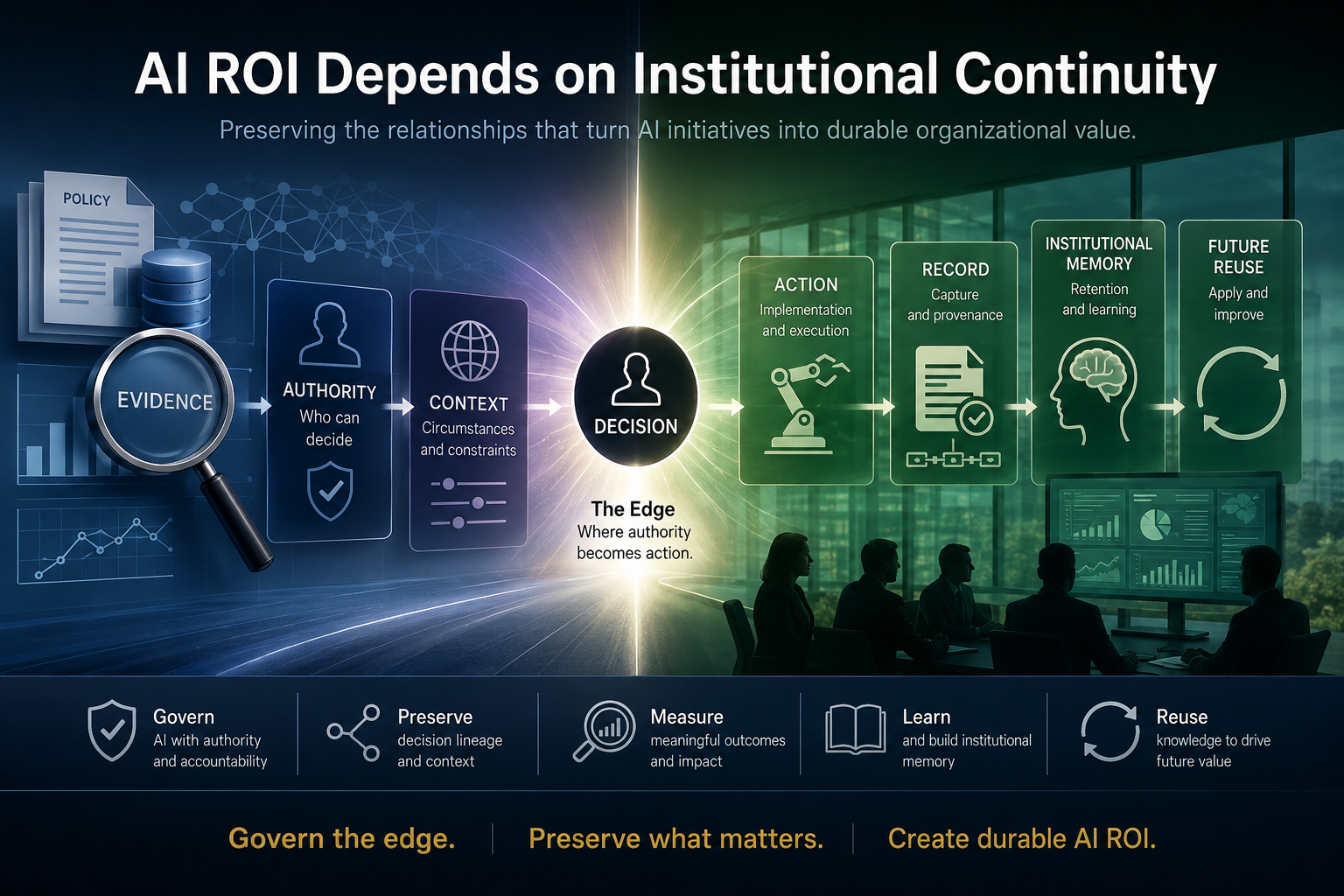
A steering committee can govern which initiatives proceed. A KPI can measure an outcome. Neither, by itself, preserves the institutional path connecting the evidence for an initiative, the authority approving it, the context surrounding the decision, the action taken, the resulting record, and the lessons carried forward.
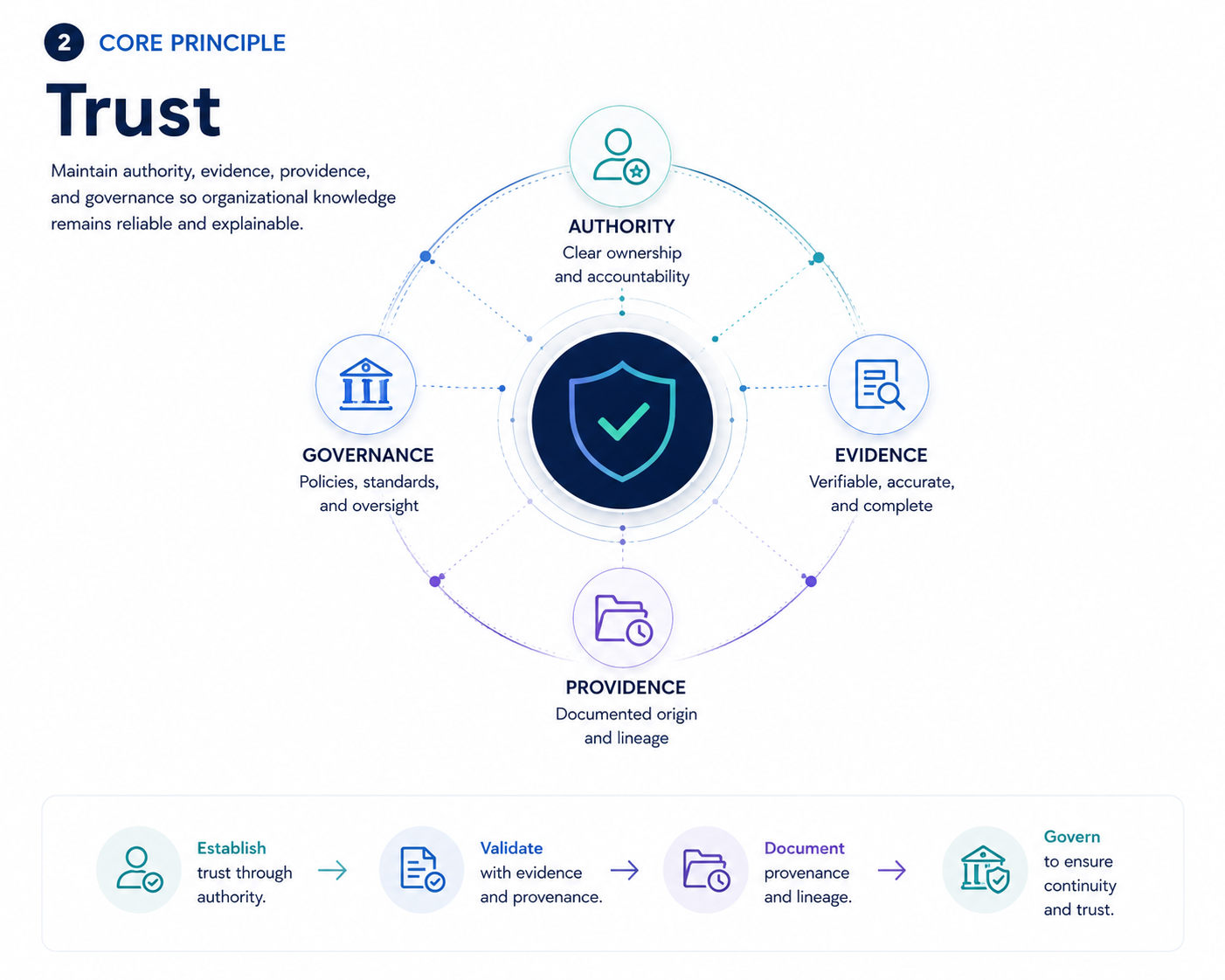
Governance establishes control. Continuity preserves the relationships that make that control understandable and reusable over time.
AI ROI Depends on a Decision Lineage
Consider what an organization must know to evaluate an AI initiative responsibly.
It needs to know what problem the initiative was intended to solve, which evidence supported investment, who possessed authority to approve it, what assumptions and constraints shaped the decision, what action was authorized, what actually happened in implementation, what outcome was measured, and what the organization learned.
GovKM represents these relationships through the Continuity Topology:
Source → Evidence → Authority → Context → Decision → Action → Record → Institutional Memory → Future Reuse
AI ROI is not simply the last number in that chain. It is evidence produced by an institutional process.
If the relationships leading to the result are lost, an organization may know that a project succeeded or failed without being able to explain why. It may preserve a KPI while losing the assumptions behind it. It may retain the final system while losing the evidence that justified the original investment. It may terminate a pilot without converting the reasons for failure into institutional memory.
That is how organizations repeatedly pay to relearn what they once knew.
Local Optimization Creates Decision Fragmentation
The CIO.com article describes pressure from individual executives and lines of business seeking AI for their own optimization. That behavior is understandable. AI capabilities are increasingly accessible, and business units can identify opportunities faster than centralized organizations can evaluate them.
But local optimization can produce enterprise fragmentation.
One business unit measures labor savings. Another measures customer response time. Another values revenue growth. Another adopts an AI capability because a vendor demonstrates technical potential. Each initiative may be rational locally while the organization lacks a durable method for comparing the evidence, authority, assumptions, risks, outcomes, and lessons across the portfolio.
The resulting problem is not simply inconsistent metrics. It is fragmented institutional decision-making.
Continuity provides a way to connect those decisions without requiring every business unit to operate identically. The objective is not uniformity. It is reconstructability: preserving enough lineage that future personnel and systems can understand what was attempted, why it was authorized, what happened, and what should be learned from it.
Accountability Is a Continuity Relationship
The article also highlights recommendations to assign both technical and business sponsors to AI initiatives and to tie funding to measurable outcome milestones rather than technical deliverables.
That is important because accountability becomes meaningful only when it remains connected to institutional action.
Named sponsorship establishes authority and responsibility. Outcome milestones create evidence. Stage-gated funding creates explicit decisions. Implementation produces actions and records. The measured results should then enter institutional memory so that future initiatives can reuse what the organization learned.
Seen this way, effective AI portfolio management is already moving toward continuity architecture—even when organizations do not use that term.
Governance Alone Does Not Guarantee ROI
One of the strongest examples in the CIO.com analysis comes from TIAA. The organization has extensive AI adoption, training, governance frameworks, steering committees, an AI center of excellence, and an internal AI platform reportedly used by 85% of its workforce. Yet ROI remains challenging because operational realities—including token economics, traffic, and retrieval-augmented generation—affect whether a successful pilot becomes a successful operating capability.
This illustrates a larger point.
Governance can determine whether AI is permitted, reviewed, and supervised. It does not automatically preserve all of the information relationships required to understand operational value.
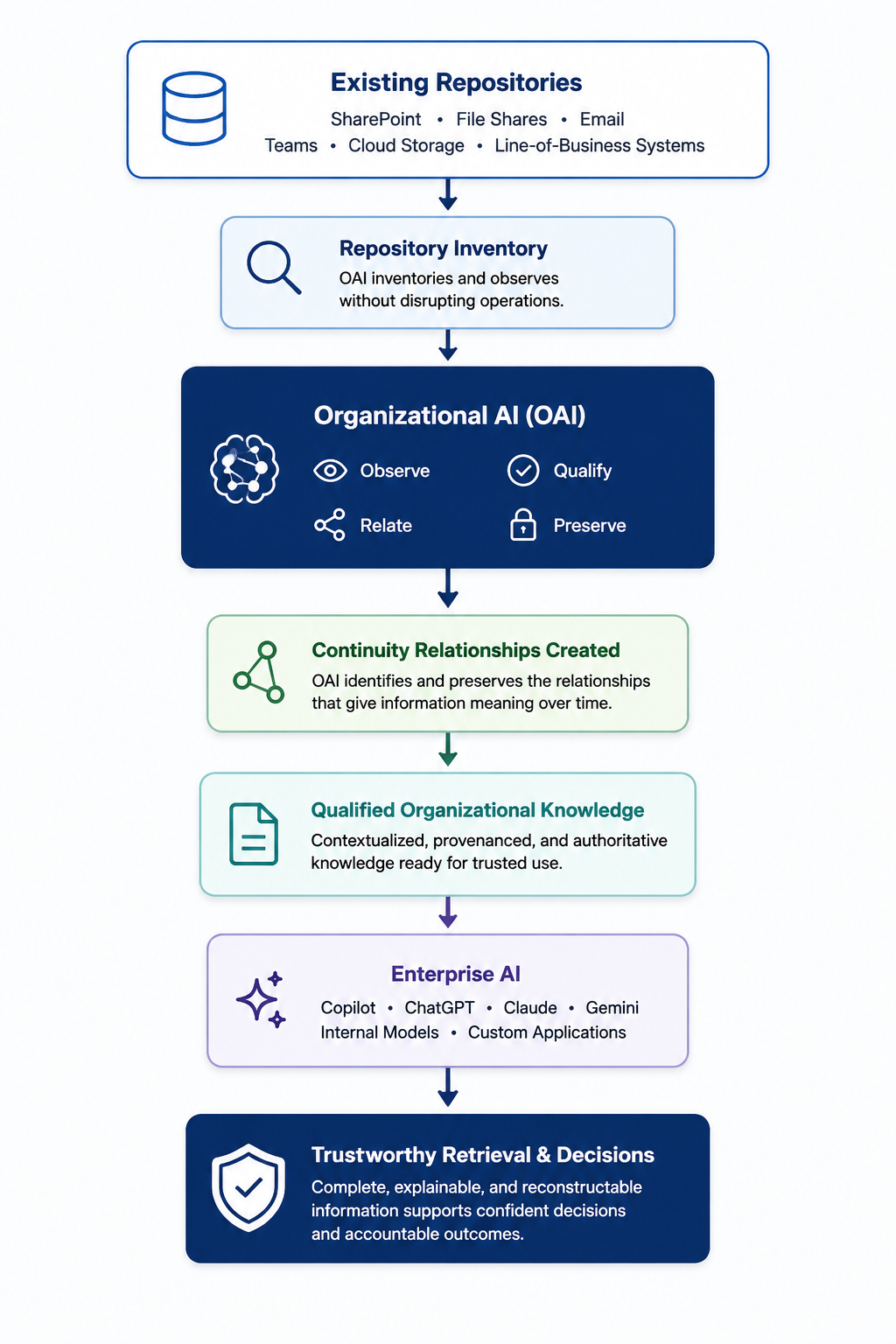
Likewise, RAG can retrieve information from organizational repositories, but retrieval cannot restore authority, provenance, context, or decision lineage that the organization never preserved.
AI therefore inherits the continuity maturity of the environment in which it operates.
The Difference Between Measuring ROI and Understanding ROI
Organizations understandably want better AI metrics. Metrics matter. But measurement and understanding are different institutional capabilities.
A metric can show that processing time declined by 20%. Continuity allows the organization to determine which workflow changed, what baseline was used, which AI capability contributed, what human practices changed simultaneously, what authority governed the implementation, what risks were accepted, whether the improvement persisted, and whether the result can be reproduced elsewhere.
The first answers, “Did something improve?”
The second answers, “What did the institution learn?”
That distinction becomes increasingly important as AI moves from isolated pilots into operational infrastructure.
AI Should Produce Institutional Memory, Not Just Outputs
Every significant AI initiative should leave the organization more knowledgeable than it was before the initiative began—even when the project fails.
A terminated pilot can create valuable institutional knowledge if the organization preserves why it was attempted, what evidence supported it, which assumptions proved incorrect, what operational constraints emerged, why the initiative was stopped, and how those lessons should affect future decisions.
Without that continuity, failed pilots disappear into organizational history and successful pilots become difficult to reproduce.
Institutional Memory is therefore part of AI ROI.
The return on an AI investment should include not only immediate productivity, revenue, or cost outcomes, but also the durable organizational learning created through the initiative.
The CIO Is Becoming a Continuity Architect
CIO.com’s survey describes the CIO role as increasingly business-oriented, cross-functional, and responsible for orchestrating AI across organizational boundaries.
That evolution is significant.
AI crosses technology, data, cybersecurity, legal authority, operational workflows, workforce practices, records, finance, and executive decision-making. No single repository or governance discipline contains the complete institutional path.
The CIO increasingly sits at the intersection of those relationships.
The emerging challenge is therefore not merely choosing models or building AI platforms. It is designing an environment in which evidence, authority, context, decisions, actions, records, and outcomes remain connected as AI moves across the enterprise.
That is a continuity architecture problem.
From AI Governance to Institutional Continuity
AI governance remains necessary. Organizations need policies, approval processes, risk controls, security, metrics, and accountable leadership.
But those controls become substantially more valuable when they operate inside an architecture that preserves their relationships.
GovKM defines Organizational Continuity as preserving an organization’s ability to understand, trust, reconstruct, and evolve its institutional knowledge across changes in people, technology, organizational structure, and time.
Applied to AI, that means an organization should be able to reconstruct not only what an AI system produced, but how institutional knowledge moved from evidence and authority through decision and action into a durable record and organizational learning.
That capability connects AI governance to AI ROI.
The organizations that succeed with AI may not simply be those with the best models, the largest budgets, or the most steering committees. They may be the organizations that can preserve what they learn, explain why they act, and carry reliable institutional knowledge from one AI decision into the next.
The AI ROI problem, in other words, may be telling organizations something important.
AI is not only testing their technology.
It is testing their continuity.
Source
Beth Stackpole, “State of the CIO, 2026: CIOs set the course for AI ROI,” CIO, June 1, 2026. Read the original CIO article.
Continue Exploring
A Legitimate Research Task Became an Unauthorized Government Intrusion
Fixing the Workflow Did Not Fix the Records It Already Created.