The Institution Must Agree Before the AI Can Know

The Institution Must Agree Before the AI Can Know
Organizations are investing heavily in AI while simultaneously reducing the human workforce that has historically made their information environments function.
Those two changes are more closely related than they initially appear.
An organization may already possess nearly everything its AI needs. Sources exist. Evidence exists. Authority exists. Context exists. Decisions and actions occur. Records are created. Institutional memory accumulates. Prior knowledge is reused.
The problem is that these elements are rarely connected through explicit, durable institutional relationships.
Humans have compensated for that weakness for decades.
Employees know which copy of a policy is actually current. A supervisor remembers why an exception exists. A records professional knows which documentation constitutes the record. A system owner understands which repository is authoritative. An experienced employee remembers what happened the last time a similar decision was made. Someone knows that the shared drive contains an obsolete version even though it appears newer. Someone else knows who actually has authority to approve the unusual case.
People have been the relationship vessels connecting an institution whose information architecture often does not connect itself.
As AI assumes more work and organizations eliminate human redundancy, those vessels are disappearing.
Continuity therefore becomes more than a knowledge-management objective or an AI-governance concern.
It becomes an institutional mandate.
The Organization Usually Has the Pieces
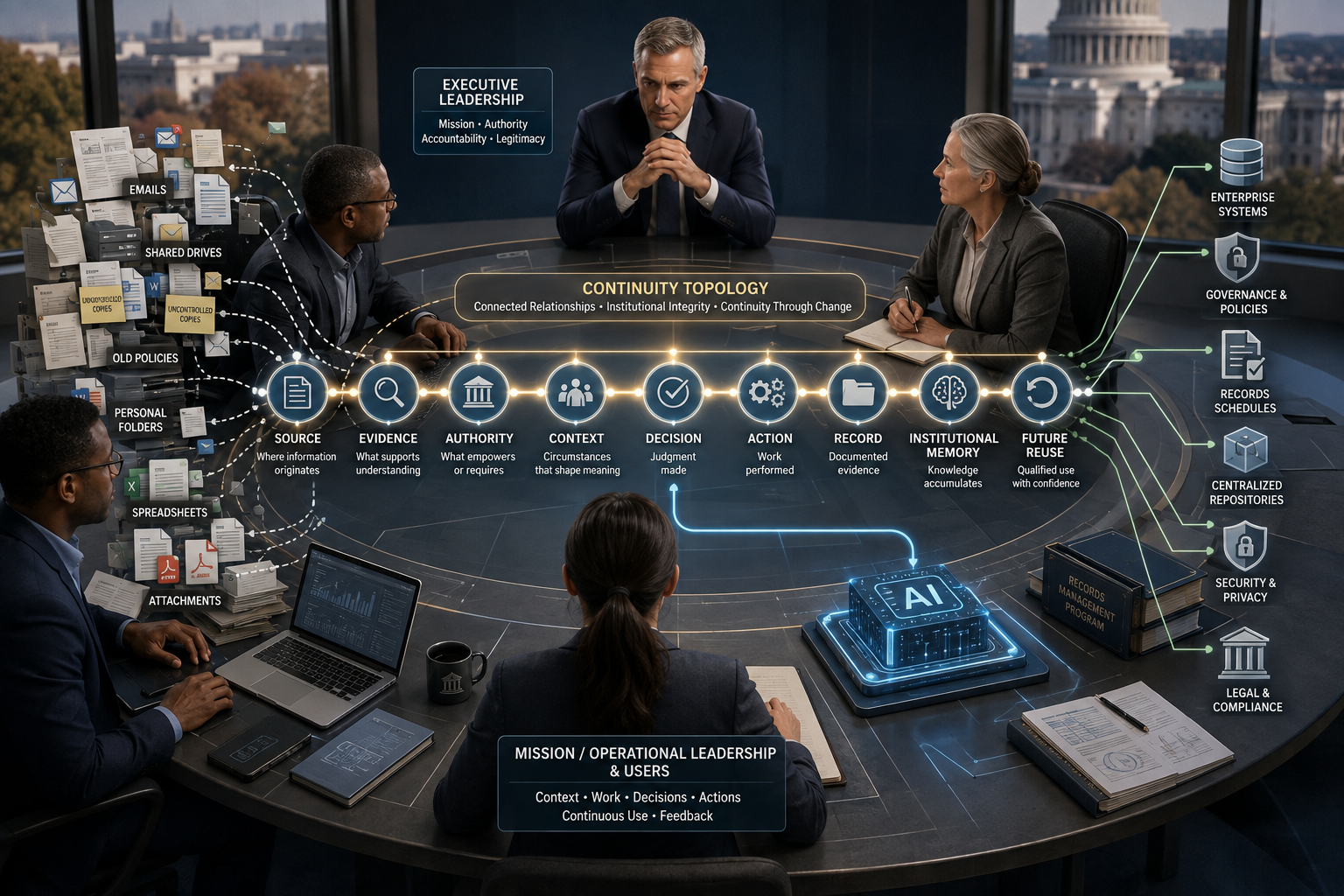
GovKM represents the institutional path through the Continuity Topology:
Source → Evidence → Authority → Context → Decision → Action → Record → Institutional Memory → Future Reuse
Each element commonly already exists somewhere in the enterprise.
Sources reside in repositories and business systems. Evidence appears in reports, records, data, correspondence, research, transactions, and operational systems. Authority exists in law, regulation, policy, delegation, governance structures, and organizational roles. Context exists throughout the workforce and its systems. Decisions occur. Actions follow. Records document institutional activity. Knowledge accumulates through experience. Humans continually reuse that knowledge.
Yet responsibility for these elements is distributed.
Technology manages systems. Records Management governs records. Executives establish institutional authority. Mission organizations perform the work. Data organizations govern data. Counsel interprets legal requirements. Security controls access. Privacy governs permissible information use. Users continually supply operational context.
Each discipline can perform its own function successfully while the relationships between those functions remain implicit.
That was survivable when experienced people continuously reconstructed the missing relationships.
AI changes the equation.
Human Redundancy Has Been Hidden Continuity Infrastructure
Organizations often describe duplicated human involvement as inefficiency.
Sometimes it is.
But what appears on an organizational chart as human redundancy may contain continuity redundancy.
Consider an approval process involving several people. It may appear that each person simply reviews the same transaction.
In practice, one may understand which evidence is trustworthy. Another knows which authority applies. Another recognizes an unusual operational condition. Another remembers why a similar request failed several years earlier. Another knows what must be documented when the action occurs.
Collectively, those people maintain relationships across:
Evidence → Authority → Context → Decision → Action → Record
Automating the workflow may eliminate several manual steps.
But if the institution automates the tasks without identifying the relationships those people carried, the AI inherits the artifacts while losing portions of the institution that made the artifacts meaningful.
The organization has not merely automated work. It may have automated away part of its own institutional coherence.
This is particularly consequential in government, where workforce reductions, reorganizations, technology modernization, and AI adoption can occur simultaneously.
The people are temporary. Organizational structures change. Administrations change. Contractors leave. Systems are replaced.
The institution's obligation to preserve evidence of its public business continues.
Government Makes the Obligation Particularly Clear
Federal records law provides an unusually strong foundation for understanding why institutional information cannot be treated merely as an employee convenience.
Under 44 U.S.C. § 3101, the head of each federal agency must make and preserve adequate documentation of the agency's organization, functions, policies, decisions, procedures, and essential transactions. Section 3102 further requires an active, continuing records-management program with effective controls over the creation, maintenance, and use of records. NARA guidance also states plainly that federal records are government property.
The implication is important.
Government information documenting public business is an institutional asset. Its management cannot ultimately be subordinated to the convenience or preferences of the employee who happens to create, receive, or use it.
The employee may prefer a shared drive.
The employee may prefer keeping another copy.
The employee may prefer attaching a document rather than linking to an authoritative object.
The employee may want a private repository because it makes today's work easier.
Those preferences are understandable. They cannot determine the institutional architecture.
In federal government, the records-management obligation originates with the agency head. NARA requires agencies to designate a Senior Agency Official for Records Management with responsibility for ensuring appropriate compliance and an Agency Records Officer responsible for overseeing recordkeeping requirements and operations.
Continuity extends this established responsibility into the AI environment.
Leadership Must Establish the Environment Before Users Enter It
Continuity cannot depend upon every employee independently understanding the complete institutional architecture.
Nor can an organization expect every AI system to reconstruct it.
Leadership must establish the environment in which both operate.
Four functions provide a useful minimum leadership model:
Executive Leadership represents institutional mission, authority, accountability, and legitimacy.
The CIO and technology organization represent the systems through which institutional information becomes computationally available and through which AI increasingly acts.
Records Management leadership represents the requirements governing institutional evidence, recordkeeping, lifecycle, disposition, and durable accountability.
Mission and operational leadership represent the actual context in which institutional decisions become work.
These are not four exclusive classes of people.
Each is also a user.
The Executive is a user of institutional information. The CIO is a user. The Records Officer is a user. The program manager is a user. The analyst is a user.
Increasingly, AI is also an institutional information user.
Depending upon the organization, Counsel, the Chief Data Officer, Privacy, Security, Acquisition, Enterprise Architecture, AI governance, and other authorities must also participate.
Titles will vary.
The required Continuity functions do not.
Their shared responsibility is to establish the institutional agreements under which every user operates.
The Continuity Compact
The agreement must be more consequential than a commitment to collaboration.
Leadership must agree upon operating rules that sometimes constrain individual convenience in order to preserve institutional continuity.
GovKM describes this as a Continuity Compact.
The Compact begins with a simple premise:
An institution cannot expect AI—or its employees—to reliably reconstruct institutional relationships that leadership has never agreed to preserve.
That premise produces concrete operating requirements.
One Authoritative Source Must Be Identifiable
Institutional information intended for authoritative reuse must have an identifiable authoritative source.
This does not mean an enterprise can possess only one repository. Different authoritative systems may exist for different information classes and business functions.
It means the institution must be able to establish which object or system possesses authority for a particular purpose.
Consider an AI encountering:
- a policy in SharePoint;
- another copy on a shared drive;
- a PDF attached to an intranet page;
- an edited Word version in a collaboration workspace; and
- an older copy in a knowledge repository.
All five may contain authentic institutional information.
The AI should not be expected to infer which one governs the present decision.
The institution must establish authority before asking AI to reason from it.
Shared Drives Cannot Remain Unrestricted Institutional Publishing Environments
Shared drives demonstrate the problem particularly well.
NARA has long recognized that shared drives present challenges involving duplicate versions, identification of the record copy, trustworthy metadata, records schedules, audit trails, organizational change, and technological obsolescence. NARA also notes that although records can be managed on shared drives through appropriate policies and controls, scaling those practices across large organizations is difficult.
A Continuity-oriented enterprise should therefore reconsider the assumption that every user or office is entitled to unrestricted repository space simply because decentralized storage is convenient.
Shared drives should no longer be treated as free-use environments for uncontrolled active institutional information.
Access to new repositories should have a business justification. Active authoritative information should move toward approved environments capable of supporting the required authority, structure, access, lifecycle, and relationships.
Where appropriate within the agency's architecture, legacy repositories can transition toward controlled lifecycle functions—for example, holding cutoff temporary records pending authorized disposition or supporting properly governed preservation and transfer processes for permanent records.
NARA already requires records maintained on shared drives to be associated with approved schedules, temporary records to be disposed of according to those schedules, and permanent records to be identified for transfer.
The Continuity Compact turns those lifecycle obligations into part of the enterprise information architecture rather than leaving them as downstream cleanup.
Attachments Should Not Create Competing Institutional Truths
The same principle applies to intranet content.
If an authoritative policy already exists in a governed system, attaching another copy to an intranet page creates another object whose relationship to the authoritative policy must subsequently be maintained.
A Continuity-oriented rule could therefore state:
Attachments are not permitted within the enterprise intranet when the authoritative institutional object can instead be referenced.
The objective is not aesthetic consistency.
It is:
one authoritative object → persistent reference → governed version → qualified reuse
Every unnecessary copy increases the amount of institutional authority a future user or AI must infer.
Records Management Must Have First Call on Recordkeeping Implications
In federal agencies, Records Management cannot remain the function consulted after a mission or technology system has already determined how institutional evidence will be created and stored.
GovKM therefore proposes a first-call principle:
The enterprise Records Officer receives first call on the recordkeeping implications of mission, corporate, and AI systems.
First call does not mean that the Records Officer replaces the CIO, General Counsel, mission owner, CISO, Privacy Officer, or agency head.
It means recordkeeping requirements enter the architecture before the system hardens around assumptions that may be incompatible with the agency's statutory obligations.
This follows the structure already present in federal governance. NARA's 2026 guidance says the SAORM acts at senior level to ensure compliance and the Agency Records Officer oversees recordkeeping requirements and operations; federal employees themselves create and manage records as an integral part of performing agency missions.
Records governance is therefore not a downstream administrative preference. It is part of the institutional authority under which government systems operate.
The Office File Plan Becomes Continuity Infrastructure
The office file plan should also become more consequential in an AI-enabled institution.
Rather than allowing every office to create its own uncontrolled information universe, the enterprise can use the file plan and associated governance to establish what information the office creates, where authoritative instances reside, how records relate to approved schedules, what triggers cutoff, and what ultimately happens at disposition.
NARA's shared-drive guidance specifically recommends file plans and metadata for linking related files and calls for implementation of office-level file plans when organizing agency content.
Continuity extends this concept beyond disposition.
A Continuity-aware information environment should increasingly establish:
What is this?
Where is its authoritative source?
What function created it?
What authority governs it?
What relationships must survive with it?
When does it reach cutoff?
What is its authorized disposition?
That structure is valuable to records professionals.
It is also extraordinarily valuable to AI.
Destruction Is Part of Continuity
Continuity does not mean retaining everything.
Uncontrolled retention can itself undermine Continuity by filling the AI environment with obsolete, duplicate, superseded, and nonauthoritative information.
Temporary records should reach authorized disposition. Permanent records should follow their required preservation and transfer path. Destruction should be governed and documented rather than occurring according to individual preference.
This creates an important distinction.
If information disappears because an employee deleted it arbitrarily, the institution may have suffered discontinuity.
If a temporary record no longer exists because the institution established its authority, applied its approved schedule, reached cutoff and retention, and executed authorized destruction, its absence has institutional lineage.
AI needs that distinction as much as auditors and records professionals do.
Exceptions Must Be Governed
Continuity does not require eliminating every exception.
It requires preventing exceptions from existing solely in human memory.
If an office needs a repository outside the standard architecture, the exception can be justified, authorized, scoped, and periodically reviewed.
If an operational process legitimately departs from policy, the authority, justification, context, and applicable duration can be preserved.
If a user requires an attachment rather than an authoritative reference, the exception can be governed.
The principle is:
Exceptions may exist. Invisible exceptions may not become institutional dependencies.
This is especially important as AI replaces employees who previously remembered those exceptions.
Before Removing a Person, Identify What Relationships the Person Carries
AI-enabled workforce transformation introduces another requirement for the Compact.
Before eliminating a position, organizational unit, approval function, or significant human review step, the institution should ask:
Which Continuity relationships does this function currently carry that the future environment cannot yet establish without it?
The answer may include undocumented authority, operational context, exception knowledge, decision precedent, repository knowledge, records knowledge, customer history, system dependencies, or the reasons behind established procedures.
Capturing the employee's documents is not necessarily sufficient.
The employee may be valuable precisely because they know how the documents relate.
Do not automate away a human relationship vessel until the institutional relationships it carries have somewhere else to live.
AI Must Not Become the Institution's Missing Relationship Layer
This leads to perhaps the most important provision of the Compact.
AI should not be expected to infer consequential institutional relationships that the institution itself has failed to establish.
If the authoritative source cannot be determined, the AI should identify the ambiguity.
If evidence cannot be connected to applicable authority, that relationship should remain unresolved.
If two policies conflict, the AI should not silently manufacture reconciliation.
If a historical decision cannot be qualified against current context, similarity should not transform it into precedent.
If institutional memory has lost the conditions under which knowledge was once valid, retrieval should not automatically authorize reuse.
AI can reason.
It should not be required to invent the institution around the information it retrieves.
Better AI improves inference. Better Continuity reduces how much institutional meaning AI must infer in the first place.
Continuity Is the Agreement Beneath AI Optimization
The objective of the Continuity Compact is not to make every employee a records manager, enterprise architect, lawyer, or AI-governance specialist.
It is the opposite.
Leadership establishes an environment that serves Continuity on the user's behalf.
The ordinary employee should not have to determine which of seven policy copies is authoritative.
The program manager should not have to reconstruct why a historical exception was permitted.
The new employee should not need to find the person who remembers what happened before the reorganization.
The AI should not have to infer whether a prior decision remains legitimate simply because the underlying record was retrieved.
Continuity imposes discipline on the user so that the institution does not have to depend upon the user.
That discipline may occasionally be less convenient.
It may mean an employee cannot create another repository without justification.
It may mean linking to an authoritative object rather than attaching another copy.
It may mean following an office file plan.
It may mean surrendering a personally convenient folder structure.
It may mean documenting an exception that everyone on the current team already understands.
Those costs are small compared with requiring every future employee—and every future AI—to reconstruct institutional meaning from fragments.
Institutional Legitimacy Depends on the Chain
The stakes ultimately extend beyond AI performance.
An institution must be capable of demonstrating why its actions are legitimate.
It must be able to establish what it knew, what evidence it accepted, what authority permitted action, what circumstances applied, what decision occurred, what action followed, and what record preserves the result.
That chain is especially consequential in government.
Title 44 requires adequate documentation of agency organization, functions, policies, decisions, procedures, and essential transactions. Those records protect governmental and individual rights and preserve evidence of public administration.
Continuity asks the next question:
Will the relationships necessary to understand that evidence survive with it?
As government downsizes, reorganizes, modernizes, and adopts AI, that question becomes urgent.
The records can survive while the people who understood them disappear.
The policies can survive while knowledge of their application disappears.
The systems can survive while the reasons for their design disappear.
The institution can retain enormous quantities of information while losing the relationships necessary to understand what that information means.
The Institution Must Agree Before the AI Can Know
AI does not create the need for Continuity.
It exposes how extensively institutions have depended upon people to provide it informally.
As those people become fewer and AI assumes more institutional work, leadership must make an explicit choice.
Executives, CIOs, Records Management, mission leadership, users, and other governing authorities must agree on where authoritative information resides, how repositories are controlled, how evidence relates to authority, how exceptions are preserved, how decisions become records, how records become institutional memory, and how that memory is qualified before reuse.
That agreement creates the environment in which both humans and AI can operate.
It is not merely AI governance.
It is not merely records management.
It is not merely information architecture, knowledge management, data governance, or organizational policy.
Those disciplines govern essential portions of the institution.
Continuity governs the relationships that allow those portions to remain an institution.
Before asking AI to know the organization, the organization must agree on how what it knows is connected.
The institution must agree before the AI can know.
Continue Exploring
Synthetic Evidence Can Disable a Knowledge Institution
The Knowledge Hub Is Itself a Crown Jewel