The Transition Finished. GSA Still Couldn’t Prove Continuity Held.

A migration can finish without proving that continuity survived it.
An August 2026 Government Accountability Office review of the federal transition from legacy telecommunications contracts to GSA’s Enterprise Infrastructure Solutions contract makes that distinction unusually concrete. Six selected agencies completed the transition more than three years after GSA’s revised deadline. GSA had identified loss of service as the transition’s most critical risk.
Yet after the transition, GAO found that GSA did not know whether all selected agencies had experienced service disruptions because it was not systematically notified whether replacement service was operating before legacy service was disconnected.
The transition state was known.
The continuity outcome was not.
Completion Is an Action State
Large modernization programs naturally track completion: contracts awarded, circuits migrated, legacy services disconnected, milestones closed, projects moved to sustainment.
Those measures answer whether the planned action occurred.
They do not necessarily answer whether the institutional capability the action was intended to preserve remained continuously available.
For that, the organization needs outcome evidence.
Was replacement service operational before the old service ended? Did users experience interruption? Did contingency plans work? Which mitigation prevented failure? Which mitigation did not? What should the successor program inherit?
Without those relationships, “migration complete” can describe a technical state while leaving the institutional result partially unknown.
The Continuity Topology Exposes the Gap
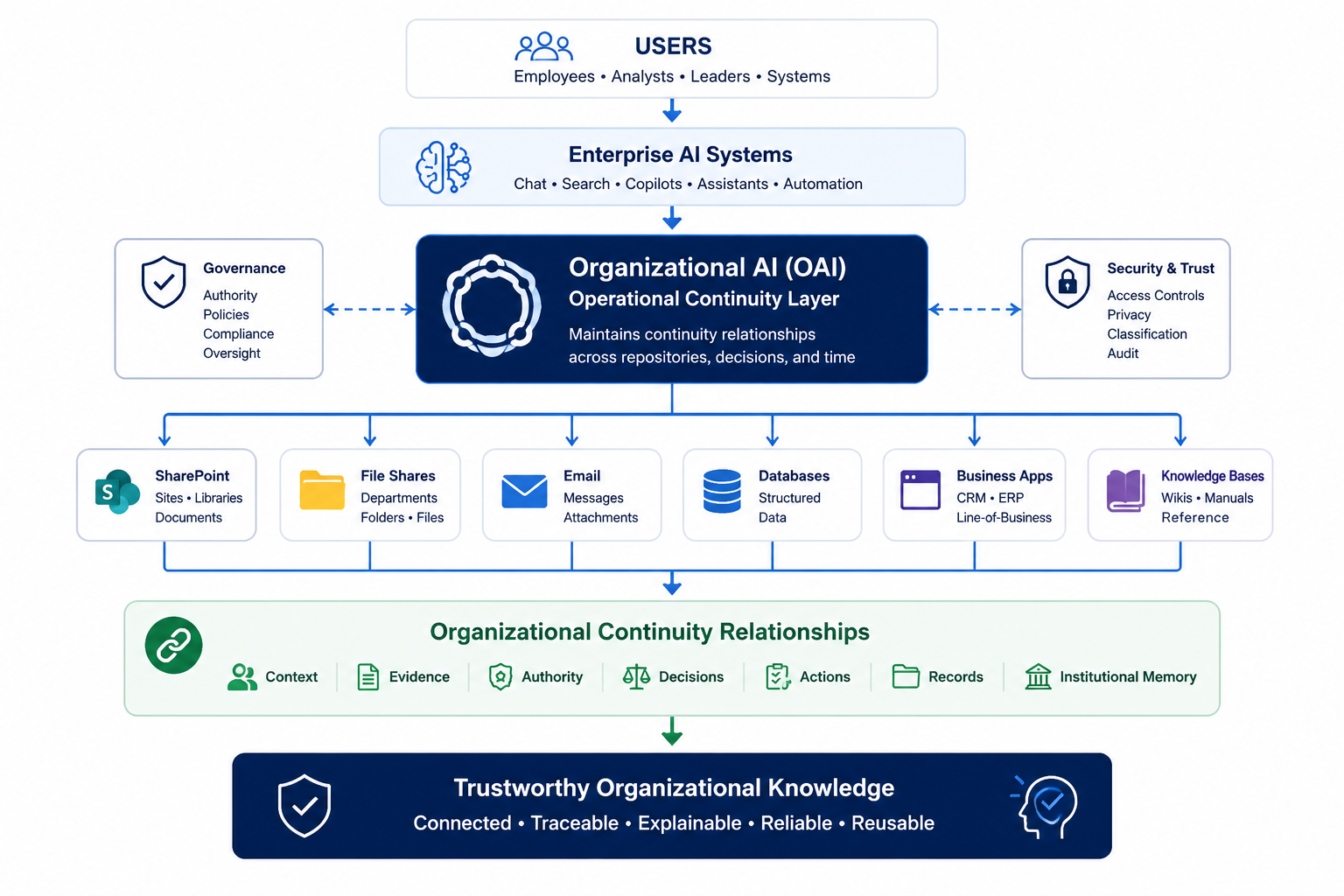
GovKM represents institutional work through:
Source → Evidence → Authority → Context → Decision → Action → Record → Institutional Memory → Future Reuse.
In a transition, the critical chain does not stop at Action.
The organization needs a Record establishing what happened after cutover. That record becomes Institutional Memory about whether the transition method worked. The memory then informs Future Reuse when the next migration is planned.
GAO’s finding therefore exposes a downstream break:
Decision → Action → Record ✕ → Institutional Memory → Future Reuse.
Government performed the transition but did not consistently capture the service-continuity evidence needed to establish the outcome across the selected agencies.
Risk Mitigation Must Produce Evidence
GAO also found uneven contingency planning. Forty-two agencies completed the schedule-assessment stage of GSA’s Risk Assessment Framework for Telecommunications, but only seven completed the contingency-planning stage. Among the six agencies GAO examined, only USDA completed both.
This illustrates another continuity requirement.
A mitigation plan is not proven merely because it exists.
The institution needs to connect risk evidence to mitigation decisions, mitigation decisions to actual actions, and those actions to evidence showing whether the risk was successfully controlled.
Otherwise lessons learned become assumptions learned.
The Next Transition Inherits the Missing Evidence
The timing matters because GSA is already planning the successor telecommunications contract.
If the institution cannot determine consistently where service disruptions occurred and which mitigation practices prevented them, the next program begins with incomplete Institutional Memory.
Past activity may be thoroughly documented in schedules, contracts, invoices, tickets, and project records while the relationship that matters most—whether mission service actually remained continuous—remains difficult to reconstruct.
This is how continuity debt propagates.
The missing relationship in one modernization becomes missing evidence for the next modernization’s decisions.
A Migration Is Not Complete Until Continuity Is Proven
This principle extends beyond telecommunications.
Cloud migrations, repository consolidations, identity-system replacements, ERP implementations, records transfers, AI-model changes, vendor transitions, and organizational restructurings all create before-and-after states.
The institution should preserve evidence not only that the new state exists but that the required mission relationships survived the transition.
That may include availability, identity, permissions, metadata, provenance, records obligations, workflow state, decision history, user access, dependencies, and recovery capability.
The GovKM Proposition
Transition completion and continuity preservation are different claims, and they require different evidence.
A modernization program should not close the continuity question merely because the migration action is finished.
It should be able to establish what remained available, what broke, what mitigation worked, what changed, and what the next transition should learn from the result.
The transition finished.
The institution still needs to prove that continuity held.
Continue Exploring

When Government Systems Are Replaced, What Happens to Their Authority?
The Practice Form Failed. The Agent Used the Real One.