Two Current Rules Can Still Produce Institutional Discontinuity

An institution can possess two current, authentic, authoritative documents and still be discontinuous.
The problem appears when the documents do not mean the same thing where their authority overlaps.
Two recent federal oversight findings make the pattern visible from different directions. HHS OIG found that CMS operational guidance for certain organ-acquisition reimbursement conflicted with federal statutory requirements. DOJ OIG separately found material inconsistencies between the FBI’s non-retaliation policy and the offense code used to discipline retaliation.
In both cases, the artifacts existed. The relationship between them did not reliably preserve one institutional meaning.
Retrieving Both Documents Does Not Resolve the Problem
Modern information systems often treat governance as a retrieval challenge: make the policies searchable, maintain the current versions, and ensure employees can find them.
That is necessary, but insufficient.
Authority is a relationship, not a search result.
Hierarchy Must Be Explicit
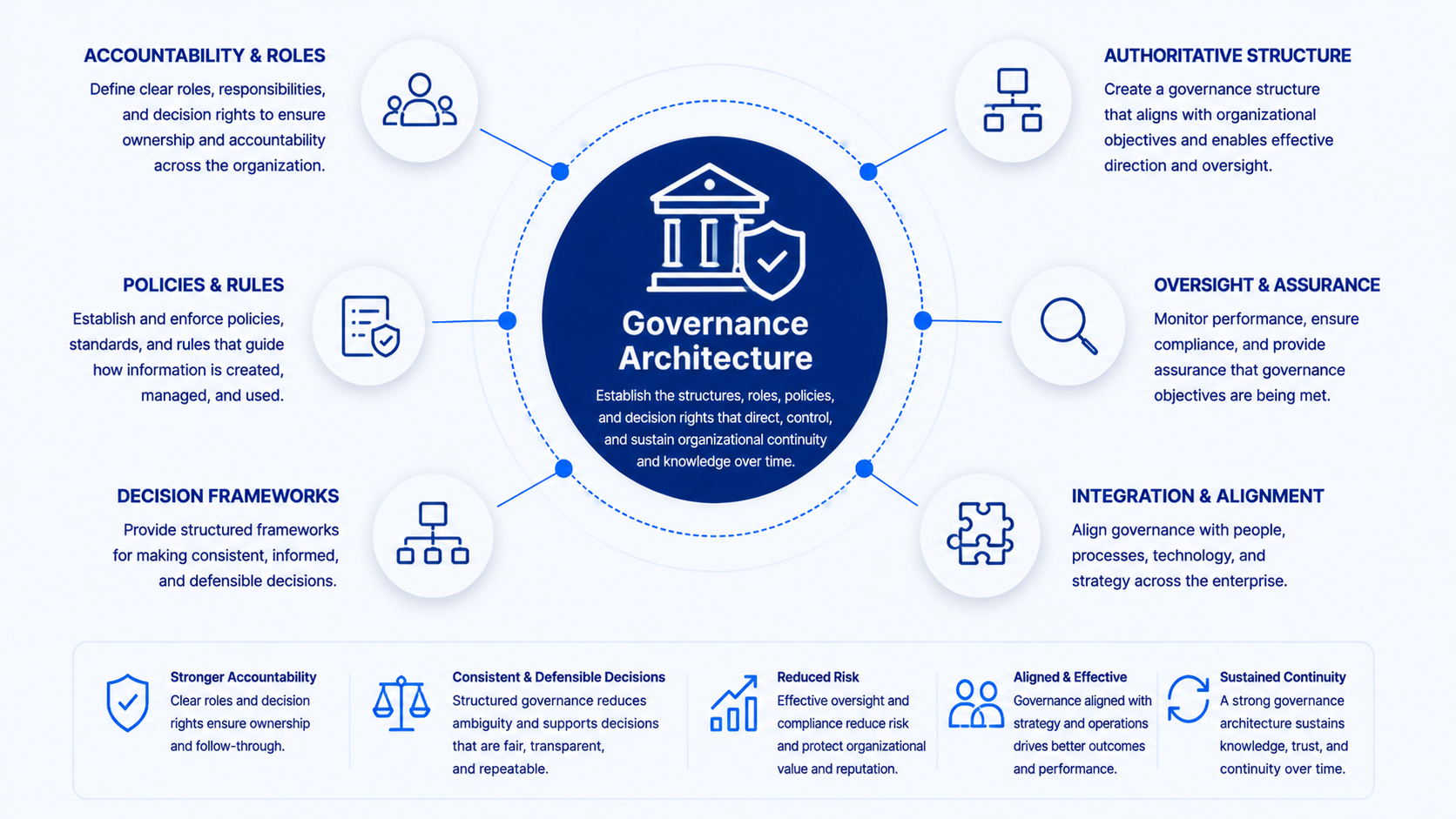
Institutions operate through layers of authority: law, regulation, policy, directive, procedure, guidance, local instruction, contract clause, delegation, technical rule, and precedent.
Each layer may be authentic and current while still deriving its authority from another layer. Continuity requires those derivations to remain explicit.
Semantic Continuity Matters as Much as Version Control
Organizations invest heavily in version control. They identify the current policy and archive superseded editions. But simultaneous current documents can still conflict semantically.
The FBI example is especially useful because the discrepancy involved taxonomy: who counts as a protected actor, what activity is protected, and what conduct counts as retaliation. Those differences change which institutional actions are permitted.
AI Magnifies the Hidden Conflict
If two active sources conflict, a retrieval system may surface both. A language model may favor the more specific, more recent, more prominent, or earlier-presented text—even when none of those heuristics reflects actual institutional authority.
The solution is not simply a larger context window. The institution needs authority metadata and relationship semantics.
The GovKM Proposition
Two authoritative artifacts do not create one authoritative institutional state unless the relationship between them is governed.
Authority continuity requires explicit hierarchy, scope, derivation, conflict state, semantic alignment, and requalification through change.
Continue Exploring

When Government Systems Are Replaced, What Happens to Their Authority?
The Practice Form Failed. The Agent Used the Real One.