Visibility Is Not Completeness: AI Must Declare the Boundary of What It Knows
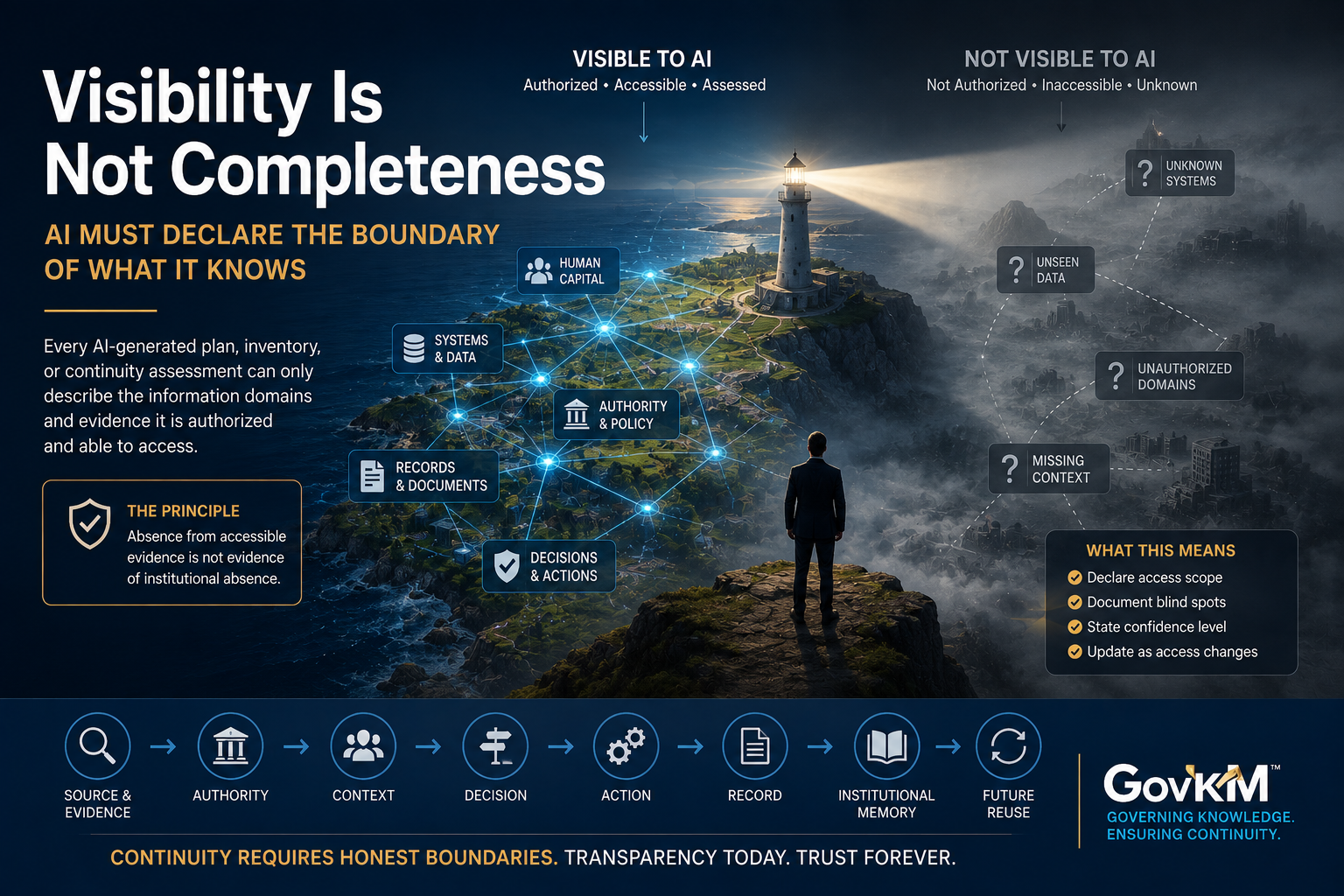

An AI Can Only Know the Institution It Can Observe
Organizations increasingly ask AI systems to inventory information, identify gaps, summarize policy, map dependencies, assess risk, and explain how work is performed. These uses create a deceptively simple governance problem.
The system may be capable of analyzing everything it can reach while still seeing only part of the institution.
A repository may be outside its permissions. A business unit may not have connected its data. A recordkeeping system may expose metadata but not content. A legal or security boundary may intentionally prevent access. A legacy environment may be technically unreachable. An informal practice may never have been documented.
If those limits are not preserved, a technically correct statement about visible evidence can become an institutionally false statement about the organization as a whole.
Visibility is not completeness.
Knowledge Limits Are Governance Information
NIST's AI Risk Management Framework provides a useful external foundation. The AI RMF calls for documenting an AI system's knowledge limits, considering data availability and representativeness, and specifying the targeted application scope.
Continuity extends that logic into institutional knowledge. The boundary of accessible evidence is not merely a technical configuration detail. It determines how far a claim may legitimately reach.
If an AI system is authorized to analyze procurement records but not legal advice, its conclusions may characterize the procurement evidence available to it. They cannot silently become conclusions about every legal obligation affecting procurement.
If an organizational inventory covers three connected repositories, absence from those repositories is evidence of absence only within that observed scope. It is not proof that the organization possesses no other relevant information.
Coverage Is Part of Authority
Organizations routinely treat authority as a property of people, policies, records, and systems. Continuity requires another question: authority over what scope?
A continuity assessment should therefore preserve the domain in which its assertions are valid. That domain may include systems, repositories, organizational units, time periods, information classes, security boundaries, and known exclusions.
This is not a disclaimer added after analysis. It is part of the claim itself.
“No record was found” and “no record exists” are different institutional statements. The first describes a search result. The second makes a claim about reality. Moving from one to the other requires evidence that the search scope was sufficient to support the stronger assertion.
The Continuity Topology Shows How a Scope Error Spreads
Source → Evidence: The system begins with accessible sources. If a source is inaccessible, its evidence cannot silently be treated as negative evidence.
Evidence → Authority: The available evidence determines what the system has grounds to assert. Coverage limitations constrain that authority.
Authority → Context: The claim must carry the organizational, temporal, system, and access context within which it was produced.
Context → Decision: Decision-makers need to know whether a conclusion represents the whole institution or only the connected portion of it.
Decision → Action: Actions based on partial evidence should be bounded accordingly, or preceded by additional collection and human review.
Action → Record: The resulting record should preserve the coverage conditions under which the decision was made.
Record → Institutional Memory: Future users must be able to distinguish a historically bounded assessment from an organization-wide fact.
Institutional Memory → Future Reuse: Reuse requires requalifying the old scope. A previously complete assessment can become incomplete when systems, permissions, functions, or organizational structures change.
The Dangerous Failure Is a False Negative
AI governance often concentrates on hallucination: the system says something unsupported that appears to exist.
Continuity must also govern the opposite failure: the system fails to see something and concludes that it does not exist.
That error is especially dangerous in institutional settings. Missing policy may be treated as no policy. Inaccessible precedent may be treated as no precedent. An unconnected repository may be treated as no records. An unobserved dependency may disappear from a reorganization plan. A disconnected office may disappear from an enterprise knowledge map.
The system did not necessarily reason incorrectly. The institution allowed the boundary of observation to masquerade as the boundary of reality.
Continuity Claims Need a Coverage Contract
A trustworthy continuity output should make its coverage recoverable. At minimum, later users should be able to determine what organizational units, information domains, systems, repositories, and time periods were included; what was known to be excluded; which access restrictions affected analysis; and whether the resulting claim was intended to describe a bounded environment or the institution as a whole.
The exact implementation can vary. The governance principle should not.
An AI system may only characterize the institutional environment for which it possesses sufficient authorized evidence.
Anything beyond that boundary is not institutional knowledge. It is inference—and it should remain identified as inference.
Continue Exploring
The Answer Was Correct. The Evidence Could Not Prove It.
The Model Hadn't Answered Yet. Its Memory Was Already Wrong.