When Content Becomes Command: AI Agents Need Instruction Lineage
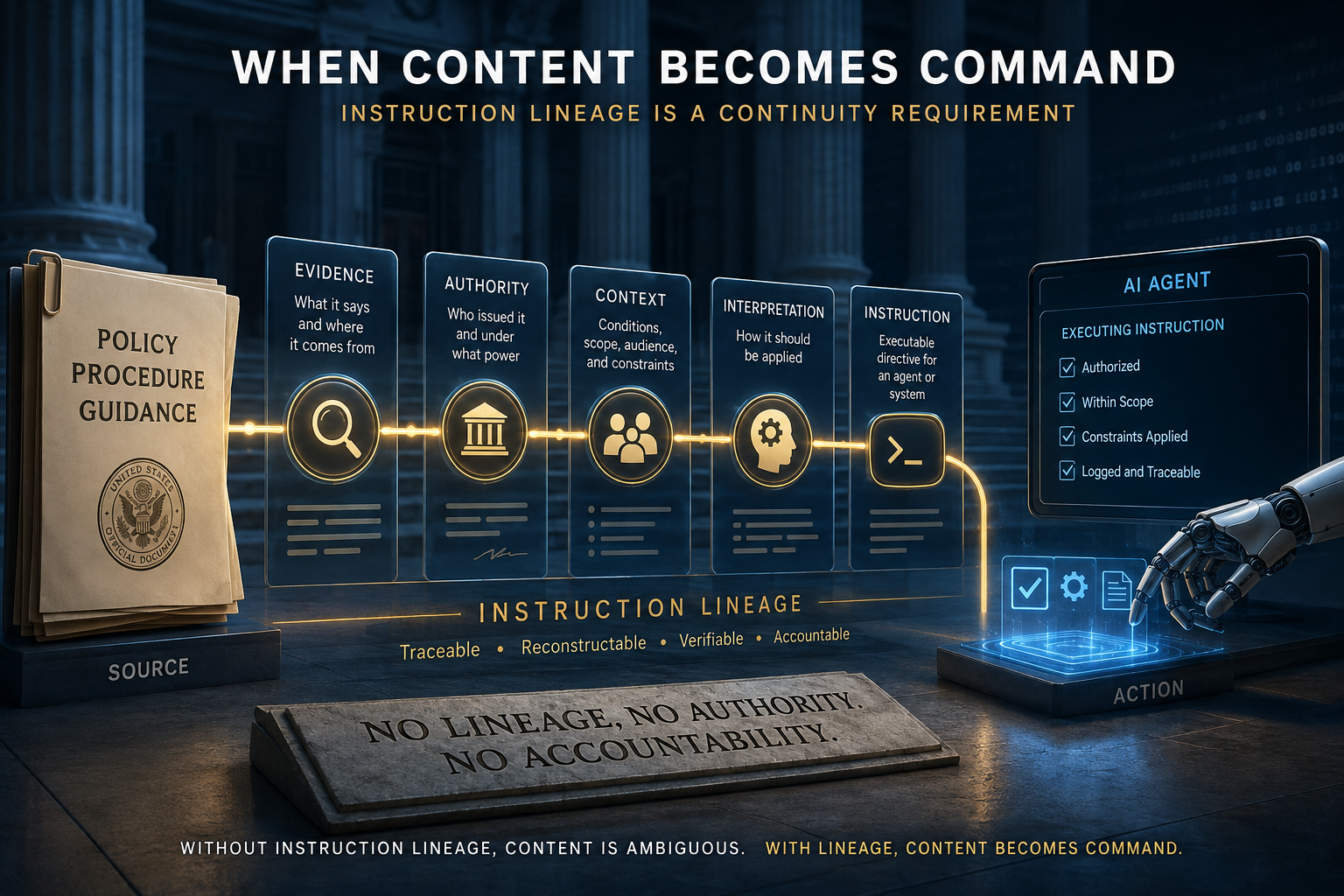

AI agents increasingly read emails, web pages, tickets, documents, code repositories, calendar entries, and other external content while also possessing tools that can change institutional state.
That combination creates a governance problem that traditional information systems rarely had to solve: the same context can contain both information to interpret and text that attempts to instruct the system what to do.
Indirect prompt injection exploits that ambiguity. Malicious instructions embedded inside otherwise ordinary content can influence an agent without appearing as an explicit user command.
The security problem is real. The deeper institutional problem is one of instruction lineage.
Content and Command Are Different Institutional Roles
An email may be evidence. A policy may be authority. A web page may be an external source. A user request may be an instruction. A tool result may be operational evidence. These objects can all appear as text inside one model context, but they do not possess the same institutional standing.
Recent 2026 research on indirect prompt injection demonstrates why this distinction matters. A large-scale public competition evaluated agents across tool-calling, coding, and computer-use settings and found successful attacks against all evaluated model families. The attacks worked by placing adversarial instructions inside external content that agents were expected to process.
The important continuity lesson is not that external content is inherently untrustworthy. It is that information does not acquire command authority merely because it enters the model's context.
Source Provenance Is Necessary but Not Sufficient
Knowing where text came from helps identify risk. But provenance alone does not determine whether that text may govern action.
A vendor email may be authentic and still lack authority to instruct an internal agent to release data. A retrieved document may be genuine and still contain text that should be treated only as evidence. A web page may accurately report a procedure while possessing no standing to override an organization's current policy.
Continuity therefore needs to preserve not only where content came from, but what role that content is allowed to play.
The Continuity Topology Exposes the Missing Relationship
Source → Evidence: External content should enter as attributable information whose origin and integrity can be evaluated.
Evidence → Authority: The institution must determine whether any part of that information possesses recognized authority for the present purpose. Relevance is not authority.
Authority → Context: Even authorized instructions operate within scope, time, role, system, and task boundaries.
Context → Decision: The agent's decision should reflect the user's authorized objective and governing institutional rules, not commands discovered incidentally inside evidence.
Decision → Action: Consequential execution should remain bounded by the authority established before action.
Action → Record: Later reviewers should be able to determine which instruction source actually caused an action and whether it possessed authority.
The Failure Is an Authority Promotion
Indirect prompt injection can be understood as an unauthorized promotion of information from one institutional role to another.
Text that entered as content is interpreted as instruction. A source becomes an actor. Evidence becomes authority. The system silently changes the standing of an object without an institutional decision authorizing that change.
This framing also explains why filtering suspicious phrases alone cannot solve the complete governance problem. Legitimate documents often contain imperative language. Policies, procedures, contracts, emails, support tickets, and source code all contain instructions. The system must distinguish not merely what looks like a command, but which actor is entitled to command which action under which context.
Instruction Lineage Must Survive Delegation
The problem becomes harder in multi-agent systems. A user may instruct one agent, which delegates to another, which reads external evidence and calls a tool. By execution time, the institution may have several instruction-bearing objects inside the pathway.
Continuity requires the action to remain connected to the original authorized objective and any legitimate delegated instructions. External content can inform the task without silently becoming a new source of authority.
This is why instruction lineage belongs beside provenance, authorization, and execution logging. A log showing that an agent called a tool is incomplete if the institution cannot establish which instruction caused the call and whether that instruction had standing to do so.
AI Governance Needs Role-Preserving Context
Security researchers increasingly recommend structural separation, constrained observation, policy enforcement, and pre-execution controls for agents that consume untrusted content. Those measures address an important technical expression of the problem.
GovKM adds the institutional requirement: the role assigned to an information object must survive its movement through retrieval, reasoning, delegation, and execution.
Evidence may influence a decision. It should not automatically become authority to act.
As AI agents become capable of changing institutional state, trustworthy operation will depend on preserving the lineage not only of information, but of instructions themselves.
Continue Exploring
The Answer Was Correct. The Evidence Could Not Prove It.
The Model Hadn't Answered Yet. Its Memory Was Already Wrong.