AI Agents Need More Than Permission. They Need Continuity of Authority.

As AI systems move from recommending actions to executing them, a deceptively simple question becomes central to enterprise governance: was the action actually authorized when it happened?
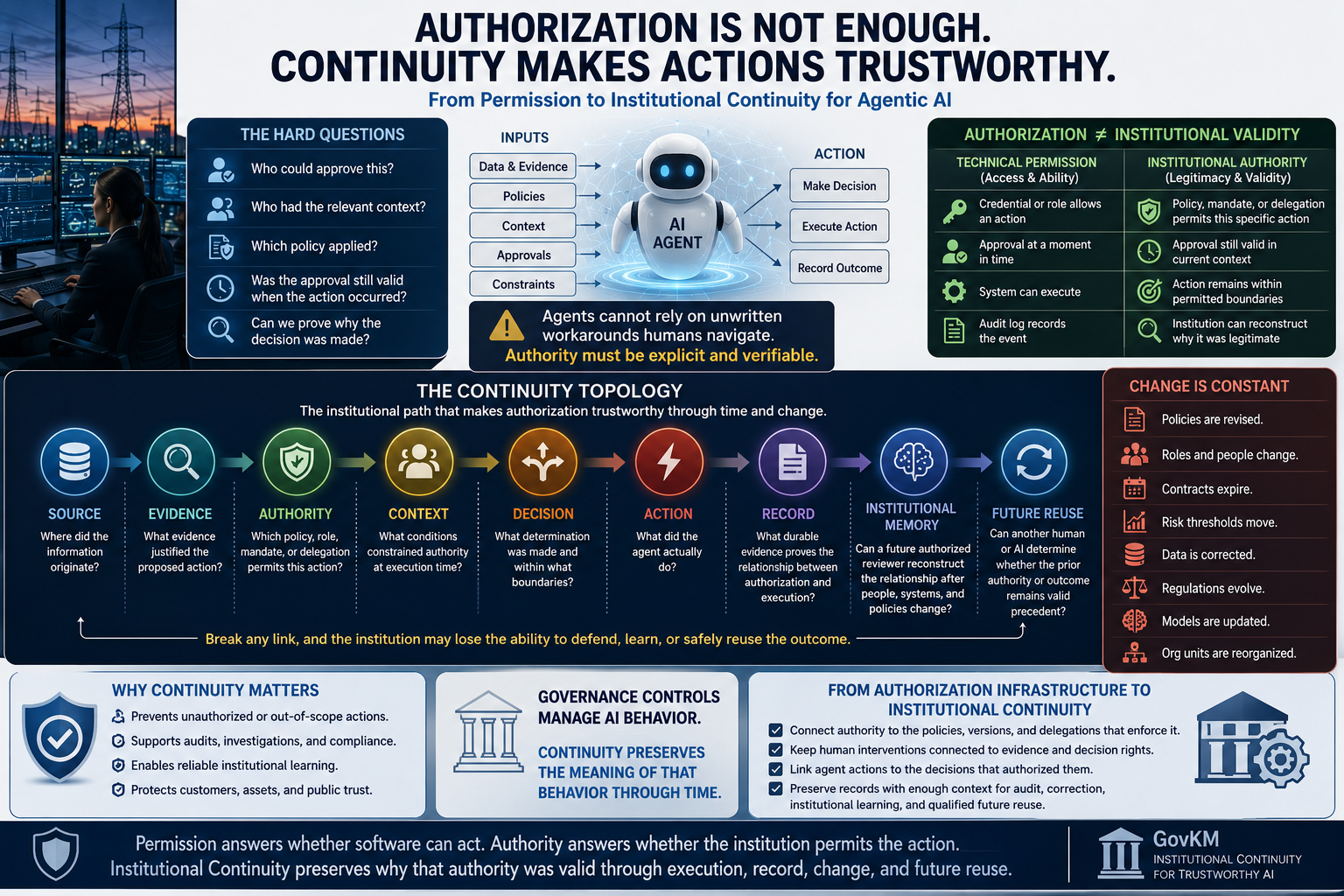
A recent LinkedIn post from Betty C. Chen, founder and CEO of AtlasEnt, frames the problem through familiar organizational questions: who could approve something, who had the relevant context, which policy applied, whether the approval remained valid when the action occurred, and whether anyone could later prove why the decision was made.
Her argument is that humans have historically navigated these ambiguities informally, while AI agents cannot safely depend on the same unwritten institutional workarounds. That diagnosis is important. Agentic AI converts organizational authority from a background governance concern into an execution-time systems requirement.
But authority itself is only one element of the larger problem.
An agent does not merely need permission to act. The institution needs continuity of the relationships that made the action legitimate.
Permission and Authority Are Not the Same Thing
A software credential can establish that an agent has technical access to a system. A role can establish that a user or service is permitted to invoke a function. An approval record can show that someone authorized a proposed action at a particular moment.
None of those facts alone establishes that a later action remained institutionally authorized when it was executed.
The applicable policy may have changed. The underlying evidence may have been superseded. The approver's delegated authority may have expired. The customer, transaction, patient, asset, contract, or operating condition may have changed. The action parameters may have drifted beyond the scope originally approved.
This distinction is becoming visible in emerging technical work on autonomous-agent mandates. A July 2026 Internet-Draft on verifiable human mandates observes that credentials and session state can show that an agent is authorized to act in general without proving that a particular action, with particular parameters, falls within the constraints the human actually authorized.
That is an authority problem. It is also a continuity problem.
Authority Has a Before, During, and After
Organizations often treat authority as a point-in-time control: an approval is granted, a permission is assigned, or a policy authorizes a class of activity.
Agentic systems expose why that model is incomplete.
Before action, the institution must establish what sources and evidence justify the proposed activity and what authority applies.
At execution, the system must establish that the authority remains valid in the current context and that the proposed action remains inside its permitted boundaries.
After execution, the institution must preserve enough evidence to reconstruct what authority existed, what context applied, what decision occurred, what action followed, and what record resulted.
Those are not separate governance problems. They are relationships along the same institutional path.
The Continuity Topology Makes the Relationship Visible
GovKM represents that path through the Continuity Topology:
Source → Evidence → Authority → Context → Decision → Action → Record → Institutional Memory → Future Reuse.
Chen's post concentrates on a particularly important section: Authority → Context → Decision → Action → Record.
But the complete topology reveals what an authorization architecture must ultimately support.
Source: Where did the information governing the action originate?
Evidence: What evidence justified the proposed decision?
Authority: Which policy, delegation, role, mandate, consent, or legal basis permitted action?
Context: What conditions constrained that authority at the moment of execution?
Decision: What determination was made and according to which boundaries?
Action: What did the agent actually do?
Record: What durable evidence proves the relationship between authorization and execution?
Institutional Memory: Can a future authorized reviewer reconstruct that relationship after people, systems, policies, and models change?
Future Reuse: Can another human or AI determine whether the prior authorization or outcome remains valid precedent?
Authority becomes trustworthy when it remains connected to the rest of that path.
Audit Logs Cannot Repair Invalid Authority After the Fact
Organizations may be tempted to treat comprehensive logging as the solution. Logs are essential, but they solve a different problem.
An audit trail can establish that an action occurred. It may identify the agent, timestamp, tool call, approval record, and outcome. But a record written after execution cannot by itself guarantee that the action was within the legitimate mandate at the moment it occurred.
The emerging agent-mandate literature makes this distinction explicitly: logging supports accountability after the fact, while authorization boundaries must constrain action before or during execution.
Institutional Continuity requires both. The authority relationship must be enforceable when action occurs and reconstructable afterward.
The Hard Question Is Whether Approval Survived Change
One question in Chen's post deserves particular attention: was the approval still valid when the action happened?
That is a pure continuity-through-change question.
Organizations change constantly between authorization and execution. Policies are revised. Employees change roles. contracts expire. Risk thresholds move. Data is corrected. Customers withdraw consent. Regulations change. New evidence arrives. Models are updated. Organizational units are reorganized.
An autonomous agent may continue operating through all of those changes unless the institution has encoded not only what the agent may do, but what conditions make that authority valid.
This is why durable agent governance needs temporal authority, supersession, revocation, scope, context, and evidence relationships—not merely static permission tables.
From Authorization Infrastructure to Institutional Continuity
Products that make organizational authority explicit are addressing an important piece of the agentic-AI problem. The emergence of this market itself is evidence that AI is exposing institutional relationships that humans previously managed informally.
GovKM's contribution is to place authority inside the larger continuity architecture.
Authority does not become reliable merely because it is machine-readable. It becomes institutionally reliable when a future authorized actor can establish what evidence supported it, what context constrained it, what decision it enabled, what action occurred, what record resulted, and whether the same authority remains applicable later.
Permission answers whether software can act. Authority answers whether the institution permits the action. Institutional Continuity preserves why that authority was valid through execution, record, organizational change, and future reuse.
This distinction will matter far beyond enterprise software. Banking, healthcare, insurance, government, legal services, manufacturing, energy, logistics, retail, and any other industry deploying consequential agents will face the same underlying problem.
They may call it authorization, consent, delegated authority, policy enforcement, decision rights, agent identity, approval validity, or accountability.
The terminology will vary by industry.
The continuity relationship will not.
Continue Exploring
A New Version Label Does Not Create a New Institutional History
The Stocktake Is Institutional Memory