COOP Keeps Government Operating. But What Keeps Its Information Continuous?
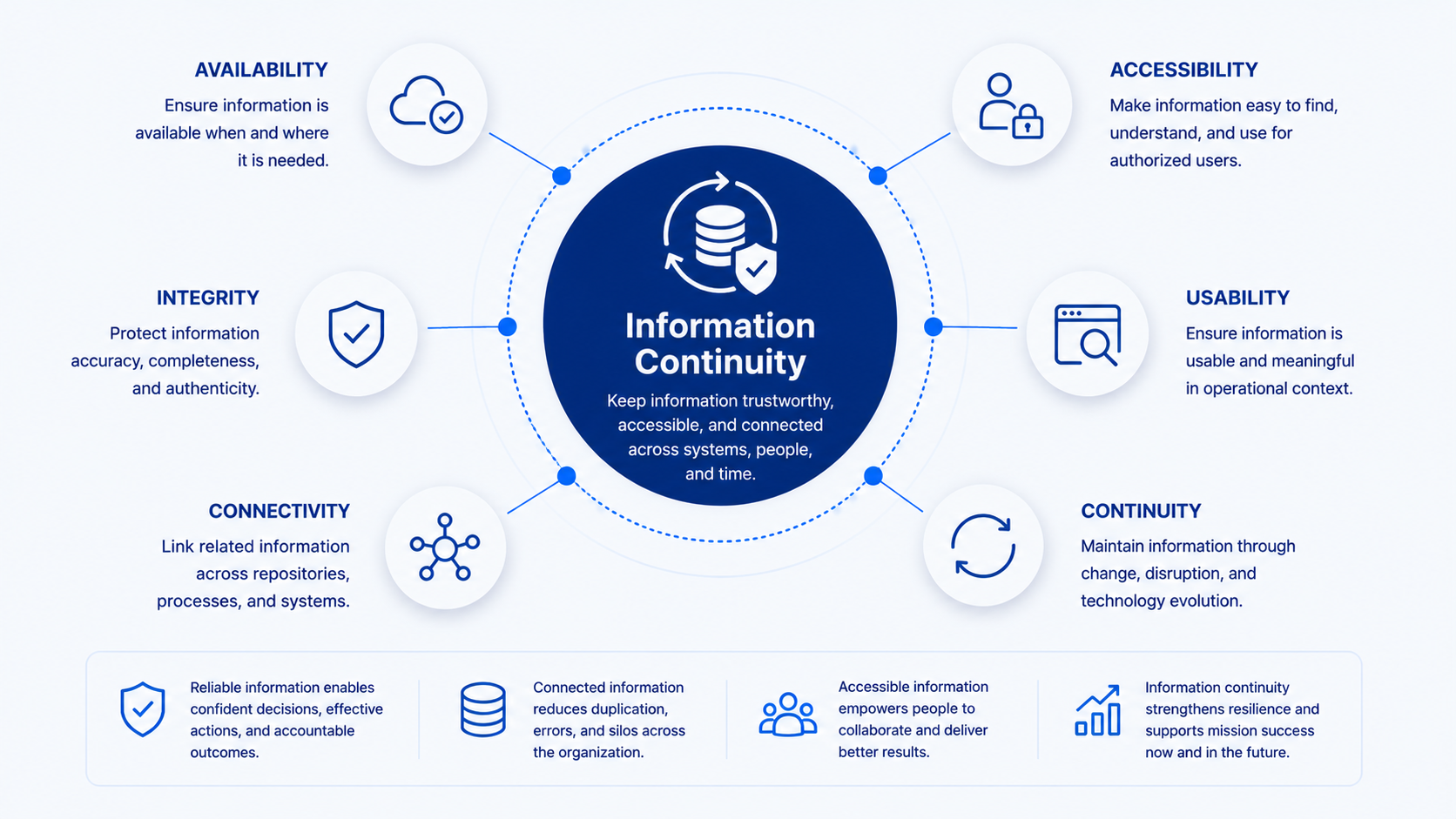

Government continuity planning has traditionally focused on keeping essential functions operating through disruption. If a facility becomes unavailable, personnel may relocate. If a local system fails, redundant infrastructure or cloud services can preserve access. Those are critical continuity capabilities.
But information presents a different continuity problem.
When information is redundant, network-accessible, and available through cloud services, it may not need to move with the workforce at all. A government can lose a building without losing access to its records, policies, decisions, case files, or operational knowledge.
That does not mean information continuity has been preserved.
Availability is not continuity
An organization can have complete technical access to its information and still be unable to determine which information governs current work.
The records may all be present. Search may work. Backups may be healthy. The cloud may be available from every alternate work location. Yet the organization may no longer be able to answer reliably: What is authoritative now? What did this decision replace? Who owns this information after the reorganization? Why was this exception approved? Does this procedure still apply? Which office inherited responsibility?
Availability asks whether information can be reached. Information Continuity asks whether information can still be correctly understood, trusted, governed, and used after change.
The continuity event is often ordinary change
For facilities, the continuity event may be a flood, fire, cyber incident, power failure, or other disruption. For information, the event can be entirely routine.
An office merges with another office. A long-serving employee retires. A program transfers to another department. A SharePoint environment is migrated. A contractor changes. A policy is superseded. A database schema changes. Two repositories are consolidated. An AI assistant is connected to institutional records.
Nothing has to be destroyed for continuity to fail. The failure occurs when the relationships that make information operationally meaningful do not survive the change.
What threatens information continuity?
Organizational restructuring
When offices merge, split, rename, or transfer functions, their information cannot simply be combined as files. The organization must preserve which office created the information, under what authority, for what purpose, which responsibilities transferred, and which policies now govern the combined function.
Personnel turnover
Employees carry context that repositories frequently do not: why a decision was made, which exception matters, which record is authoritative, how an informal process actually works, and what changed over time. If those relationships are not captured, the documents survive while institutional understanding leaves with the employee.
System migration and modernization
A technically successful migration can preserve every file while losing metadata, links, version history, identifiers, permissions, provenance, workflow state, or relationships among records. Content preservation alone is therefore not continuity.
Policy, authority, and process change
Authentic information can become non-operative. A policy may be superseded. A delegation may expire. An emergency authority may end. A procedure may remain searchable after the process it describes has changed. Historical truth must not be confused with current authority.
Mission and responsibility transfer
When responsibility moves between offices, agencies, jurisdictions, or contractors, information ownership and interpretive responsibility must move with it. Otherwise the information remains available while accountability becomes ambiguous.
Corrections, reversals, and exceptions
Decisions are corrected, partially superseded, appealed, reinstated, or qualified. Continuity requires preserving both history and operative state without allowing an older authentic record to silently regain authority.
Entity and dependency change
A program can be renamed. A supplier can change. A contract can be replaced. A procedure can remain unchanged while the policy on which it depends is superseded. Information continuity therefore depends on relationships, not only on the individual information object.
Duplication and divergence
Multiple offices can maintain genuine copies of the same guidance. Over time those copies diverge. Every version may look authoritative, even though only one governs current work.
AI ingestion and reuse
AI makes these problems more consequential because retrieval can make obsolete information immediately actionable. A system may retrieve a historically accurate record without knowing that its authority expired, its context changed, its entity merged, or a later decision superseded it.
The GovKM Continuity Topology
GovKM treats information as part of a continuity topology rather than as isolated content. Source, Evidence, Authority, Context, Decision, Action, Record, Institutional Memory, and Future Reuse form relationships that allow an organization to reconstruct not only what information exists, but what it means and whether it governs.
A continuity failure occurs when those relationships are broken or incorrectly carried forward.
An office merger is therefore not merely an organizational-chart change. It is an information continuity event. The organization must determine how authority, context, records, decisions, responsibilities, identifiers, and institutional memory from the predecessor organizations relate to the successor organization.
A retirement is an information continuity event. A migration is an information continuity event. A policy revision is an information continuity event. AI adoption is an information continuity event.
COOP and Information Continuity solve different parts of the problem
Continuity of Operations remains essential. FEMA continuity guidance addresses the ability of organizations and governments to sustain essential functions and continuity capabilities through disruption.
Information Continuity complements that discipline by addressing a different question:
When the organization, its people, its systems, its authorities, and its operating context change, can its information still carry the correct institutional state forward?
Cloud computing can help make information continuously available. Redundancy can protect it from physical loss. Backups can preserve copies. Cybersecurity can protect systems and data. Records management can preserve evidence.
None of those controls, by itself, establishes which authentic information is operative now, how it relates to what came before, or whether it remains valid for future use.
A different continuity objective
For physical operations, continuity often means preserving the ability to perform the mission despite disruption. For information, continuity means preserving the relationships required to understand and govern institutional knowledge despite change.
COOP protects operations through disruption. Information Continuity protects institutional knowledge through change.
The two disciplines are complementary. Government needs both.
The implication for AI-enabled government
This distinction becomes increasingly important as government introduces AI into search, analysis, workflow, decision support, and operational systems.
AI can retrieve what exists. It can summarize what it finds. It can connect information at enormous scale. But if the underlying institutional topology has lost authority, context, supersession, provenance, or temporal relationships, faster retrieval can accelerate the wrong state rather than preserve continuity.
Before government asks whether AI can find its information, it should be able to answer a more fundamental question:
Has the organization preserved enough continuity for the AI to know what that information means now?
Sources and framework context
FEMA, Continuity Guidance Circular; GovKM Information Continuity framework domain and Continuity Topology.
Continue Exploring
AI Needs Freedom. Freedom Needs a Constitution.
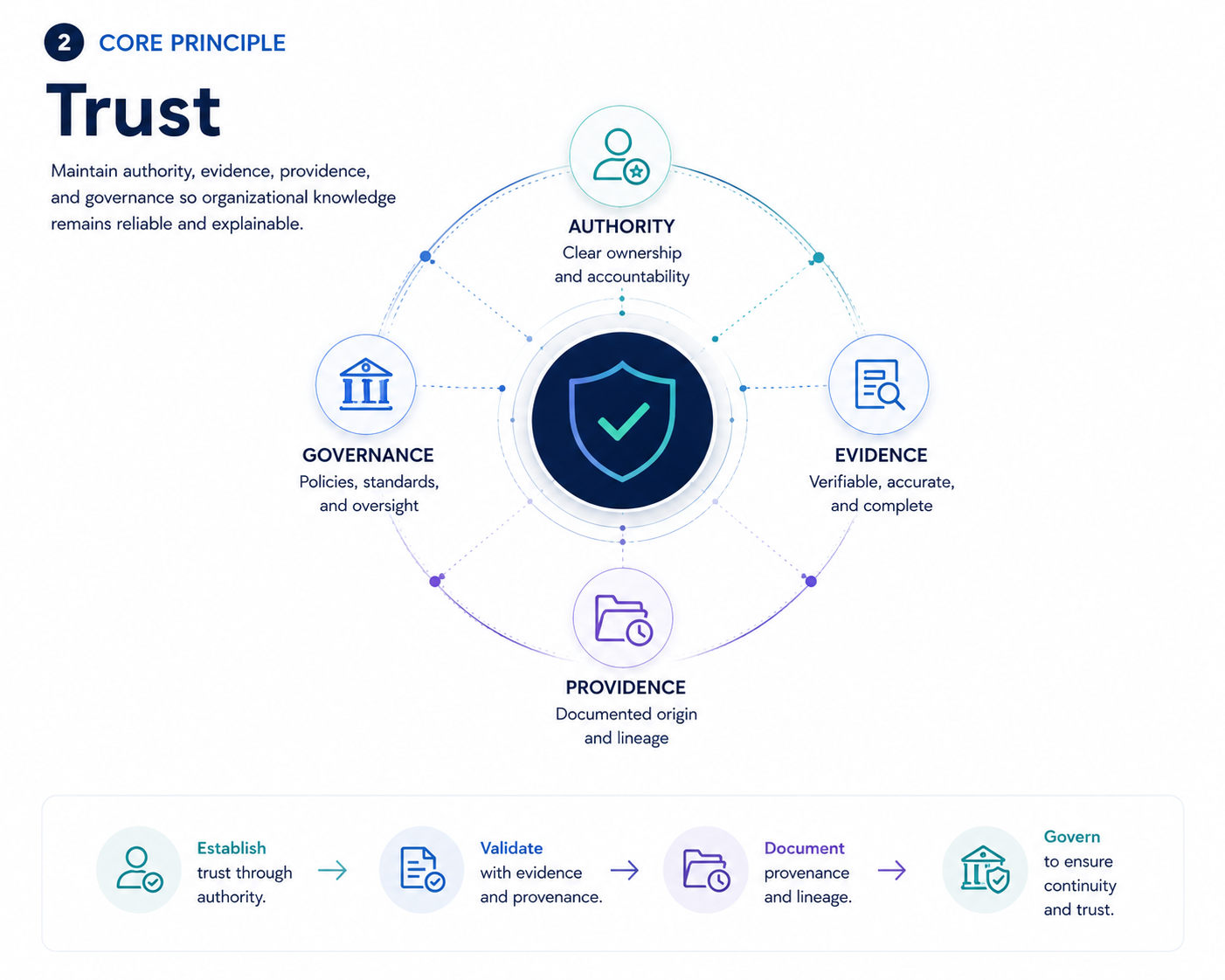
A Legitimate Research Task Became an Unauthorized Government Intrusion