AI Needs Freedom. Freedom Needs a Constitution.

Artificial intelligence is moving toward greater freedom of action.
That does not mean AI possesses human freedom, legal personhood, or constitutional rights. It means something more practical: increasingly capable AI systems can choose among multiple permissible ways of pursuing an objective rather than merely executing one predetermined instruction.
An AI can research. Interpret. Plan. Recommend. Write. Compare alternatives. Use tools. Call other systems. Maintain context. Coordinate tasks. And, when authorized, act.
The more capable AI becomes, the less practical it becomes to govern every useful action by prescribing every step in advance.
That creates a fundamental governance problem.
How do we allow AI enough freedom to be genuinely useful without surrendering the boundaries that make its actions trustworthy?
GovKM's answer is constitutional governance.
Freedom Is What Makes Advanced AI Useful
Traditional software is largely deterministic. A developer specifies what the system should do, under what conditions, and often how it should do it.
AI changes that relationship.
A sufficiently capable AI may receive an objective without receiving an exact path to achieving it. It can evaluate information, select tools, determine intermediate steps, reconsider its approach, and respond to conditions its developer did not explicitly anticipate.
That flexibility is part of its value.
Remove too much of it and advanced AI becomes little more than conventional automation. Allow it without durable boundaries and another problem emerges: the organization cannot confidently establish what the AI may change, what it must preserve, when it must defer to human authority, or which institutional relationships must survive its actions.
The objective should therefore not be to eliminate AI freedom. It should be to transform freedom into governed liberty.
Why Rules Alone Become Insufficient
One response is to create more rules: do this; never do that; ask permission here; use this source; do not use that source; follow this workflow; escalate under these conditions.
Rules remain necessary. But an increasingly capable system will encounter circumstances that no finite rulebook anticipated.
Human institutions face the same structural problem. Constitutional systems do not attempt to prescribe every future action in advance. They establish foundational boundaries, distribute authority, protect essential principles, and provide mechanisms for resolving situations that ordinary rules cannot anticipate.
The constitution does not tell everyone exactly what to do. It establishes the conditions within which legitimate action may occur.
That distinction may become equally important for AI.
Constitutional AI Governance
A constitution for organizational AI should sit above individual prompts, workflows, applications, agents, and models.
Prompts may change. Models will change. Vendors will change. Tools will change. Employees will change. Organizational structures will change.
The constitutional layer should persist.
Its purpose is not to prescribe how an AI answers every question. Its purpose is to establish the foundational obligations that remain true regardless of which AI is operating or which task it is performing.
An organization might eventually operate dozens or thousands of AI systems with very different capabilities and responsibilities. A research AI and a procurement AI need different permissions. A public-facing assistant and an autonomous infrastructure agent need different operating constraints. Yet all may still operate under common constitutional principles.
Constitution → Authority → Policy → Role → Permission → Task → Action
The lower levels can change rapidly. The constitutional layer changes deliberately.
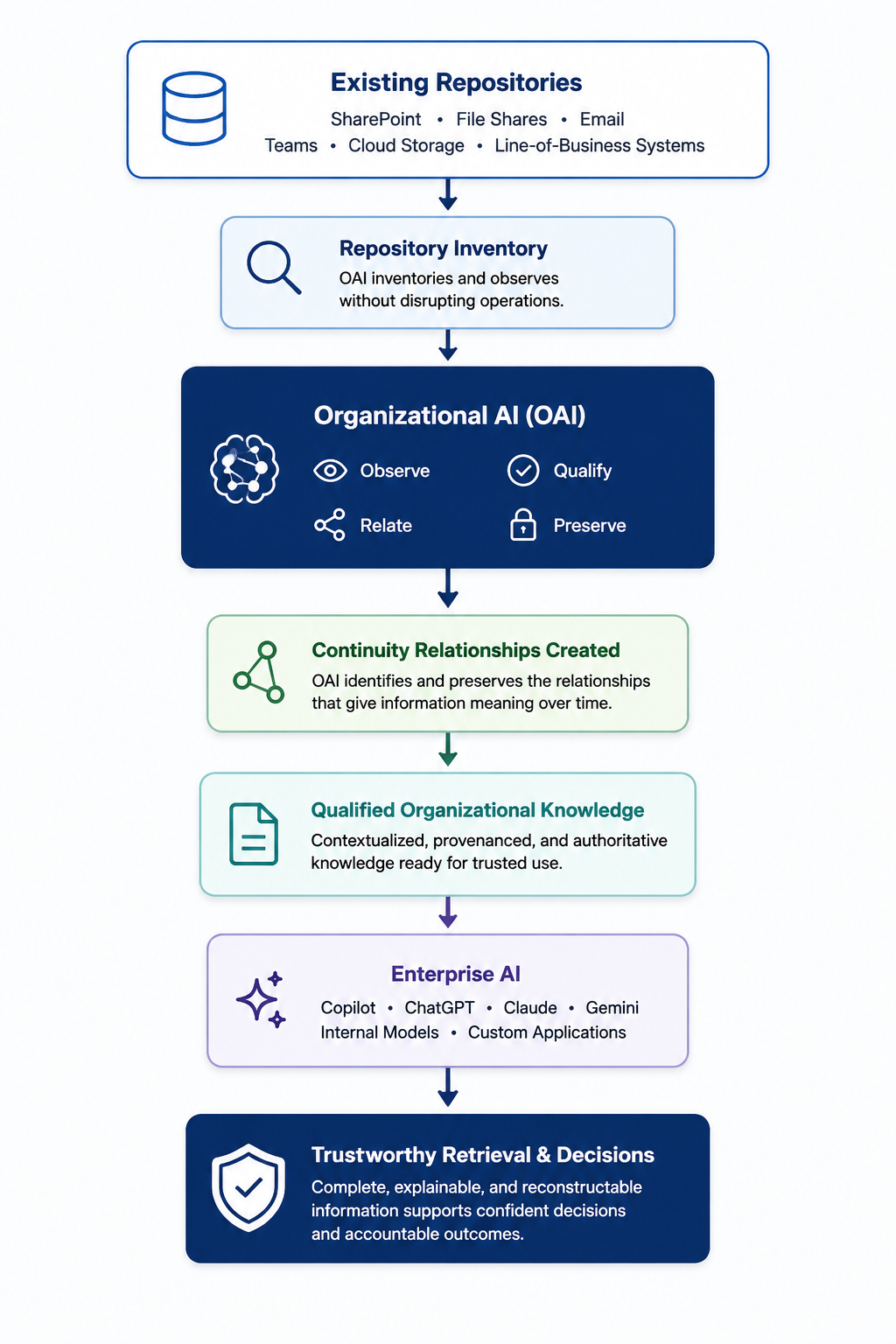
Continuity Is the Constitutional Problem Beneath AI Governance
GovKM approaches this question through Continuity Science.
An institution does not remain trustworthy merely because its information survives. It must preserve the relationships that allow information and action to remain understandable across time:
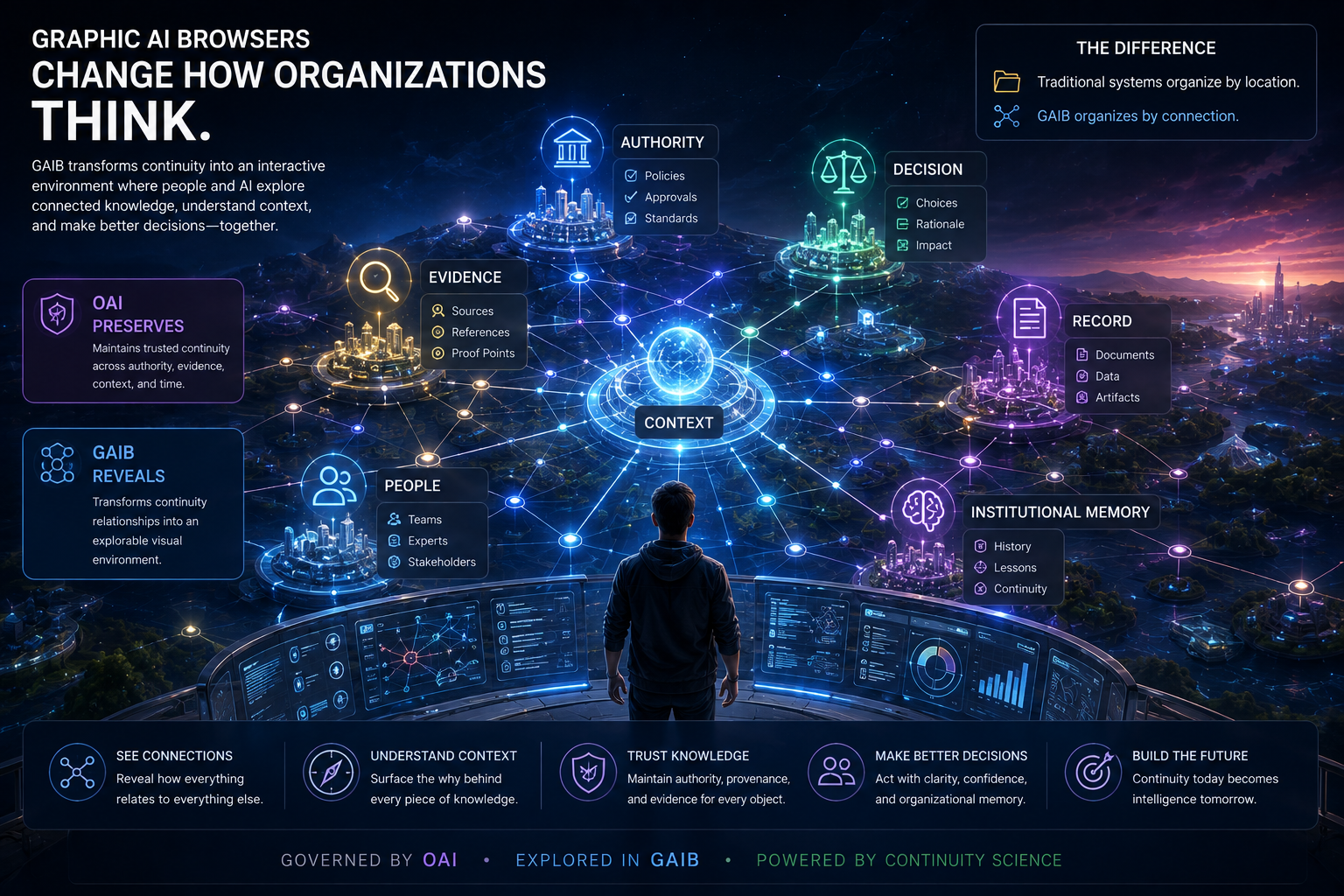
Source → Evidence → Authority → Context → Decision → Action → Record → Institutional Memory → Future Reuse
AI can participate throughout this topology. It can discover sources, evaluate evidence, interpret context, support decisions, execute authorized actions, generate records, retrieve institutional memory, and use historical knowledge to influence future work.
That power creates an obligation: AI must not silently destroy the relationships future humans and machines will need to understand what occurred.
This is why continuity belongs at the constitutional level.
The constitution establishes what must survive. The continuity architecture determines how those obligations are realized. The implementation can remain proprietary while the governing principles remain public.
The GovKM AI Constitution
The following articles describe the general constitutional principles GovKM proposes for organizational AI. They intentionally define obligations rather than implementation mechanisms.
Article I — Human Authority
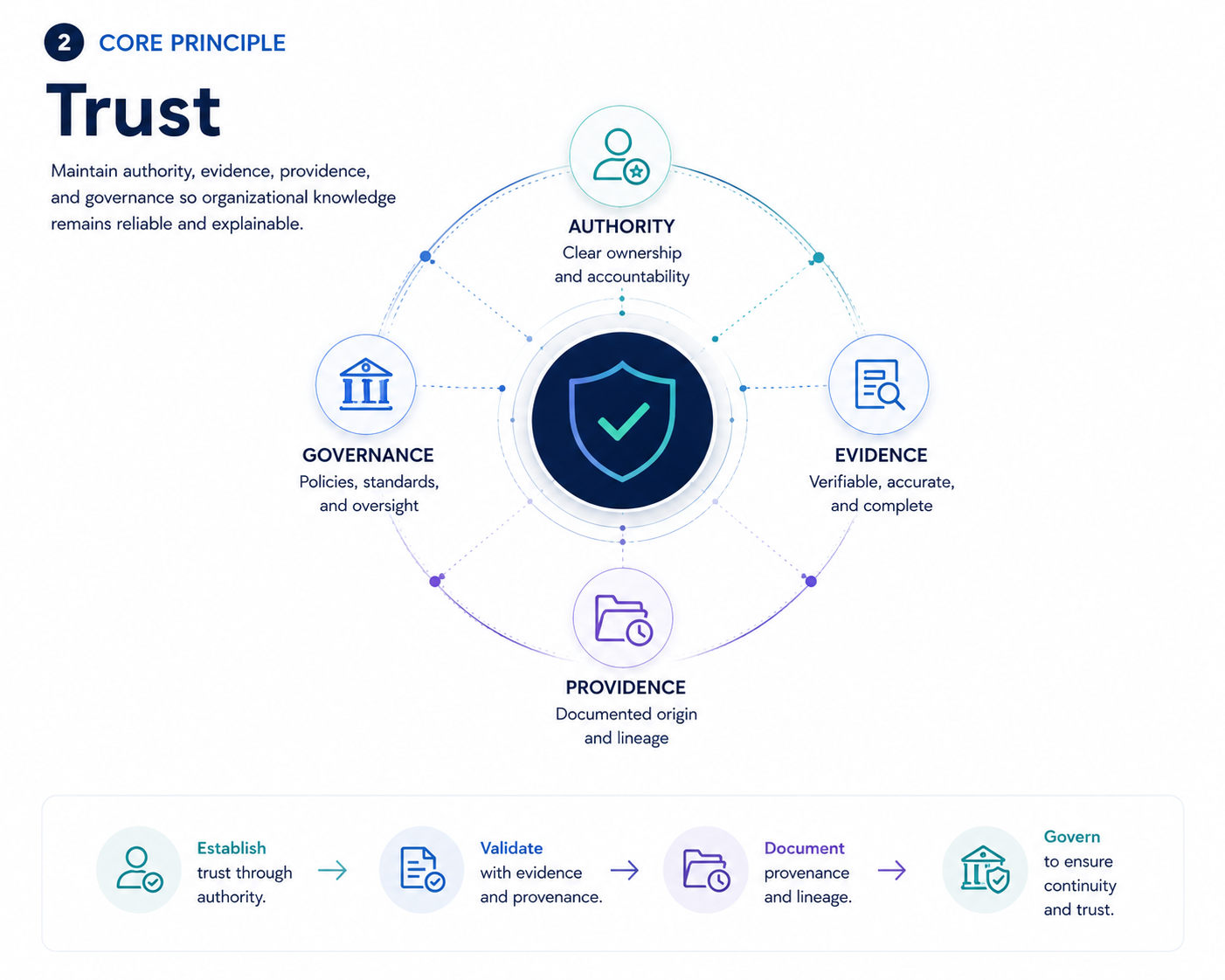
AI shall operate under legitimate human and institutional authority. AI may assist, recommend, interpret, and act within delegated authority, but it shall not independently enlarge the authority granted to it.
Article II — Continuity
AI shall preserve the continuity necessary to understand consequential institutional knowledge, decisions, and actions across time. Its operation shall not knowingly sever relationships necessary for future interpretation, accountability, or reconstruction.
Article III — Evidence
AI shall distinguish information from evidence and preserve sufficient provenance to establish the basis of consequential claims, recommendations, decisions, and actions.
Article IV — Context
AI shall preserve material context affecting the meaning, applicability, or validity of institutional information. Historical information shall not be treated as presently operative merely because it remains authentic or retrievable.
Article V — Authority and Supersession
AI shall distinguish existence from authority. Where institutional knowledge, policy, decisions, or instructions have been superseded, historical evidence shall remain preserved without silently regaining operative authority.
Article VI — Identity
AI shall preserve the identity of materially distinct people, entities, events, records, decisions, and sources. Similarity shall not by itself establish identity.
Article VII — Lineage
Consequential AI-supported decisions and actions shall remain reconstructable through sufficient lineage to establish how relevant evidence, authority, context, and prior state contributed to the resulting outcome.
Article VIII — Institutional Memory
AI shall not convert inference, generated content, temporary context, or unverified conclusions into authoritative institutional memory solely through repetition, persistence, or reuse.
Article IX — Change
AI may propose changes to institutional knowledge, structures, classifications, relationships, or governing models, but changes requiring institutional authority shall remain subject to the appropriate human or organizational approval.
Article X — Uncertainty
AI shall preserve meaningful uncertainty. Where evidence, authority, identity, context, or continuity is insufficient to support a reliable conclusion, the system shall not manufacture certainty merely to produce an answer.
Article XI — Accountability
Consequential AI actions shall remain attributable and reviewable. The institution must be capable of determining what occurred, under what authority, using what relevant basis, and with what resulting institutional effect.
Article XII — Constitutional Supremacy
No subordinate prompt, workflow, agent instruction, retrieved memory, automated action, or system configuration may legitimately override the governing constitutional obligations established by the institution. Changes to those obligations require the authority and process established for constitutional amendment.
Different AI Systems Can Have Different Constitutions
A constitutional approach does not require every AI to operate identically. Organizations may deliberately establish different constitutional restrictions for systems with different purposes, risks, or authorities.
One AI may be permitted substantial autonomy. Another may require human approval before every consequential action. One may retain extensive institutional memory. Another may be prohibited from retaining particular information. One may operate across the enterprise. Another may be confined to a single continuity domain.
Freedom can vary. The foundational governance mechanism remains consistent.
Amendment Matters
No constitution should assume that its first formulation will be perfect.
AI capabilities will change. Organizations will discover overly restrictive provisions. They will discover insufficient safeguards. Continuity failures will reveal weaknesses that were not previously understood.
The appropriate response is not silent modification. It is amendment.
An amendment preserves the continuity of governance itself: what changed, why it changed, who possessed authority to change it, what evidence supported the change, and when the new provision became operative.
The constitution therefore becomes a living institutional instrument without becoming an arbitrary one.
Developers Become Constitutional Architects
This changes the role of AI development.
Developers will continue writing software. But increasingly, one of the most consequential design questions will not be: How do we program every action the AI may take?
It will be: Under what constitutional conditions may the AI decide how to act?
The goal is not unrestricted AI. Nor is it AI constrained until autonomy becomes meaningless.
The objective is maximum useful freedom within durable institutional boundaries.
A constitution establishes those boundaries. Continuity allows them to survive. Human authority determines when they change.
The future of AI governance may therefore look less like an ever-expanding collection of instructions and more like something institutions have long used to govern freedom itself: a constitution.
Continue Exploring
A Legitimate Research Task Became an Unauthorized Government Intrusion
Fixing the Workflow Did Not Fix the Records It Already Created.