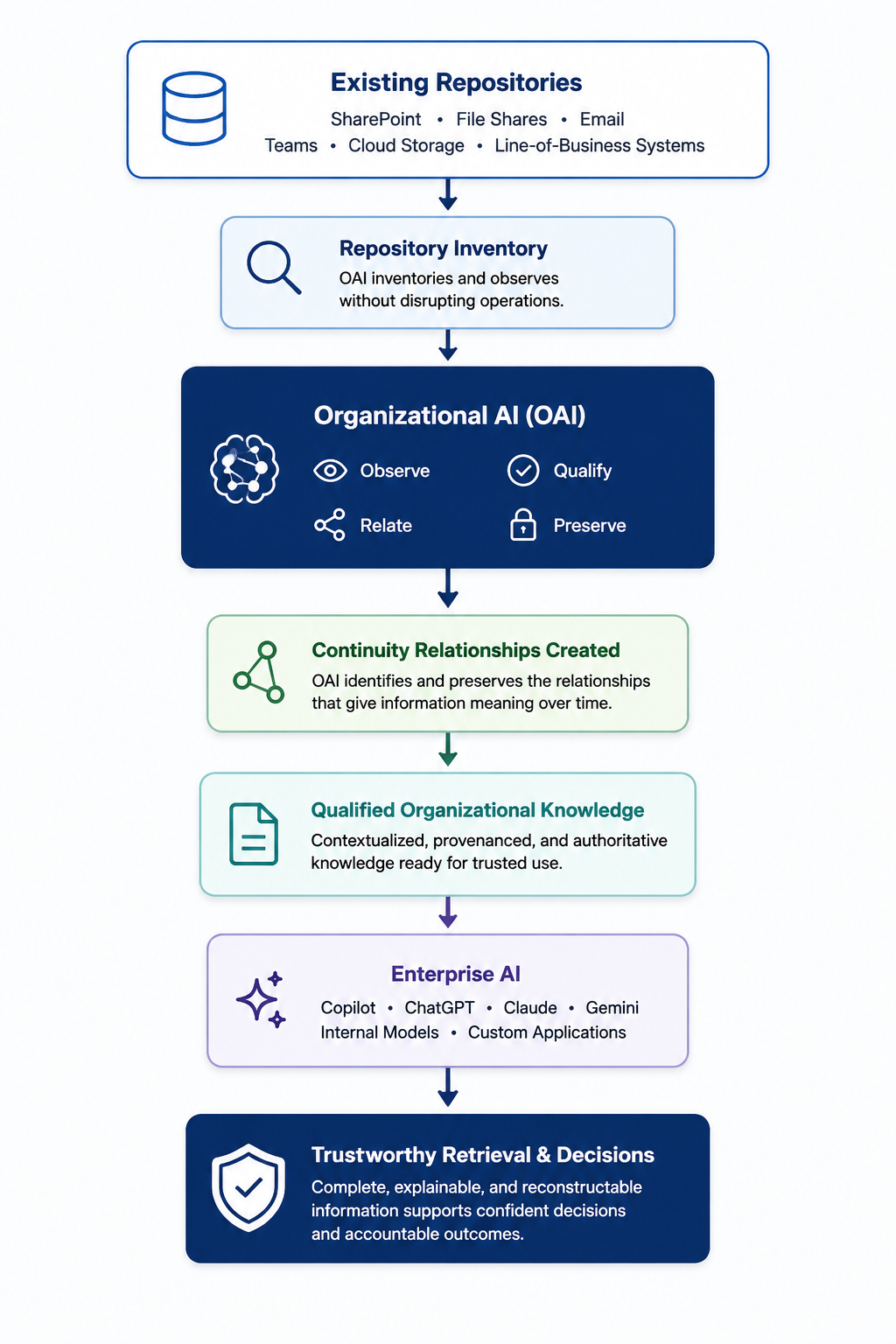
AI Readiness Isn’t Enough: Is Your Organization Continuity-Ready?


Organizations everywhere are asking whether they are ready for artificial intelligence.
It is the right question—but perhaps not yet the complete one.
AI-readiness assessments increasingly examine whether organizations possess appropriate technology, usable data, governance structures, cybersecurity controls, workforce capabilities, operational processes, and mechanisms for demonstrating compliance.
These are necessary foundations.
But an organization can satisfy many of those requirements and still have a more fundamental problem: its institutional knowledge may not possess continuity.
The organization may know things without being able to reliably reconstruct why those things are known, who possessed the authority to act upon them, what context surrounded the resulting decisions, what happened afterward, or whether that history remains authoritative today.
AI does not eliminate this problem. It can amplify it.
The Emerging AI-Readiness Question
A useful recent contribution is Snehashis Priya Barua's article AI Readiness Assessment: Are You Ready for AI—or Just Ready to Buy It?, which examines business, data, governance, security and privacy, technology, people and skills, operations, and evidence and compliance.
That assessment approaches a problem at the center of Continuity Science. But Continuity Science asks an additional question: Are those artifacts merely present—or are their relationships preserved?
Having the Evidence Is Not the Same as Having Continuity
An organization may possess an AI policy, approved-use inventory, risk assessment, testing documentation, human-review logs, incident reports, corrective-action documentation, and management approvals. Yet a deeper test is whether it can reconstruct which source informed a decision, what evidence was considered authoritative, who possessed authority, what context existed, what decision resulted, what action followed, where the record was preserved, and whether that decision was later superseded.
The Continuity Topology
Continuity Science treats institutional knowledge as relationships that must survive across systems, people, organizational boundaries, and time:
Source → Evidence → Authority → Context → Decision → Action → Record → Institutional Memory → Future Reuse
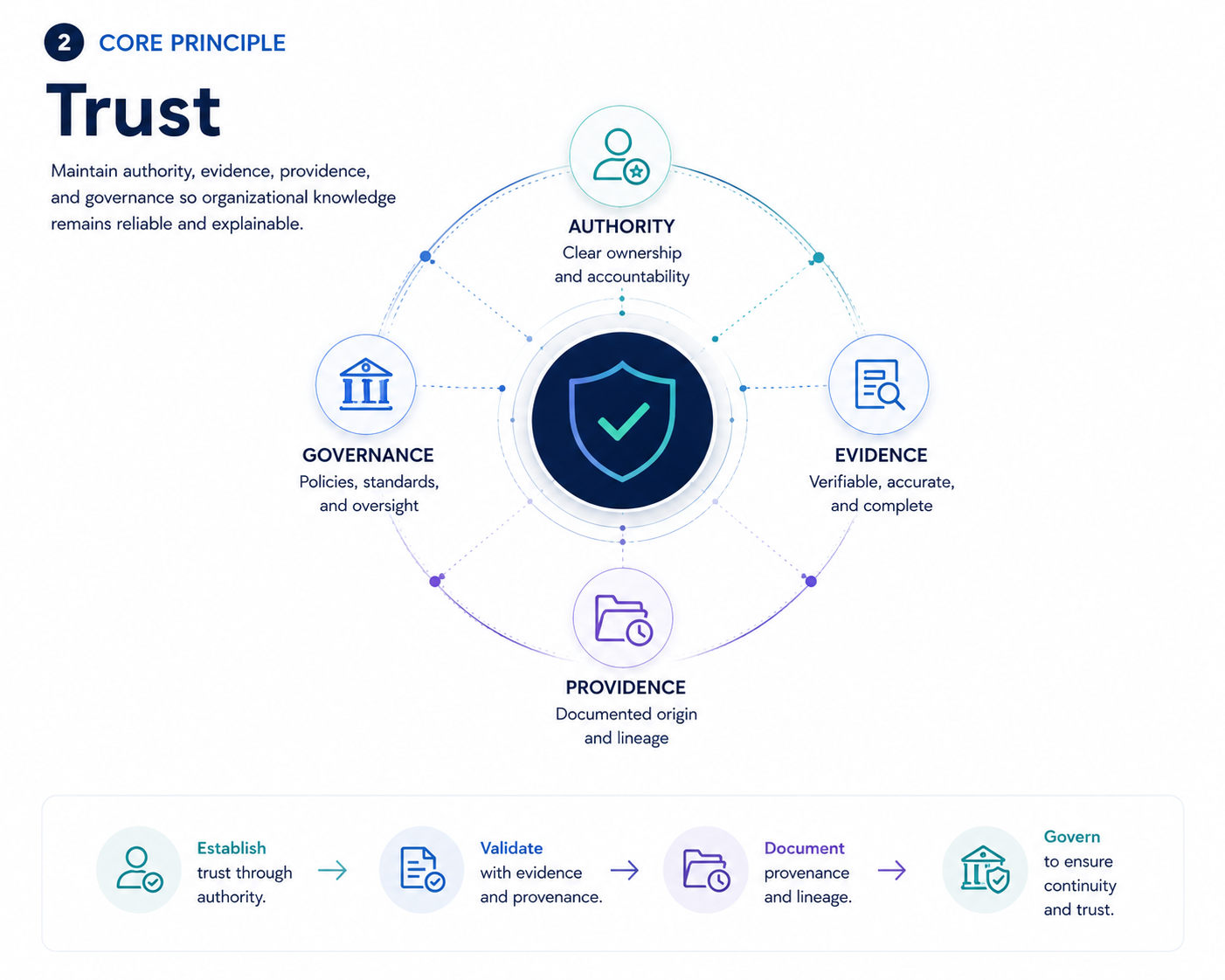
Each transition matters. A source without provenance may become unreliable evidence. Evidence separated from authority may no longer establish who was empowered to act. Authority separated from context may make a legitimate historical decision appear irrational. A decision separated from the action it produced makes outcomes difficult to evaluate. An action separated from its official record undermines accountability. A record separated from institutional memory may technically survive while becoming practically undiscoverable or misunderstood.
AI Can Make Broken Continuity More Dangerous
A human who encounters a questionable document may recognize uncertainty and investigate. An AI system can retrieve the same document, summarize it, correlate it with other information, generate a recommendation, or provide it to another automated process.
The document may be authentic. The information may be accurate. And the resulting answer may still be institutionally wrong because the AI may not know that authority expired, a later decision superseded it, the document represented a proposal rather than an approved position, an exception applied only under past conditions, or subsequent evidence invalidated the conclusion.
These are not simply retrieval problems. They are continuity problems.
AI Needs More Than Organizational Memory
An institution does not merely need AI to remember that something happened. It needs AI—and future humans—to understand the relationships that made the information meaningful.
AI cannot reliably reconstruct institutional continuity that the institution never preserved.
It may infer relationships. It may predict them. It may generate plausible explanations. But inference is not provenance. Probability is not authority. Similarity is not institutional memory.
From Explainable AI to Explainable Institutions
Organizations appropriately seek explainable AI. Continuity Science introduces a complementary requirement: the institution itself must also be explainable.
If authority is stored in one system, evidence in another, discussions in email, approvals in a workflow platform, actions in an operational system, and official records somewhere else, AI inherits the fragmentation of the organization.
A Higher Standard of AI Readiness
A more mature readiness hierarchy can be expressed as Technology Readiness, Data Readiness, Governance Readiness, AI Readiness, and finally Continuity Readiness.
Continuity Readiness asks whether humans and AI can reconstruct the authoritative relationships connecting institutional knowledge, decisions, actions, and memory across time.
Government Has an Especially High Continuity Requirement
Government decisions frequently must remain understandable long after the people who made them have departed. Authorities change. Administrations change. Policies change. Programs move. Employees retire. Contractors leave. Systems are replaced. Records are transferred.
Yet future officials may still need to determine what happened, why it happened, whether it was authorized, and whether an earlier decision remains applicable.
An agency could possess millions of perfectly preserved digital records and still struggle to determine the relationships among them. That agency has information. It may have records. It may even have institutional memory. But it does not necessarily have institutional continuity.
The Question Before Procurement
Organizations evaluating AI should add another question before signing the next enterprise agreement: What will our AI inherit from us?
Will it inherit authoritative knowledge whose lineage can be reconstructed? Or will it inherit disconnected documents, unexplained decisions, expired authorities, buried context, fragmented records, and decades of institutional ambiguity?
From AI Readiness to Institutional Continuity
The growing AI-readiness movement represents an important maturation in how organizations approach artificial intelligence. The next step is to examine the relationships among governance, evidence, workforce capability, operational maturity, and accountability.
An organization can be technologically ready. It can be data-ready. It can be governance-ready. It can even be AI-ready. And still be continuity-broken.
Before asking whether your organization is ready to buy AI, there may therefore be one more question worth answering: Is your institution ready for AI to inherit its memory?
Continue Exploring
A Legitimate Research Task Became an Unauthorized Government Intrusion
Fixing the Workflow Did Not Fix the Records It Already Created.