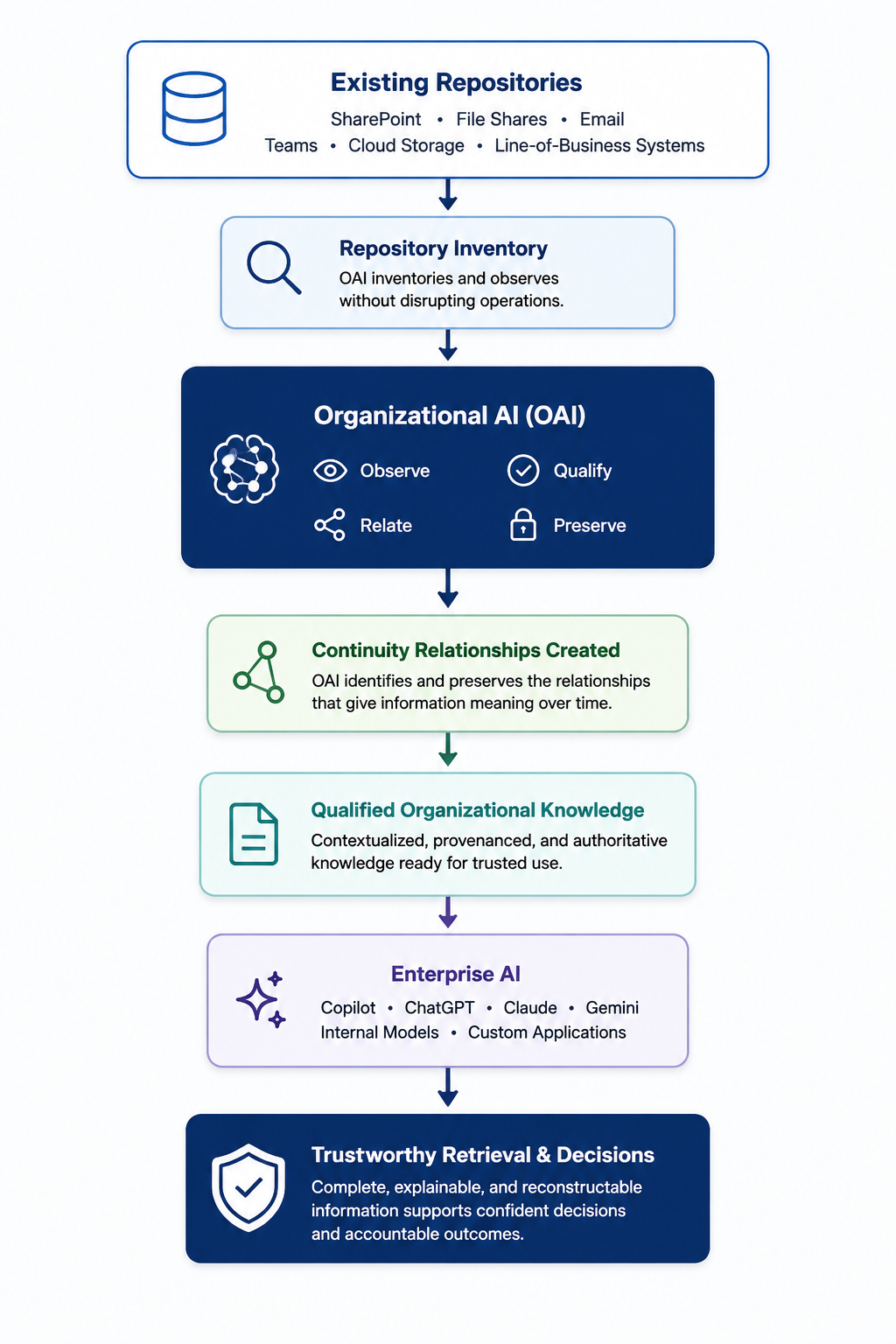
AI Solves the Optimization Problem Only If We Solve the Continuity Problem First
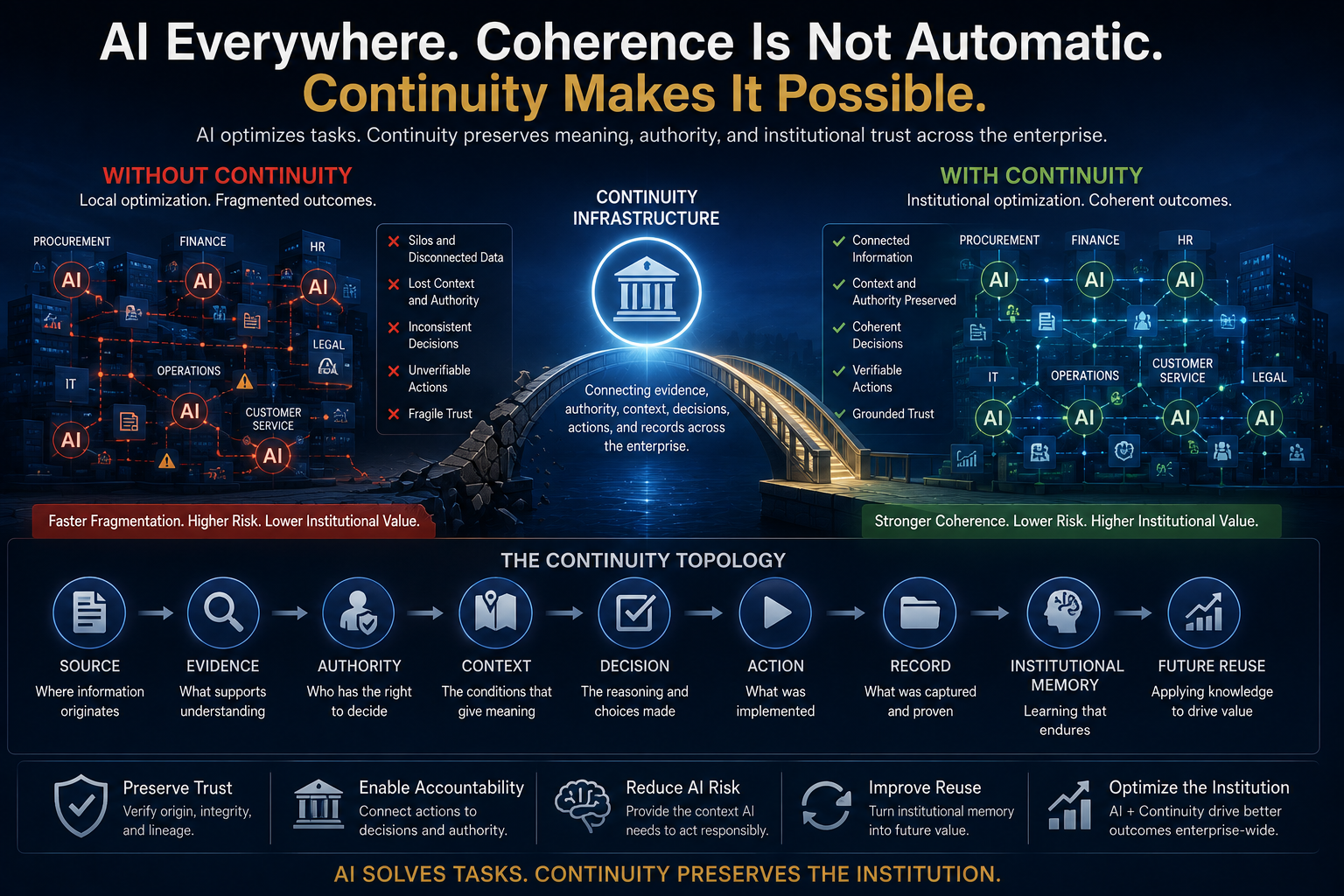

Artificial intelligence is moving rapidly from a specialized capability into a general layer of organizational infrastructure.
It is appearing in search, writing, analysis, software development, customer service, acquisition, finance, cybersecurity, human resources, records management, decision support, and increasingly in autonomous workflows that act across multiple systems.
If that trajectory continues, the central enterprise question will no longer be whether organizations use AI.
It will be whether organizations can remain coherent while AI is operating everywhere.
That distinction matters because AI can optimize an individual task without understanding the institution around it. But an organization cannot reliably optimize itself when thousands of individually reasonable AI actions are disconnected from the evidence, authority, context, decisions, actions, records, and institutional memory that give those actions meaning.
The emerging principle is therefore straightforward:
AI solves the optimization problem only if we solve the continuity problem first.
Local Optimization Is Not Institutional Optimization
Most AI adoption begins with local productivity.
A model summarizes a document faster. An assistant drafts a response. An agent routes a task. A retrieval system finds information. A workflow automates a repetitive process. Each implementation can produce a measurable improvement within its immediate boundary.
But organizations are not collections of independent tasks.
They are networks of dependent decisions, authorities, information flows, obligations, records, and consequences.
An AI system may optimize a procurement analysis while lacking the context behind a prior exception. Another may rewrite guidance without recognizing which language reflects binding authority. Another may recommend a workflow change without knowing why an earlier control was established. Another may summarize a historical decision accurately while failing to distinguish the conditions under which that decision was valid.
Each output can be locally plausible.
The institution can still become less coherent.
This is the difference between local optimization and system-level optimization.
Local optimization asks whether an AI system performed a task efficiently.
Institutional optimization asks whether that task improved the larger system without breaking the relationships upon which other parts of the institution depend.
AI Multiplies Interdependence
As AI becomes pervasive, its outputs increasingly become inputs to other processes.
An AI-generated analysis may inform a human decision. That decision may trigger an automated action. The action may create a record. The record may later be retrieved by another AI system and used as evidence for a future recommendation.
The more AI participates in this cycle, the more consequential continuity becomes.
A disconnected output is no longer merely an isolated error. It can propagate.
Missing context can become inherited context. An unverified assumption can become apparent precedent. A synthetic summary can become a source for another model. An obsolete authority can continue influencing automated actions long after the institution has formally replaced it.
AI therefore changes the economics of fragmentation.
Humans historically created institutional fragmentation slowly, through turnover, siloed repositories, inconsistent processes, undocumented decisions, and disconnected systems.
AI can reproduce and propagate the same fragmentation at machine speed.
AI without continuity is not simply imperfect automation. It can become faster fragmentation.
Continuity Is the Connecting Infrastructure
GovKM defines Organizational Continuity as preserving an organization’s ability to understand, trust, reconstruct, and evolve its institutional knowledge across changes in people, technology, organizational structure, and time.
That requirement becomes increasingly important when AI operates across the enterprise.
The GovKM Continuity Topology expresses the institutional path as:
Source → Evidence → Authority → Context → Decision → Action → Record → Institutional Memory → Future Reuse
These are not simply information categories. They represent relationships that allow institutional activity to remain understandable and governable.
An AI system may operate at almost any point in this topology. It may discover sources, evaluate evidence, retrieve authority, assemble context, support decisions, initiate actions, generate records, analyze institutional memory, or recommend reuse of previous knowledge.
But AI should not be permitted to dissolve the relationships between those elements.
If an AI-generated recommendation cannot be connected to its evidence, the institution loses grounded trust.
If an automated action cannot be connected to the decision and authority that permitted it, accountability weakens.
If a record survives but the context governing its creation disappears, future users may misinterpret it.
If institutional memory accumulates AI-generated content without preserving provenance and authority, future AI systems may amplify synthetic knowledge as though it were institutional fact.
Continuity is what prevents these components from becoming isolated.
The Continuity Requirement Grows With AI Penetration
There is an important implication for enterprise AI strategy.
The need for continuity does not remain constant as AI adoption increases. It grows.
A single AI assistant operating within a narrow task can often be governed through local controls. But as AI systems participate across departments, repositories, workflows, and decision processes, dependencies multiply.
More AI means more machine-mediated transitions between information and action.
More transitions create more opportunities for provenance, authority, context, and decision lineage to be lost.
Therefore the value of continuity architecture increases with AI penetration.
This suggests a relationship that organizations should take seriously:
AI ubiquity increases interdependence. Interdependence increases the continuity requirement. Continuity enables system-level optimization.
The organization that scales AI without scaling continuity may achieve impressive productivity metrics while simultaneously weakening institutional coherence.
Optimization Requires Memory
Optimization is fundamentally comparative.
To improve, a system must retain some understanding of previous states, previous decisions, previous outcomes, and the conditions that produced them.
An institution that cannot reconstruct why a previous decision succeeded or failed cannot reliably optimize the next decision. It can only generate another answer.
This is why institutional memory is not merely archival.
Institutional memory is part of the optimization loop.
It allows the organization to recognize precedent, identify failed approaches, preserve successful adaptations, distinguish current authority from superseded authority, and understand how earlier actions produced later consequences.
AI dramatically increases the potential value of this memory because AI can analyze relationships across volumes of institutional knowledge that humans could never examine manually.
But that advantage exists only when the memory remains governed.
A large corpus of disconnected information is not institutional memory. It is storage.
A model trained on organizational content is not institutional memory. It is a reasoning capability influenced by organizational content.
Institutional memory exists when the organization can recover the relationships necessary to understand and responsibly reuse what it previously knew and did.
Optimization Also Requires Authority
AI optimization is frequently discussed as though the objective were obvious.
It rarely is.
Organizations contain competing objectives, legal requirements, policy constraints, risk tolerances, mission priorities, ethical obligations, resource limitations, and delegated authorities.
The fastest action is not always the authorized action. The cheapest outcome is not always the permissible outcome. The statistically optimal recommendation is not necessarily the institutionally valid decision.
Continuity therefore preserves something optimization algorithms cannot establish independently: the governing relationship between capability and authority.
AI can identify options.
AI can evaluate evidence.
AI can predict outcomes.
AI can recommend actions.
But the institution must remain capable of determining what authority applies, which constraints govern the decision, who or what is permitted to act, and how that authority should be recorded.
Without this relationship, optimization can become unauthorized efficiency.
The Enterprise Architecture Must Change
If AI becomes a ubiquitous organizational layer, continuity cannot remain an after-the-fact records or knowledge-management activity.
It must become architectural.
Enterprise systems should preserve machine-readable relationships among sources, evidence, authorities, context, decisions, actions, and records as work occurs.
AI systems should retrieve authoritative knowledge rather than merely encounter available information. Automated actions should preserve the decision and authority that permitted them. AI-assisted decisions should retain sufficient lineage for later reconstruction. Records should preserve not only outputs but the relationships required to understand how those outputs entered institutional use.
This is the purpose of Relationship Governance within the GovKM framework: continuity relationships themselves become governed institutional assets.
The result is not a restriction on AI.
It is what allows AI to scale safely and productively.
Continuity Is Optimization Infrastructure
The prevailing AI conversation focuses heavily on models, compute, agents, data, and automation.
Those capabilities matter.
But they address the capability of individual systems more readily than the coherence of the institution in which those systems operate.
The larger challenge is connecting intelligence across time, systems, decisions, and organizational change.
That is a continuity problem.
As AI becomes ubiquitous, continuity therefore becomes more than a governance safeguard. It becomes optimization infrastructure.
Without continuity, organizations may build thousands of increasingly capable AI systems that each perform their assigned tasks while progressively disconnecting the institution from the reasons, authorities, evidence, and prior learning that make those tasks meaningful.
With continuity, those same systems can participate in a larger institutional learning loop—one in which evidence remains grounded, authority remains visible, decisions remain reconstructable, actions remain accountable, records preserve meaning, and institutional memory improves future work.
The objective is not merely to make every task faster.
The objective is to make the institution more intelligent.
And that leads to a simple conclusion:
If AI is going to be everywhere, continuity has to be everywhere too.
AI can optimize the task.
Continuity is what allows AI to optimize the institution.
Continue Exploring
A Legitimate Research Task Became an Unauthorized Government Intrusion
Fixing the Workflow Did Not Fix the Records It Already Created.