Blockchain Can Prove What Existed. Can It Preserve What It Meant?
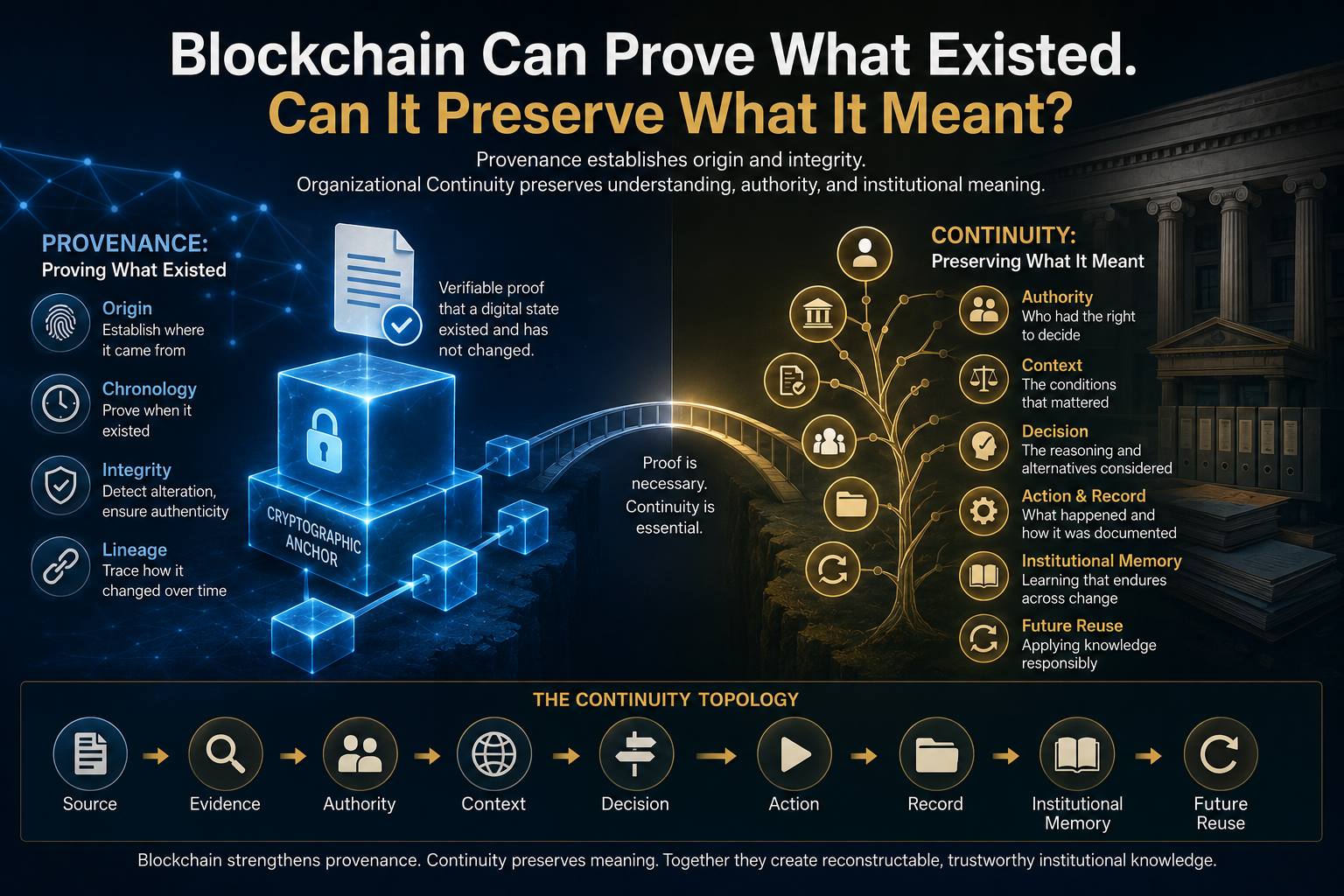

Blockchain can prove something important: that a particular digital object, statement, or state existed at a particular point in time and has not silently changed since it was anchored.
For organizations increasingly concerned with artificial intelligence, synthetic content, provenance, and institutional trust, that capability matters. It can strengthen evidence of origin, chronology, integrity, and lineage in ways that ordinary repositories often cannot.
But an institutional question remains.
If we can prove what existed, can we also preserve what it meant?
That distinction reaches beyond blockchain. It goes to the heart of Organizational Continuity.
Provenance Is Becoming an Architectural Requirement
As AI systems generate, transform, summarize, and recombine information, organizations face a growing provenance problem. Future users may need to distinguish an original source from a later representation, identify when a doctrine or policy first appeared, establish whether an artifact changed, and determine which version existed when a decision was made.
Traditional content systems can preserve versions and timestamps, but those controls are often repository-specific and dependent on the continued integrity of the system that maintains them. Cryptographic anchoring offers another layer: evidence that a defined digital state can be checked against an independently preserved fingerprint.
This is a valuable continuity capability.
It is also incomplete by itself.
An Immutable Artifact Can Still Lose Its Institutional Meaning
Imagine that an organization cryptographically anchors a policy on the day it is approved. Years later, the organization can demonstrate that the retained policy matches the anchored version exactly.
That proves something consequential about integrity.
But future personnel may still need answers to different questions. What evidence led to the policy? Who possessed authority to approve it? What legal or operational context governed the decision? Which alternatives were considered? What action followed? Was the policy later superseded? Which record documented the outcome? How should the old policy be interpreted under current conditions?
The artifact may be immutable while these relationships disappear.
When that happens, the organization has preserved the object but not necessarily the institutional knowledge surrounding it.
Source and Integrity Are Only Part of the Continuity Path
GovKM represents institutional continuity through a topology:
Source → Evidence → Authority → Context → Decision → Action → Record → Institutional Memory → Future Reuse
Blockchain or another cryptographic provenance mechanism can contribute strongly to several points in this topology. It can help anchor a source, preserve evidence that a record existed, establish chronology, detect alteration, and support later verification.
But the topology deliberately extends beyond provenance.
An institution must also preserve the relationships that establish why information was institutionally significant and how it moved into organizational action.
A timestamp cannot by itself establish authority. A hash cannot explain context. An immutable document cannot automatically reveal the evidence considered in a decision. Proof that an artifact existed does not establish that its authority remains current. And permanent preservation does not guarantee responsible future reuse.
Those are relationship problems.
The Difference Between Provenance and Continuity
Provenance asks where something came from and how its lineage can be established.
Continuity asks whether the institution can still understand, trust, reconstruct, and responsibly reuse what it knows after people, systems, structures, and circumstances have changed.
The two are complementary.
Strong provenance improves continuity because an organization cannot reliably reconstruct institutional knowledge if it cannot establish origin or integrity. But provenance becomes more powerful when it remains connected to evidence, authority, context, decisions, actions, and records.
That is the difference between preserving a trustworthy artifact and preserving a trustworthy institutional path.
A Positive Signal: Architecture Is Moving Toward Provenance
Recent AI-era architectures are beginning to treat provenance as something that must be designed into the system rather than added after the fact.
One example observed by GovKM is Cognitive Fusion, whose public-facing material presents a Genesis construct for its intellectual architecture and describes doctrine and terminology as blockchain-anchored. Based on the material reviewed, the important observation is not whether its architecture is equivalent to GovKM's. It is that another independently presented architecture appears to recognize chronology, provenance, doctrine, and durable origin as first-class design concerns.
That convergence is significant.
Organizations are beginning to confront a problem that conventional AI governance language does not always capture: as machine-generated knowledge becomes easier to create, the ability to establish where institutional knowledge came from, which state was authoritative, and how it changed becomes increasingly important.
Cryptographic provenance is one response to that problem.
Organizational Continuity extends the question further.
From Immutable Evidence to Reconstructable Knowledge
The objective should not be to put every organizational artifact on a blockchain. Nor should blockchain be treated as a substitute for records management, governance, metadata, knowledge management, or institutional authority.
The more useful architectural question is where independently verifiable provenance strengthens continuity.
For a consequential institutional decision, an organization might preserve a cryptographic reference to the evidence package, the authoritative policy state, the approved decision, and the resulting record. Those anchors could strengthen later verification.
But the organization would still need to preserve the governed relationships among those objects.
The hash helps establish that the evidence has not changed. Governance establishes whether that evidence was sufficient. Authority establishes who could decide. Context explains the conditions under which the decision was valid. Records preserve durable evidence of the action. Institutional memory carries the learning forward. Future reuse requires determining whether the old knowledge remains applicable.
Together, these properties create something stronger than immutability.
They create reconstructability.
Why This Matters for AI
AI makes this distinction urgent because AI systems are exceptionally capable of finding and recombining information while being unable, without appropriate architecture, to guarantee that the institutional relationships surrounding that information remain intact.
An AI system may retrieve an authentic, cryptographically verified policy and still misuse it if the policy has been superseded. It may identify an unchanged decision record without understanding the authority boundary that governed the original decision. It may reproduce a historically accurate conclusion in a context where that conclusion is no longer valid.
Trustworthy AI therefore requires more than proof that its source material is authentic.
It requires enough continuity for the system and its human users to determine what the material means now.
Blockchain Can Strengthen Continuity Without Becoming Continuity
The emergence of blockchain-anchored provenance should be viewed as a positive development for institutional knowledge architecture. It recognizes that origin, chronology, and integrity cannot always be left implicit.
But no provenance technology, by itself, can preserve the complete institutional meaning of the information it anchors.
That meaning exists in relationships.
GovKM's position is therefore not that blockchain is insufficient and should be replaced. It is that provenance technologies become more valuable when incorporated into a broader continuity architecture.
Organizations need to know not only that an artifact existed and remained unchanged, but also what evidence supported it, what authority governed it, what context made it meaningful, what decision depended upon it, what action followed, what record resulted, and how that knowledge should influence future work.
Blockchain can help prove what existed.
Organizational Continuity asks whether the institution can still explain what it meant.
Continue Exploring
A Legitimate Research Task Became an Unauthorized Government Intrusion
Fixing the Workflow Did Not Fix the Records It Already Created.