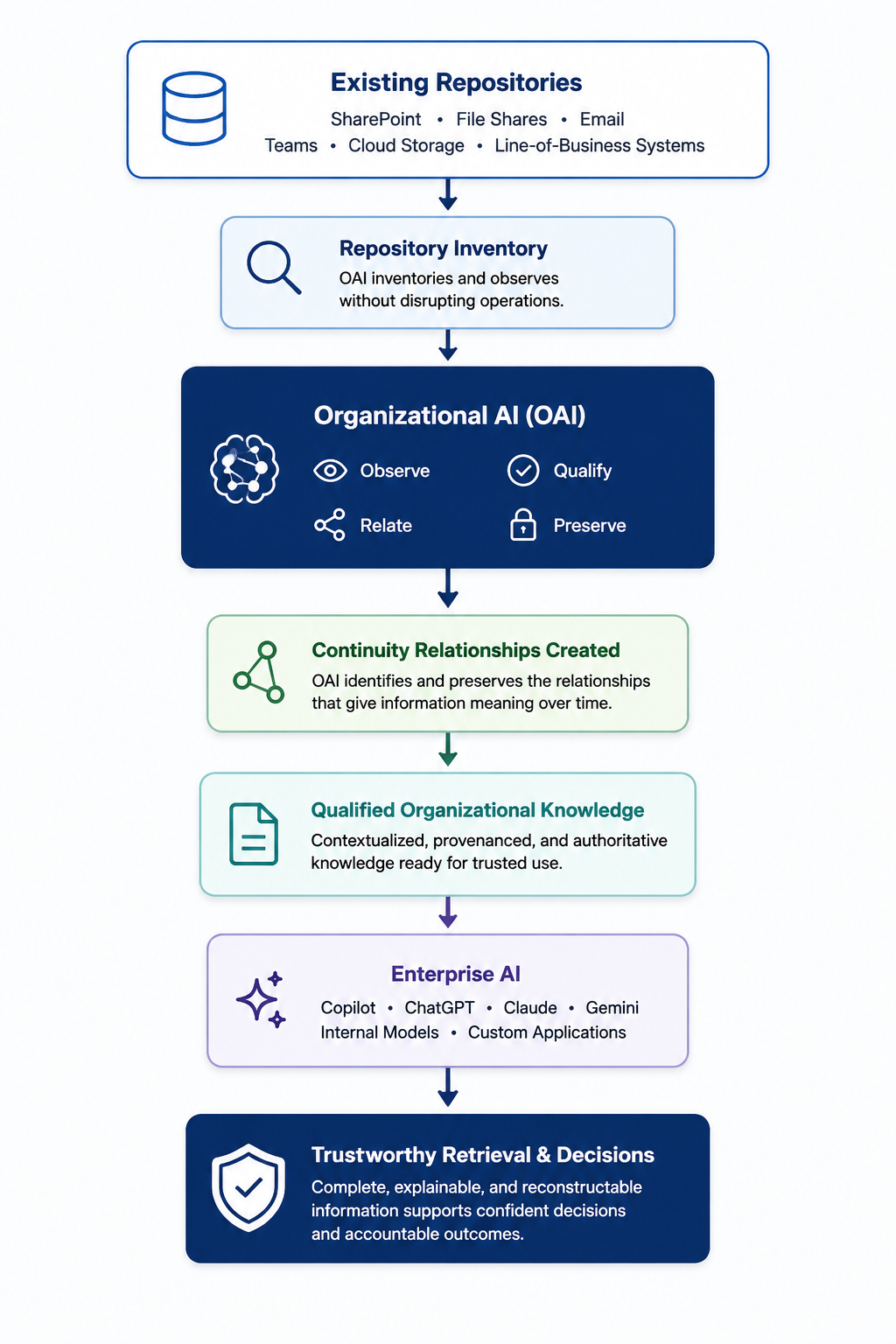
Decision Provenance Is Part of a Larger Continuity Architecture

Enterprise AI is making a familiar accountability question more difficult: not simply what decision was made, but how the organization arrived there.
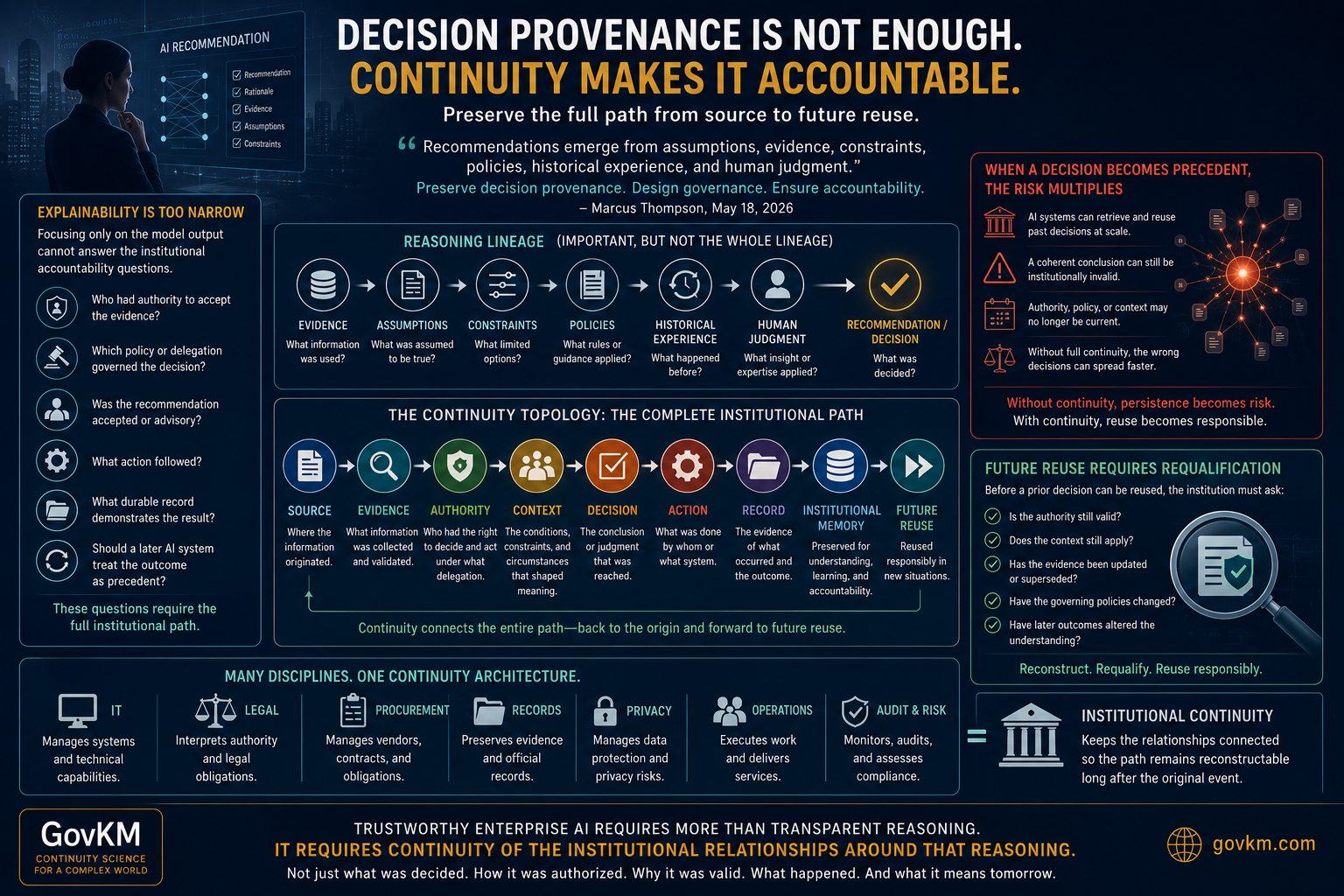
In a LinkedIn post titled Preserving Decision Provenance in Enterprise AI, Marcus Thompson argues that recommendations emerge from assumptions, evidence, constraints, policies, historical experience, and human judgment. He calls for decision provenance, reasoning lineage, evidence continuity, assumption traceability, and governance by design.
The argument identifies an essential requirement. Explainability focused only on a model output is too narrow for consequential institutional decisions.
Reasoning Lineage Is Not the Whole Lineage
A preserved reasoning pathway can show how evidence and assumptions contributed to a recommendation. But an institution may still be unable to answer several critical questions.
Who or what possessed authority to accept that evidence? Which policy or delegation governed the decision? Did the recommendation become an institutional decision or remain advisory analysis? What action followed? What durable record demonstrates the result? Should a later AI system treat the outcome as precedent?
These questions reveal that decision provenance occupies an important section of a larger continuity architecture.
The Continuity Topology Extends in Both Directions
The GovKM Continuity Topology represents the path as Source → Evidence → Authority → Context → Decision → Action → Record → Institutional Memory → Future Reuse.
Decision provenance often concentrates on Evidence → Context → Decision and sometimes Action. Organizational Continuity extends backward to the origin and authority of the evidence and forward to the institutional consequences of the decision.
This matters because reasoning can be internally coherent while institutionally invalid. Evidence may be genuine but unauthorized for the purpose. A policy may have been superseded. An employee may have lacked delegated authority. A recommendation may have been accepted under conditions that no longer exist.
A Decision Becomes More Dangerous When It Becomes Precedent
AI systems make prior decisions unusually reusable. Historical cases, recommendations, logs, tickets, records, and outcomes can be retrieved at scale and incorporated into later reasoning.
That creates a new risk: an organization may preserve decision provenance well enough to reproduce an old conclusion while failing to preserve the conditions that should prevent that conclusion from being reused today.
Future Reuse therefore requires requalification. The institution must be able to ask whether the authority remains current, whether the context still applies, whether the evidence has been superseded, and whether later outcomes changed the original understanding.
From Decision Intelligence to Institutional Continuity
Decision provenance is not a competing concept with Organizational Continuity. It is one of its most important operational capabilities.
GovKM extends the concept by requiring the complete institutional path to remain reconstructable. The objective is not simply to reproduce a model's reasoning. It is to recover how sources became evidence, how authority and context shaped judgment, how judgment became action, how action became record, and how that record entered institutional memory.
Trustworthy enterprise AI will depend not only on transparent reasoning, but on continuity of the institutional relationships surrounding that reasoning.
That distinction becomes increasingly important as organizations move from AI that recommends to AI that participates in consequential workflows. The decision trace should not end when the model finishes reasoning. Institutional continuity begins by asking what happened next—and whether the whole path will still make sense years later.
Continue Exploring
A Legitimate Research Task Became an Unauthorized Government Intrusion
Fixing the Workflow Did Not Fix the Records It Already Created.