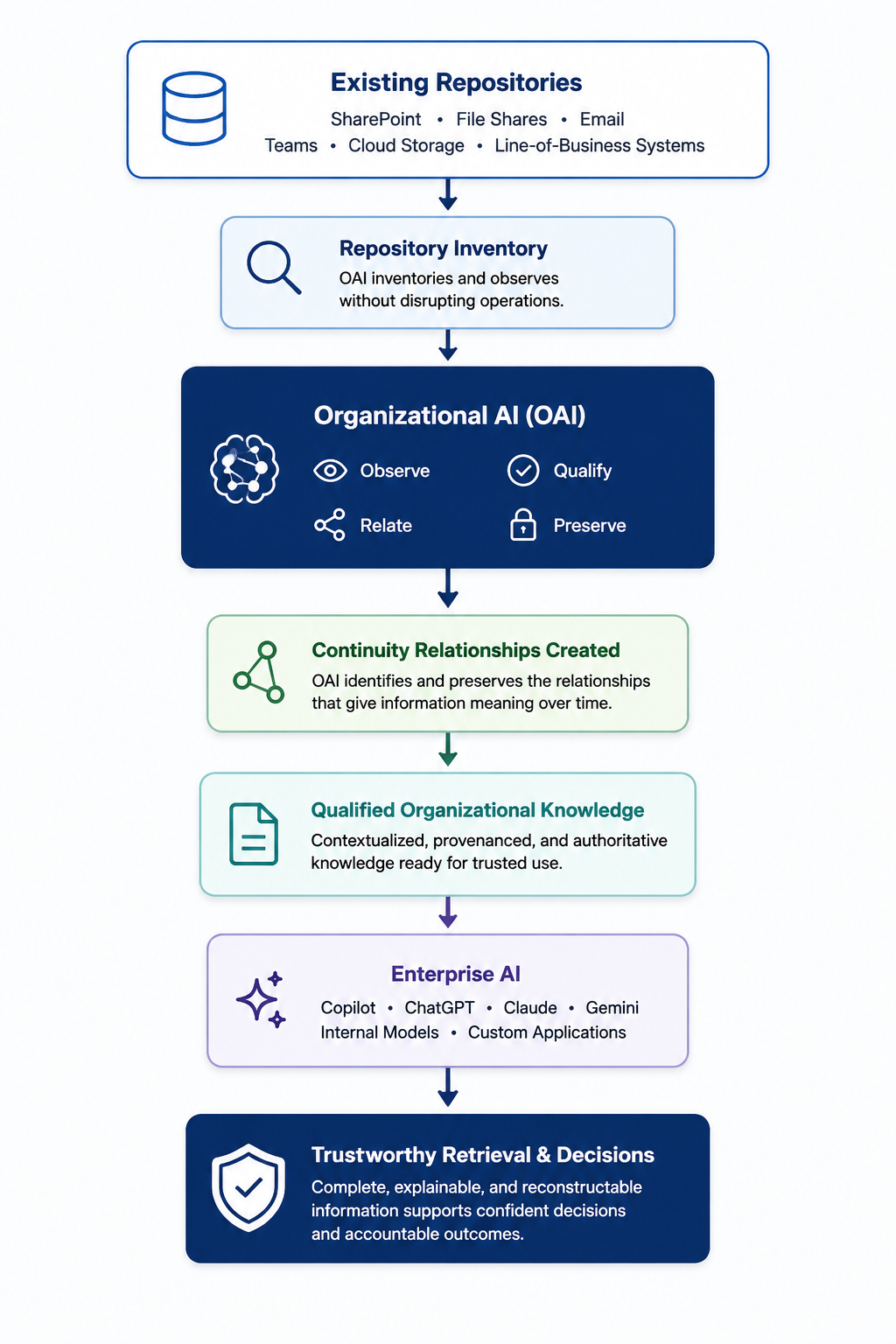
Enterprise AI Memory Is Not Institutional Continuity
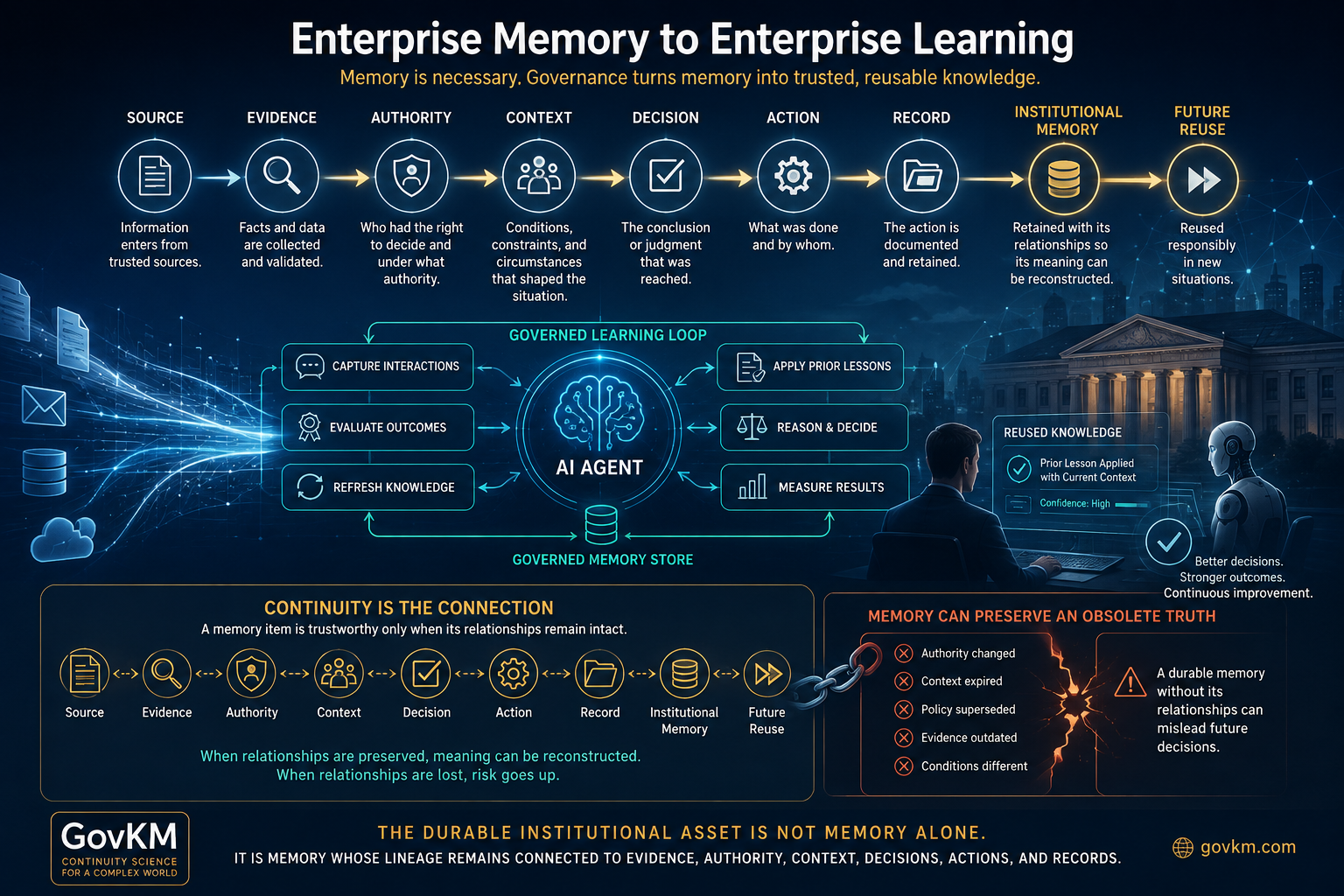

Enterprise AI is rapidly acquiring memory. Agents can retain prior interactions, retrieve organizational knowledge, preserve working context, and use earlier outcomes to influence later work. That capability is often described as the foundation for systems that learn over time.
Gaurav Agarwaal makes an important distinction in his July 8, 2026 LinkedIn article, Enterprise Memory to Enterprise Learning: memory is necessary, but it is not sufficient. He argues that organizations need a governed learning architecture that captures interactions, evaluates outcomes, refreshes enterprise knowledge, and improves subsequent reasoning. That is a meaningful advance over treating memory as a larger vector store.
Learning Creates a New Governance Problem
The moment an organization allows prior AI interactions to influence future reasoning, memory becomes more than storage. It begins to function as institutional precedent. A prior conclusion, correction, exception, or successful action can shape what an agent recommends next.
That creates a deeper question: what must remain attached to a learned item for the institution to rely on it later?
A lesson may have been valid because of a particular source, evidentiary record, policy, delegated authority, operating condition, customer circumstance, regulatory environment, or human judgment. If the lesson survives while those relationships disappear, the organization has preserved the conclusion while losing the basis that made the conclusion valid.
Viewed Through Organizational Continuity
Viewed through Organizational Continuity, enterprise learning spans the entire Continuity Topology: Source → Evidence → Authority → Context → Decision → Action → Record → Institutional Memory → Future Reuse.
Memory sits near the end of that path, not at the beginning. Institutional Memory becomes trustworthy when the relationships leading into it remain recoverable. Future Reuse becomes responsible when the institution can requalify the remembered knowledge against current evidence, authority, context, and purpose.
This is why even a governed learning loop can accumulate continuity debt. The system may know that an outcome was previously judged successful without retaining who possessed authority, which evidence was considered, what constraints applied, what action actually occurred, or whether the governing conditions have since changed.
Memory Can Preserve an Obsolete Truth
AI makes this risk operational. Human employees often compensate for missing relationships through experience: they remember that a procedure changed, recognize an obsolete policy, or know that an exception applied only to one customer. An AI system may instead encounter a durable memory object and treat persistence as evidence of continuing validity.
The problem is not merely whether memory is accurate. The problem is whether its institutional relationships remain current and reconstructable.
A mature enterprise-learning architecture therefore needs mechanisms for supersession, authority changes, temporal validity, provenance, correction, and challenge. It must preserve not only what the organization learned, but why that learning was accepted and when it should stop governing future behavior.
From Enterprise Learning to Institutional Continuity
GovKM extends the enterprise-learning argument by treating memory as one element in a larger continuity architecture. Persistent memory solves persistence. Governed learning improves selection and reuse. Institutional Continuity preserves the relationships that allow future personnel and AI systems to determine what a remembered item means, why it was trusted, what resulted from it, and whether it remains fit for reuse.
The durable institutional asset is not memory alone. It is memory whose lineage remains connected to evidence, authority, context, decisions, actions, and records.
As enterprises build self-learning agents, that distinction will become increasingly important. The organizations that learn fastest will not necessarily be the organizations that learn most safely. The stronger architecture will be the one that can continuously distinguish reusable institutional knowledge from conclusions whose governing conditions have expired.
Continue Exploring
A Legitimate Research Task Became an Unauthorized Government Intrusion
Fixing the Workflow Did Not Fix the Records It Already Created.