Government Information Management Is Not Optional. AI Readiness Demands a Compliant Architecture.


Compliance Is the Minimum. AI Readiness Is the Competitive Imperative.
Federal agencies are free to select different technologies and information architectures. They are not free to disregard the laws, regulations, and binding policies governing their information.
An alternative architecture that cannot demonstrate compliance with applicable federal requirements is not an acceptable substitute merely because it is familiar, widely deployed, or supported by a major technology vendor.
Where an architecture fails applicable compliance requirements, it is substandard for the government's purposes and exposes the organization to avoidable legal, operational, security, and institutional risks.
The same principle applies to information continuity.
An agency may maintain technically approved repositories while failing to preserve sufficient evidence of decisions, identify authoritative information, or maintain effective information-governance controls.
Those deficiencies must be evaluated against the agency's actual obligations. They cannot be dismissed simply because the underlying technology is functioning as designed.
But regulatory compliance is only the minimum threshold.
Artificial intelligence introduces a second imperative: information must be organized and governed so that authorized AI systems can interpret, retrieve, and use it reliably and efficiently.
An architecture may satisfy applicable records-management and security requirements while remaining poorly suited to AI interaction.
That architecture may be compliant, but it is not necessarily AI-ready.
The Cost of Falling Behind
Government agencies are increasingly operating in an environment where information-processing capability influences mission performance.
An organization that cannot efficiently identify authoritative information, reconstruct relevant decisions, or provide reliable context to AI systems may spend more time validating answers, correcting errors, and reconstructing information than an organization with a mature, AI-ready information environment.
The consequences extend beyond administrative inefficiency.
Agencies with poorly prepared information environments risk falling behind more capable peers in service delivery, analytical responsiveness, decision support, and institutional knowledge preservation.
Private organizations face corresponding competitive disadvantages.
For national security and mission-critical government organizations, the implications can be more serious. Information-management deficiencies may impair the speed and reliability of analysis in environments where adversaries are also seeking technological and operational advantages.
This is not a claim that every agency with fragmented information has already suffered a measurable competitive or national-security loss. It is a foreseeable operational risk that agencies should evaluate and mitigate.
An organization whose information cannot support trustworthy AI interaction risks being outperformed by organizations—and potentially adversaries—whose information can.
Alternative Architectures Must Prove Their Adequacy
GovKM does not propose that every agency adopt identical software or repository structures.
It proposes that every architecture be evaluated against the same essential obligations and operational outcomes.
An alternative architecture should be considered acceptable only when the organization can demonstrate that it:
- Satisfies all applicable statutory, regulatory, contractual, and binding policy requirements.
- Preserves required records, provenance, and evidence of government activity.
- Maintains appropriate information security, privacy, and access controls.
- Supports reliable identification of authoritative information.
- Enables efficient, governed retrieval and interpretation for intended AI uses.
- Provides verification evidence and ongoing mechanisms for detecting deficiencies.
The first three requirements establish essential compliance responsibilities. The remaining requirements establish important information-governance and AI-readiness outcomes, subject to the organization's mission and intended uses.
An architecture that fails applicable mandatory requirements requires corrective action.
An architecture that meets those requirements but performs poorly against AI-readiness objectives should be recognized as operationally deficient for AI-dependent missions.
Neither condition should be obscured by successful platform deployment, vendor certification, or the mere availability of AI features.
The Government Standard Should Be Higher Than Technical Functionality
The question for government leaders is no longer whether their agencies possess modern information technology.
It is whether their information environments can demonstrate compliance while supporting the next generation of government operations.
A repository can be operational without being adequately governed.
An information environment can be compliant without being optimized for AI.
An AI system can retrieve documents without establishing that its answers reflect authoritative government information.
These distinctions must inform procurement, modernization, records governance, enterprise architecture, and AI deployment decisions.
GovKM's proposed EICARS methodology provides a technology-independent approach to evaluating and improving these conditions.
Agencies may implement equivalent outcomes through alternative architectures. Those alternatives should be accepted on demonstrated compliance and operational performance—not assumptions.
Riverton: A Fictional Government Example
Consider Riverton, a fictional government organization used to illustrate GovKM's proposed method. Its active work is distributed across shared drives, email, collaboration sites, and mission systems. Experienced employees know where to find the current policy; an AI assistant may instead retrieve a plausible superseded copy. This is an illustrative scenario, not a finding about an actual agency or an executed GovKM test.
Riverton first identifies its applicable authorities, required records, responsible officials, access restrictions, and approved retention schedules. It assesses the existing environment while staff continue current work. In parallel, it prepares a governed environment for active content, communicates the changes and deadlines, and provides a familiarization period.
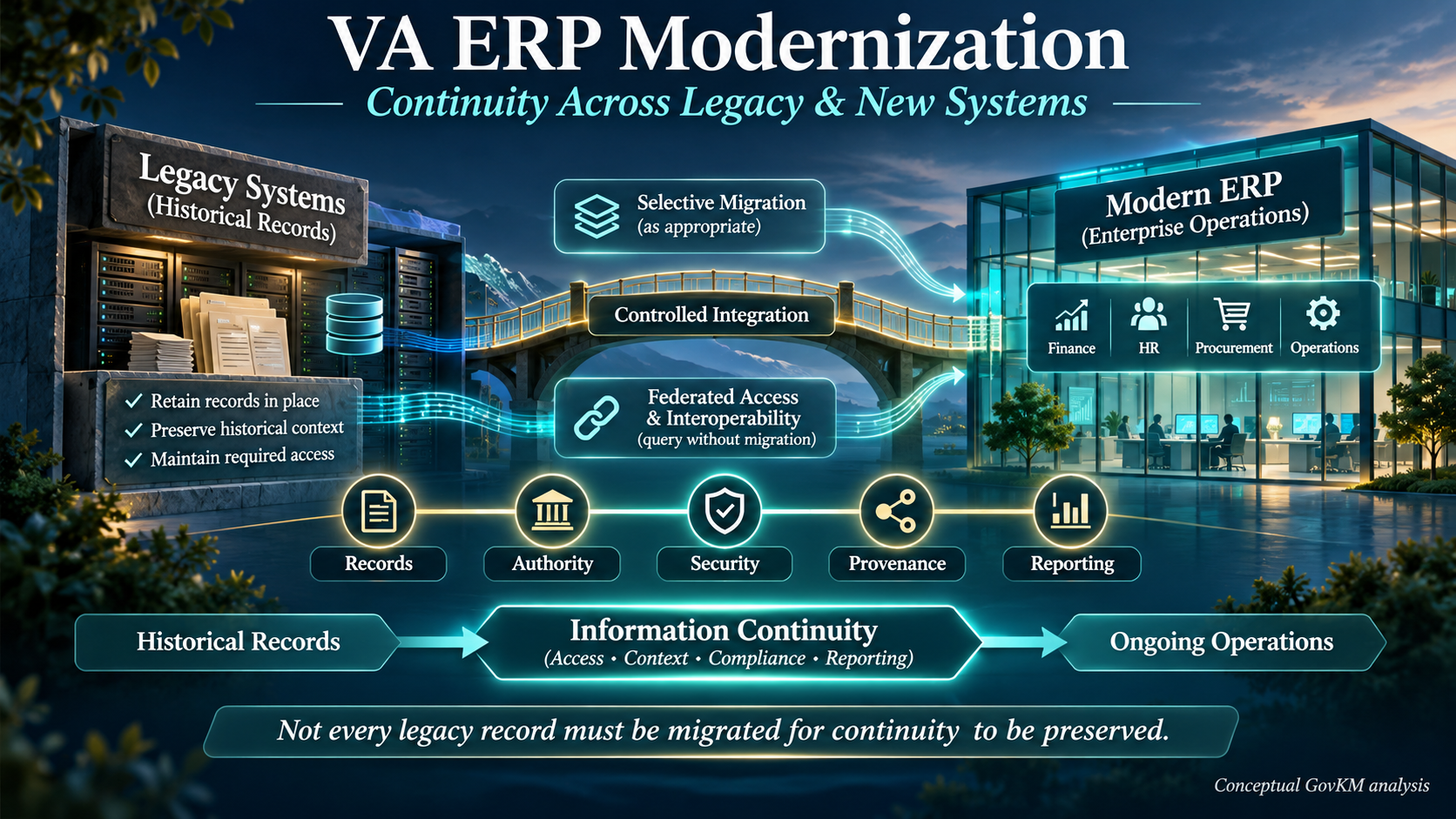
At a planned cutover, staff move only active content into the prepared environment. Required historical records remain protected under their existing retention, access, and preservation obligations; active-content prioritization does not authorize deletion or abandonment of archives. Current policies, their effective dates, approving roles, supporting evidence, and superseded versions are made distinguishable to authorized users and retrieval systems.
Before expanding AI use, Riverton asks an authorized reviewer and its intended AI system to identify the policy governing a dated decision, cite the supporting record, recognize a later amendment, and respect restricted material. It records retrieval accuracy, evidence gaps, correction effort, and response time against a baseline. Improvements must be demonstrated; no savings or performance gains are assumed.
This progression moves Riverton from dependence on individual memory toward shared, governed information and then evaluated AI use. The example describes public implementation outcomes, without disclosing proprietary GovKM mechanisms. It is a proposed approach, not a federally prescribed migration sequence.
The Decision Facing Government
Government information architecture is no longer simply a matter of administrative organization.
It is an element of institutional capability.
Agencies that preserve fragmented, poorly governed information environments may carry those deficiencies into every AI system they deploy.
Agencies that establish verifiable, continuous, AI-ready information environments are better positioned to use their accumulated institutional knowledge efficiently, securely, and reliably.
Compliance is not optional. AI readiness is increasingly a mission requirement. Information continuity is the architectural objective that connects them.
The government should demand evidence that its information architecture meets both its binding obligations and its intended AI-performance requirements.
Anything less leaves avoidable vulnerabilities, inefficiencies, and competitive disadvantages unaddressed.
The question is not whether government can afford to modernize its information architecture.
It is whether government can afford to deploy increasingly capable AI over information environments that remain unprepared to support it.
Official Authorities and the Scope of GovKM's Proposal
Binding obligations depend on applicability. Federal statutes, regulations, and applicable binding policies govern the agencies, records, systems, and activities within their scope. They do not require adoption of EICARS or certify any GovKM implementation. State and local governments must identify their own applicable authorities; federal requirements do not automatically apply to every public institution.
- 44 U.S.C. §§ 3101–3102 — Federal agency records responsibilities. Agency heads must preserve adequate documentation of agency activity and maintain continuing records-management programs. These duties support the article's requirement for evidence of government decisions and effective records controls.
- 36 CFR Part 1236, especially §§ 1236.10–1236.14 and 1236.20 — Electronic records management. Applicable systems require controls for reliability, authenticity, integrity, usability, content, context, and structure, as well as preservation planning and recordkeeping functionality. These are regulatory responsibilities, not a mandate for a particular vendor or GovKM architecture.
- 44 U.S.C. § 3554 — Federal information-security responsibilities. This provision establishes agency responsibilities for information security, including an agency-wide security program, subject to statutory scope. AI retrieval does not remove those responsibilities.
- 5 U.S.C. § 552a — Privacy Act. Its requirements apply to covered federal systems of records and their handling of information about individuals. Applicability and lawful disclosure must be assessed before AI access.
- OMB Memorandum M-25-21 — Accelerating Federal Use of AI through Innovation, Governance, and Public Trust. The memorandum directs covered agencies toward mission-enabling AI with governance and safeguards; its requirements, definitions, and exceptions must be assessed for each use. It does not prescribe EICARS or establish a universal AI-optimized repository design.
GovKM's proposed methodology: EICARS is a vendor-neutral approach for preparing continuous, governed, AI-ready information environments. Its architecture outcomes, Riverton sequence, and competitiveness assessment are GovKM recommendations and analysis. They are not independent legal mandates, a compliance determination, or government endorsement. Private entities may adopt the methodology while mapping their own legal and contractual duties. See GovKM's EICARS overview.
Continue Exploring

Finance Data Governance: Preparing Retail Information for Enterprise AI

Joint Training Knowledge Governance: Preparing Defense Information for AI