How Can Government Knowledge Be Controlled?

Government has spent decades building systems for controlling information.
Records management governs records. Data governance governs data. Cybersecurity governs access and risk. Information governance establishes policies and controls. Knowledge management helps organizations capture, share, and reuse what people know. Technology teams administer the systems where much of that information lives.
Yet institutional knowledge still disappears.
It disappears when experienced personnel leave. It fragments when organizations reorganize. It becomes difficult to trust when systems are replaced. Decisions survive without the evidence that supported them. Records remain after the context that made them meaningful has been lost. Policies are retained even when later users can no longer determine which authority applied, why an exception was made, or whether the conditions surrounding an earlier decision still exist.
This suggests that government may already control many of the individual pieces of institutional knowledge while leaving something more important insufficiently governed: the relationships that make those pieces meaningful together.
Government Already Controls Many Kinds of Information
The problem is not an absence of governance disciplines. Government organizations operate under extensive legal, regulatory, policy, security, records, privacy, data, and technology controls.
Each discipline serves an important purpose. Records management ensures that evidence of government activity is captured and retained for appropriate periods. Cybersecurity protects systems and information from unauthorized access and disruption. Data governance establishes rules for data quality, stewardship, and use. Information governance coordinates policy and accountability for information assets. Knowledge management supports the creation, sharing, and application of organizational knowledge.
But each discipline naturally focuses on a particular object of control.
The record. The dataset. The system. The policy. The repository. The process. The user. The risk.
Institutional knowledge crosses all of them.
The Problem Is That Each Discipline Controls Something Different
A government decision may begin with a source, depend on evidence, require recognized authority, be interpreted within a particular context, result in an action, generate a record, enter institutional memory, and later influence another decision.
No single artifact contains that entire institutional path.
A final memorandum may record the decision but not preserve every source consulted. A database may retain the underlying data without preserving the authority that permitted a particular interpretation. A records repository may retain the official record while losing the operational context that explains why the organization acted as it did. An employee may remember the reasoning, but that memory may leave when the employee does.
The organization therefore can retain all of the individual artifacts and still lose the knowledge that connected them.
Knowledge Depends on Relationships
Information becomes institutional knowledge through relationships.
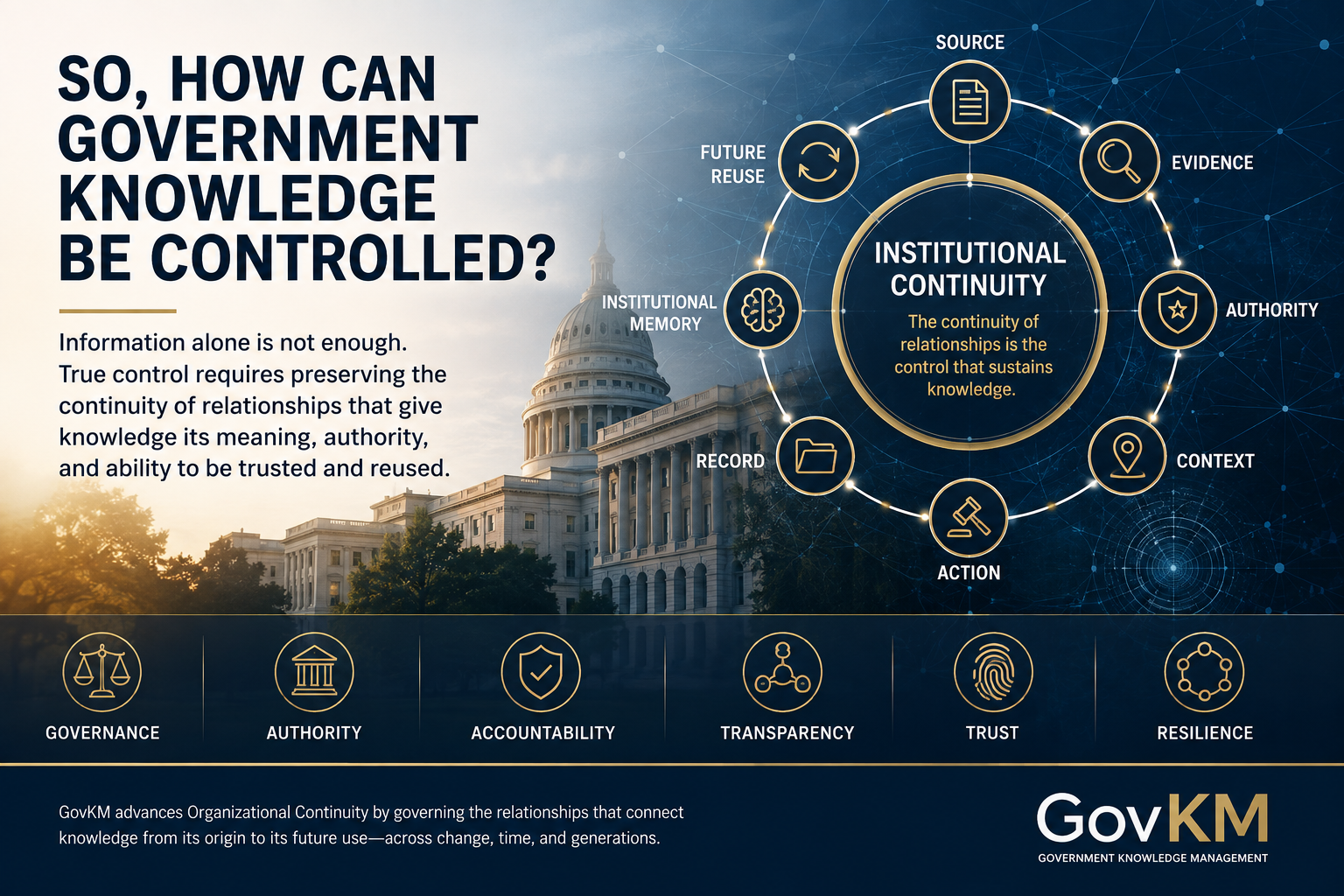
A source establishes origin. Evidence supports or challenges a claim. Authority determines whether an interpretation or action is institutionally valid. Context defines the circumstances in which information should be understood. Decisions convert evidence, authority, and context into institutional judgment. Actions translate decisions into operational effect. Records preserve durable evidence of what occurred. Institutional memory preserves the organization's accumulated understanding. Future reuse applies that preserved knowledge to new analysis, decisions, actions, and learning.
If those relationships disappear, the information may remain while the institution's ability to understand and trust it deteriorates.
An authentic record without context can be misinterpreted. Evidence without authority may not justify action. A decision without its supporting evidence may be impossible to defend or reconstruct. A prior policy reused without understanding whether its authority was superseded can become a source of institutional error.
This is why controlling information is not the same as controlling institutional knowledge.
Control the Continuity, Not Just the Artifact
GovKM approaches this problem through Organizational Continuity: preserving an organization's ability to understand, trust, reconstruct, and evolve its institutional knowledge across changes in people, technology, organizational structure, and time.
The governing object is not merely the document, record, dataset, or repository. It is the continuity of the relationships that allow institutional knowledge to remain meaningful and usable.
This changes the governance question.
Instead of asking only, "Was the record retained?" the organization can also ask: Can the source still be identified? Is the supporting evidence recoverable? Is the authority clear? Does the original context remain intelligible? Can the decision be reconstructed? Can the action be connected to the decision that authorized it? Has the resulting knowledge entered institutional memory in a form that can be responsibly reused?
Those questions expose continuity failures that traditional artifact-centered controls may not reveal.
The Continuity Topology
GovKM represents this institutional path as a Continuity Topology:
Source → Evidence → Authority → Context → Decision → Action → Record → Institutional Memory → Future Reuse
The topology is not intended to imply that every government process occurs as a perfectly linear sequence. Real institutional work branches, loops, revisits earlier assumptions, introduces new evidence, changes authority, and produces multiple records.
The topology instead identifies the relationships that must remain recoverable if institutional activity is to remain understandable over time.
That distinction matters. Continuity does not require freezing an organization in place. It requires preserving enough lineage for later personnel and systems to understand how the organization moved from what it knew to what it decided and did.
Why This Matters More in the Age of AI
Artificial intelligence increases the importance of these relationships because AI can retrieve, combine, summarize, and generate information much faster than organizations can manually validate every connection.
An AI system can locate a policy but may not know that the authority behind it has changed. It can summarize a record without knowing which contextual limitations governed its original use. It can produce a plausible recommendation from incomplete evidence. It can repeat an earlier organizational conclusion without distinguishing a superseded decision from current authority.
The more capable AI becomes at working across institutional information, the more important it becomes to preserve the conditions that allow both humans and machines to determine what should be trusted.
Trustworthy organizational AI therefore depends on more than access to information. It depends on continuity across provenance, evidence, authority, context, decisions, actions, and records.
From Information Governance to Institutional Continuity
Government does not need to abandon records management, information governance, data governance, cybersecurity, knowledge management, or the other disciplines that already protect essential institutional assets.
It needs an architecture that preserves the relationships among them.
That is the role GovKM is exploring through Organizational Continuity and the emerging discipline of Continuity Science.
The central proposition is simple: institutional knowledge survives change only when the relationships required to understand, trust, reconstruct, and reuse that knowledge survive with it.
Government knowledge therefore cannot be controlled solely by controlling where information is stored or which discipline owns a particular artifact. It must also be governed as a connected continuity architecture.
What Comes Next
This article opens a broader GovKM publication series examining what happens when those continuity relationships break—and how organizations can preserve them deliberately.
Upcoming articles will distinguish Institutional Continuity from records management and other adjacent disciplines, examine recurring continuity failures in government and enterprise AI, and explore the Continuity Topology in greater depth.
The question is no longer simply whether government kept the information.
The more important question is whether it preserved enough continuity to understand what that information means, where it came from, who had authority, what evidence informed the decision, what action followed, and whether that knowledge can still be trusted and responsibly reused.
Continue Exploring
A Legitimate Research Task Became an Unauthorized Government Intrusion
Fixing the Workflow Did Not Fix the Records It Already Created.