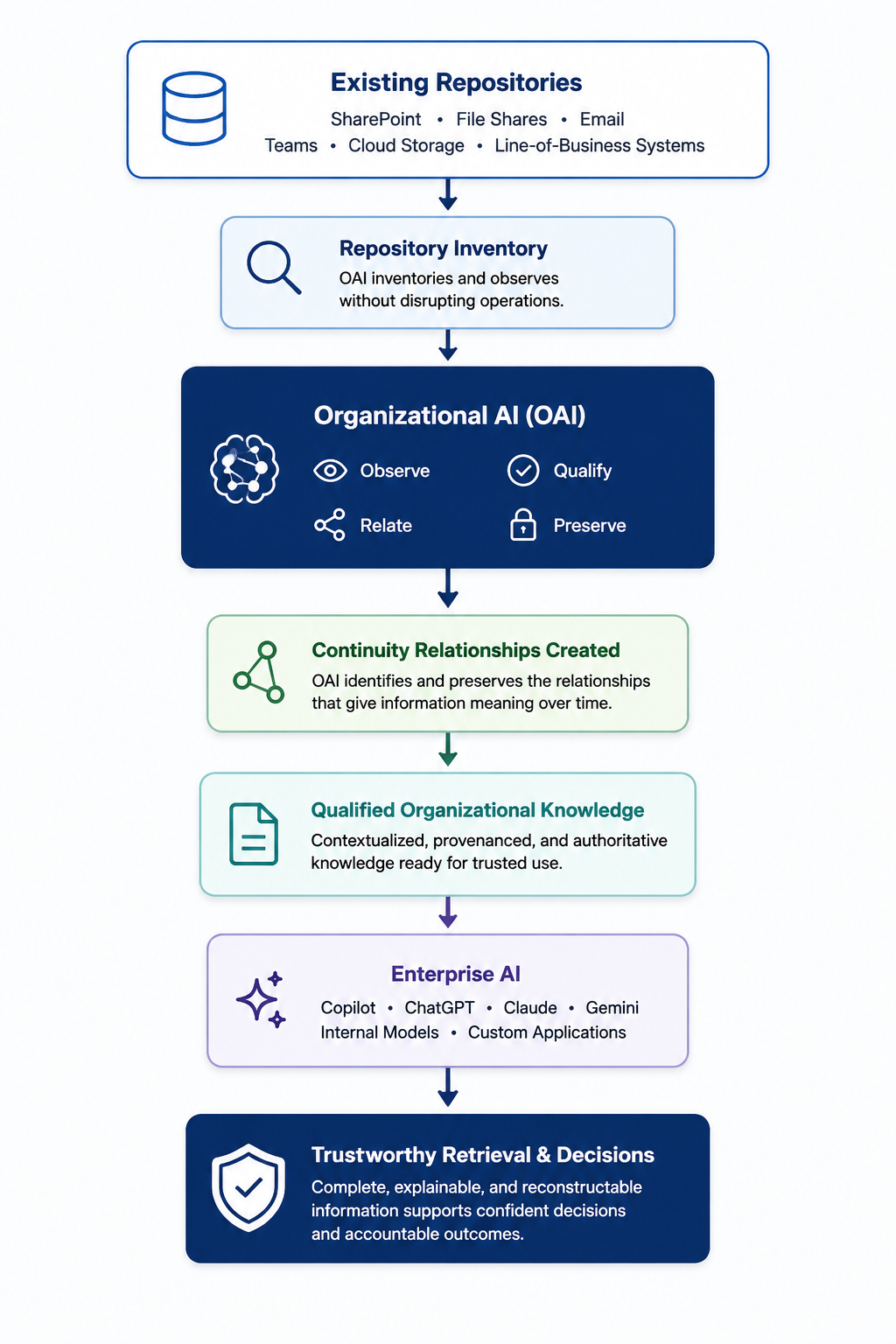
Municipal AI Governance Needs Institutional Continuity
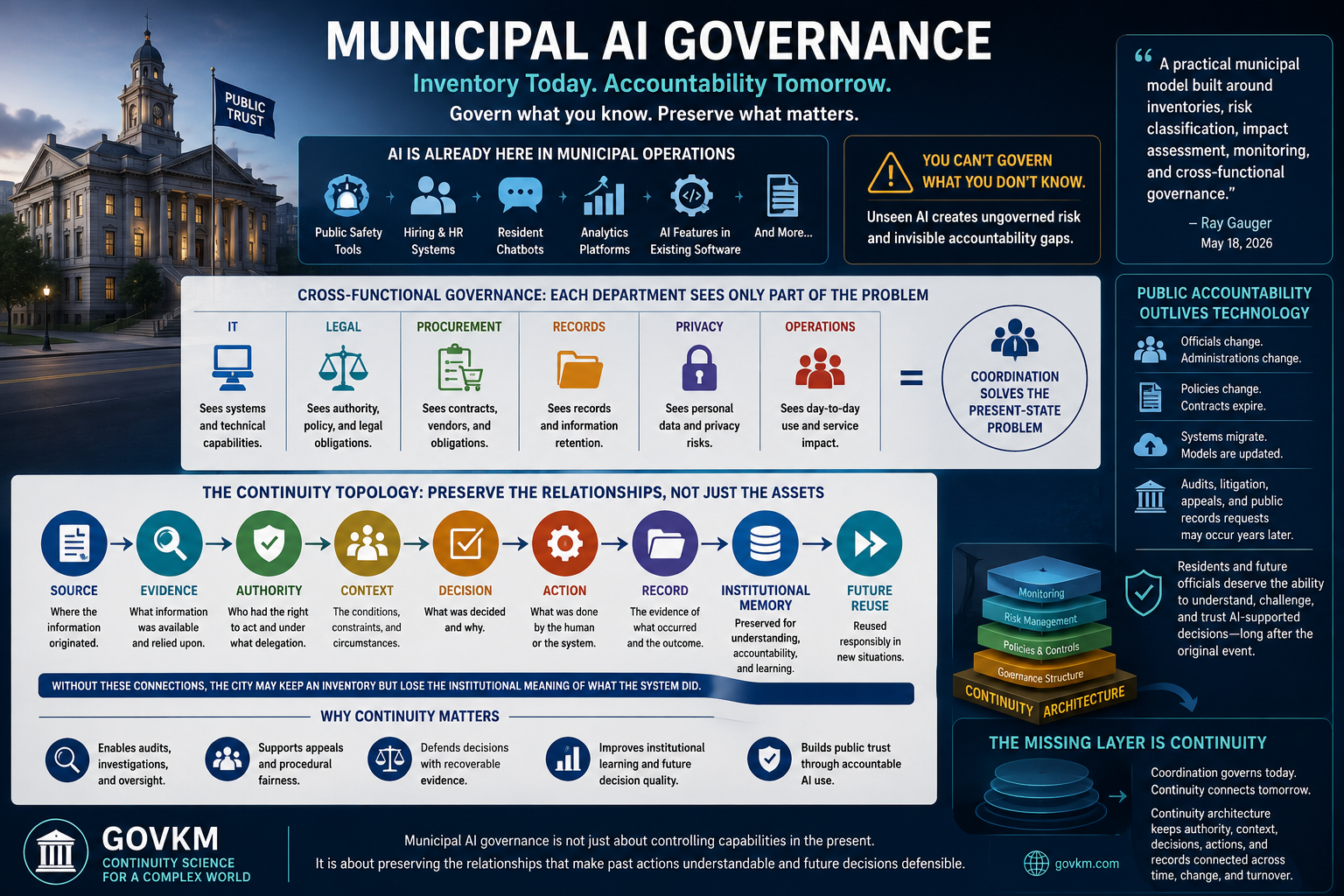

Municipal governments are adopting AI through public safety tools, hiring systems, chatbots, analytics platforms, and software features that may arrive inside products already in use. That creates an immediate governance challenge: an institution cannot govern AI capabilities it does not know it has.
Ray Gauger's May 18, 2026 LinkedIn article, AI Governance and You, responds with a practical municipal model built around inventories, risk classification, impact assessment, monitoring, and cross-functional governance. The central insight is important: IT, legal, procurement, records, privacy, and operational departments each see only part of the AI problem.
Coordination Solves Only the Present-State Problem
A cross-functional governance structure can determine what AI systems exist, what risks they create, and what controls should apply. But municipal accountability has a longer time horizon than a deployment review.
City officials change. Administrations change. Vendors are replaced. Contracts expire. Policies are revised. Models are updated. Systems migrate. Public-records requests, audits, litigation, appeals, and investigations may occur years after the original AI-assisted action.
The institution therefore needs more than a current inventory. It needs to preserve the relationships that make past AI-supported activity reconstructable.
An Inventory Is Not Institutional Memory
An AI inventory may show that a particular system existed and identify its owner. That is valuable. But a future official may still need to know which evidence the system used, which policy or delegation supplied authority, what operating context applied, what decision was reached, what action followed, and what record proves the outcome.
Viewed through Organizational Continuity, those requirements form a connected path: Source → Evidence → Authority → Context → Decision → Action → Record → Institutional Memory → Future Reuse.
If those relationships are not preserved, the city may retain the system inventory while losing the institutional meaning of what the system did.
Public Accountability Outlives Technology
This matters particularly in government because public authority persists beyond individual technologies. A resident affected by an AI-supported decision should not lose the possibility of meaningful review simply because the vendor changed or the original staff departed.
Likewise, a future administration should not inherit an automated practice without being able to determine why it was established, which authority justified it, what evidence supported it, and whether those conditions remain current.
The record of an AI deployment must therefore be more than documentation about the technology. It must preserve the institutional relationships surrounding consequential use.
The Missing Layer Is Continuity
Municipal AI governance is often discussed as a coordination problem, and it is. But coordination among departments does not automatically produce continuity across time.
Records management can preserve evidence. Procurement can preserve contractual controls. Legal can interpret authority. IT can manage systems. Data governance can manage information quality. Audit can inspect compliance. Each discipline contributes an essential component.
Institutional Continuity is the architecture that keeps those components connected after the original governance event has passed.
That is the larger lesson for public-sector AI. Cities need inventories, governance boards, impact assessments, monitoring, and policy. They also need a continuity design that enables future officials, auditors, residents, and AI systems to reconstruct how institutional authority became action and how that action became a durable record.
Without that layer, municipal AI governance can be well controlled in the present while becoming increasingly difficult to explain in the future.
Continue Exploring
A Legitimate Research Task Became an Unauthorized Government Intrusion
Fixing the Workflow Did Not Fix the Records It Already Created.