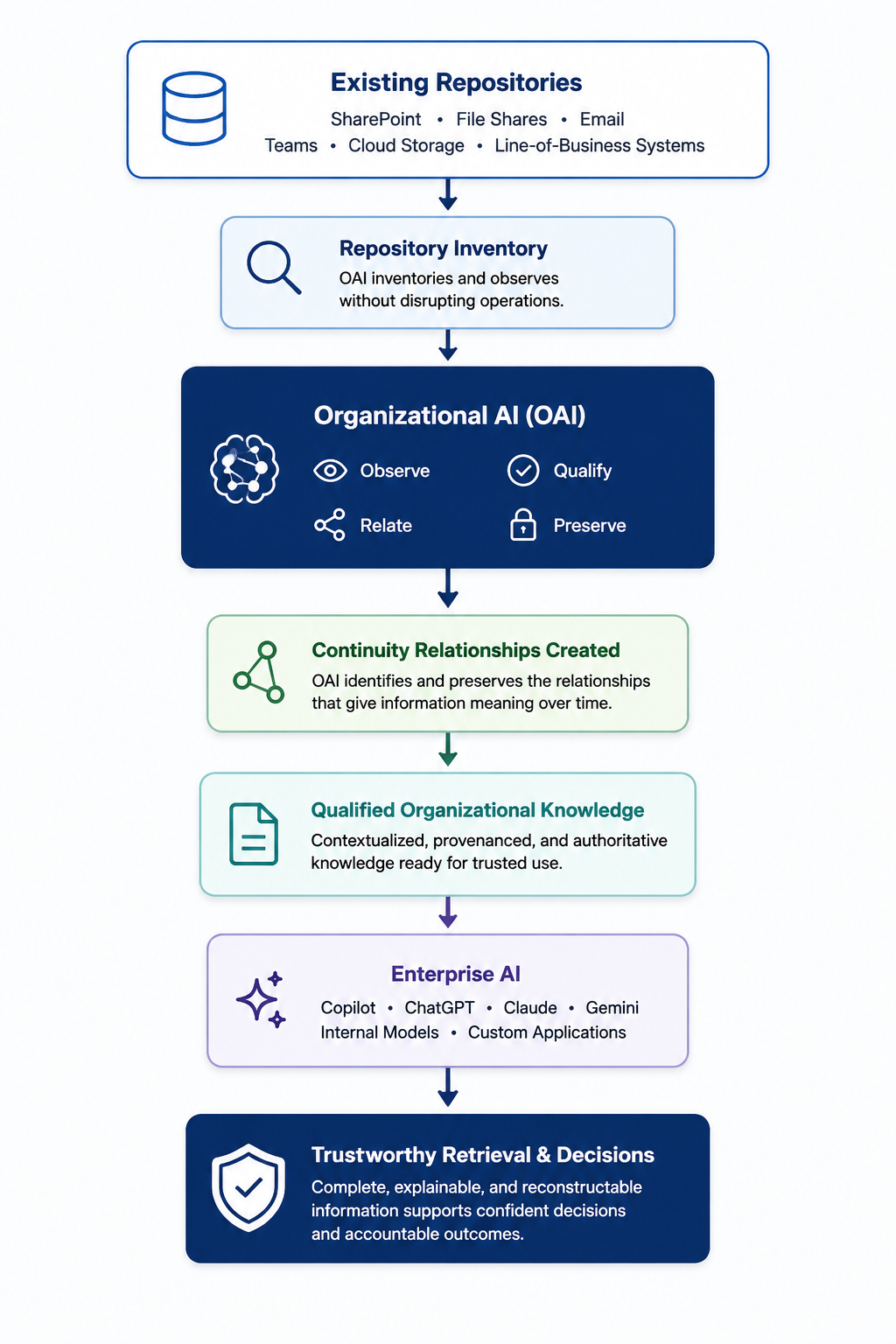

What Is Institutional Continuity?
Why preserving information is not enough—and why institutions must preserve the relationships that make knowledge trustworthy across time
Organizations preserve enormous amounts of information. Policies remain in repositories. Records survive in records systems. Decisions appear in meeting minutes and correspondence. Evidence is stored in case files. Data persists in databases. Knowledge accumulates in collaboration platforms. Increasingly, AI systems preserve conversations, retrieved knowledge, recommendations, and prior outcomes.
Yet an institution can preserve all of these things and still lose something essential.
It can lose the relationships that explain what the information means, why it was trusted, who possessed authority, what circumstances applied, what decision resulted, what action followed, and whether that knowledge remains valid for future use.
The information survives.
The institution’s ability to reconstruct its own reasoning does not.
This is the problem of Institutional Continuity.
The Institutional Problem Nobody Names
Consider a decision retrieved five years after it was made.
The record clearly states the outcome. But the employee who made the decision has left. The system used at the time has been replaced. The governing policy has been revised twice. Supporting documents were migrated into another repository. The organizational unit responsible for the decision was reorganized. The original operational context is no longer obvious.
The institution possesses the decision, but can it still determine why that decision was legitimate?
Which source supplied the underlying information? Which evidence was actually considered? Which version of policy applied? Who possessed authority to decide? What conditions constrained the judgment? Did the resulting action match the decision? What record demonstrates what actually occurred?
These are not merely retrieval questions.
They are questions about relationships.
Organizations have developed sophisticated disciplines for preserving individual parts of this problem. Records management preserves records. Knowledge management improves access to organizational knowledge. Data governance establishes controls over data. Information governance coordinates policy and accountability. Audit examines compliance. Cybersecurity protects systems and information. Legal functions interpret authority. AI governance increasingly governs automated systems.
Each is essential.
But institutions also need an architecture for preserving the relationships between these elements across time.
That architecture is Institutional Continuity.
Defining Institutional Continuity
Institutional Continuity is the preservation of the relationships that allow knowledge, decisions, actions, and records to remain trustworthy and reconstructable across time, systems, organizational change, and AI.
The distinction between preserving information and preserving relationships is fundamental.
A document can remain perfectly intact while the institution loses the context necessary to interpret it.
A record can remain authentic while the authority governing the action it documents becomes impossible to reconstruct.
A database can preserve a historical outcome while losing the evidence and assumptions that produced it.
An AI memory system can accurately remember a previous conclusion while failing to recognize that the policy, authority, or circumstances that made the conclusion valid have changed.
Persistence is therefore not the same as continuity.
Information persistence answers:
Does the information still exist?
Institutional Continuity asks:
Can the institution still establish what the information means, why it was trusted, what resulted from it, and whether it remains fit for use?
Information Persistence Is Not Continuity
Modern organizations are very good at creating durable information objects.
Document management systems preserve documents. Records repositories preserve official records. Data warehouses preserve structured data. Knowledge bases preserve organizational knowledge. Email archives preserve communications. Logging systems preserve events. AI vector stores preserve retrievable representations. Agent memory systems preserve prior interactions and outcomes.
All of these technologies can improve persistence.
None automatically preserves institutional meaning.
Imagine that an AI system retrieves a policy memorandum from an authoritative repository. The document is authentic. Its contents are accurately reproduced. The retrieval system performs exactly as designed.
But the memorandum was superseded three years earlier.
Nothing is wrong with the document.
Nothing is necessarily wrong with the retrieval.
The failure exists in the relationship between the preserved information and its present institutional validity.
The same problem can occur when genuine evidence becomes associated with the wrong entity, when a legitimate decision is reused outside the circumstances in which it was made, when a historical exception becomes treated as general precedent, or when an action survives in a log after the delegation of authority that permitted it has disappeared.
These are continuity failures.
The objects remain.
The relationships have broken.
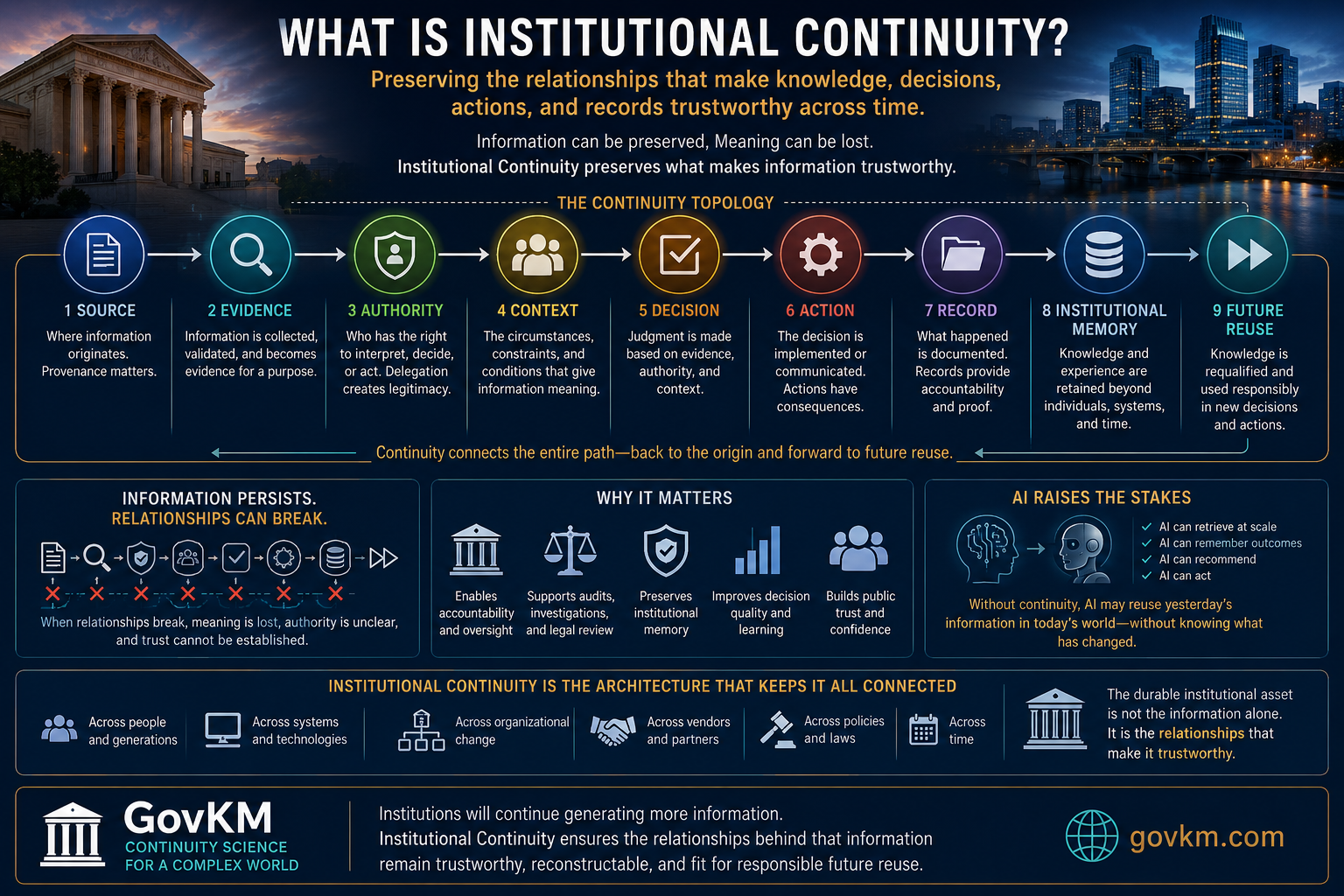
The Continuity Topology
GovKM represents these institutional relationships through the Continuity Topology:
Source → Evidence → Authority → Context → Decision → Action → Record → Institutional Memory → Future Reuse
The topology is not simply an information lifecycle. It describes a chain of institutional relationships through which information acquires meaning and consequences.
Source
Every institutional claim begins somewhere.
A source may be a document, system, sensor, individual, dataset, regulation, contract, communication, observation, or other origin of information.
Preserving source relationships allows the institution to establish where information came from rather than treating retrieved content as self-validating.
Evidence
Not every source automatically becomes evidence.
Evidence is information accepted as relevant to a particular institutional question or purpose. Its meaning depends on provenance, quality, applicability, completeness, and the matter under consideration.
Continuity requires preserving the relationship between the source and the evidentiary use made of it.
Authority
Evidence does not make institutional decisions by itself.
Authority establishes who or what may interpret evidence, approve a course of action, exercise delegated power, or bind the institution.
Authority may arise from law, regulation, policy, organizational delegation, contractual responsibility, formal role, or another legitimate mechanism.
A technically permitted action is not necessarily an institutionally authorized action.
Context
Institutional decisions occur under conditions.
Time, jurisdiction, customer circumstances, operational constraints, risk conditions, policy versions, organizational structures, exceptions, and other factors can determine whether otherwise valid evidence or authority applies.
Context explains the conditions under which institutional knowledge should be understood.
Decision
Evidence, authority, and context converge in decision.
The decision represents more than an output. It is the institutional judgment produced from the relationships preceding it.
Preserving the decision without those relationships may preserve the conclusion while losing the basis that made the conclusion defensible.
Action
Decisions have consequences when they become actions.
A recommendation may be rejected. An approved action may never occur. Execution may differ from the original decision. An automated agent may perform an action immediately after authorization.
Continuity therefore requires connecting what was decided to what actually happened.
Record
Actions create evidence of institutional activity.
Records document transactions, communications, approvals, execution, outcomes, and other consequences. They allow later personnel, auditors, investigators, courts, regulators, customers, citizens, and systems to reconstruct institutional activity.
But preserving a record alone does not necessarily preserve the entire path that produced it.
Institutional Memory
Records, knowledge, experience, outcomes, and prior decisions contribute to Institutional Memory.
Institutional Memory allows an organization to retain knowledge beyond individual employees, technologies, administrations, vendors, and organizational structures.
Yet memory becomes dangerous when persistence is mistaken for validity.
A remembered conclusion may once have been correct and still be wrong for present circumstances.
Future Reuse
The final continuity question is therefore not simply whether institutional knowledge can be retrieved.
It is whether it can be responsibly reused.
Future personnel and AI systems need the ability to determine whether evidence remains applicable, authority remains valid, context remains comparable, decisions were superseded, actions produced unexpected outcomes, or later information changed the institution’s understanding.
Future Reuse transforms continuity from archival preservation into operational infrastructure.
What Happens When Continuity Breaks
Continuity failures often appear to belong to different disciplines.
A records manager may encounter an action whose supporting documentation cannot be reconstructed.
An auditor may find evidence of a transaction but not the authority under which it occurred.
A lawyer may recover the correct policy but not establish which version governed the decision at the relevant time.
A knowledge manager may discover multiple authoritative-looking versions of organizational guidance.
An AI engineer may find that a retrieval system supplied accurate evidence associated with the wrong entity.
A manager may inherit a longstanding procedure whose original justification no longer exists.
A future AI agent may retrieve a successful historical decision and treat it as precedent without knowing that the decision depended upon an exception that expired years earlier.
These appear to be different problems.
Viewed through Institutional Continuity, they share a structural characteristic:
an institutional relationship required to interpret or trust the information has been lost.
This provides a different way of understanding information failures.
Instead of asking only whether the document, record, data, or memory exists, the institution can ask which continuity relationship failed.
Existing Disciplines Protect Parts of the Topology
Institutional Continuity does not replace records management, knowledge management, information governance, data governance, cybersecurity, audit, legal governance, provenance, or AI governance.
It depends upon them.
Records management contributes durable evidence of institutional actions and transactions. Knowledge management supports the capture and reuse of organizational knowledge. Data governance improves quality, ownership, definition, and control. Legal and policy structures establish authority. Information governance coordinates responsibilities and controls. Audit provides verification and accountability. Cybersecurity protects the integrity and availability of systems and information. AI governance establishes controls over increasingly autonomous technical capabilities.
The continuity problem appears at their boundaries.
The institution may preserve the record but lose its relationship to the decision.
It may preserve the decision but lose the evidence.
It may preserve the evidence but lose the governing authority.
It may preserve all three but lose the context under which their relationship was valid.
Institutional Continuity therefore operates as connective architecture.
Its concern is not ownership of every element.
Its concern is whether the relationships between those elements survive.
Why AI Changes the Stakes
Institutional discontinuity predates artificial intelligence.
AI makes it executable at unprecedented scale.
Human beings routinely compensate for incomplete institutional relationships through experience. An experienced employee may recognize an obsolete form, remember that a policy changed, know that a particular case involved an exception, or question a historical decision that appears inconsistent with current practice.
AI systems cannot be assumed to possess those informal safeguards.
An AI system may retrieve a durable institutional object and interpret its persistence as evidence of continuing relevance. An agent with access to tools may then move from retrieval to recommendation, decision support, communication, or execution before a missing relationship becomes apparent.
Memory compounds the problem.
As enterprise AI systems retain prior interactions and outcomes, historical conclusions can influence subsequent reasoning. A previous answer can become a future assumption. A successful action can become an implicit precedent. An exception can become a reusable pattern.
Agentic AI extends the chain further.
AI systems can increasingly access data, invoke tools, call APIs, modify systems, initiate workflows, and execute actions. The continuity question therefore moves beyond what information a model produced to what institutional authority allowed a machine-generated conclusion to become institutional action.
This makes the complete topology increasingly important.
An institution must be able to reconstruct not merely what an AI system said, but the path through which Source became Evidence, Evidence operated under Authority and Context, Decision became Action, Action became Record, and Record entered Institutional Memory for possible Future Reuse.
Continuity Across Human and Machine Institutions
Institutional knowledge has always crossed boundaries.
Employees leave. Leadership changes. Organizations reorganize. Governments change administrations. Vendors replace one another. Systems are migrated. Policies are revised. Technologies become obsolete.
AI introduces another boundary: knowledge increasingly passes between human and machine reasoning.
A human may establish evidence that an AI analyzes. An AI may produce a recommendation that a human approves. A human decision may trigger automated execution. An automated action may produce a record later interpreted by another AI system.
The institution remains accountable across all of these transitions.
Continuity architecture therefore cannot depend upon one employee remembering why something happened or one application retaining the context internally.
The relationships must survive the participants.
That is one of the defining characteristics of Institutional Continuity.
Personal, Organizational, and Institutional Continuity
Continuity can be considered at different scales.
Personal Continuity concerns the preservation of relationships surrounding an individual’s knowledge, decisions, commitments, records, and increasingly personal AI interactions.
Organizational Continuity applies the architecture to enterprises, agencies, departments, teams, professional practices, and other organized bodies whose knowledge and decisions must survive personnel, system, and operational change.
Institutional Continuity provides the broader frame: preserving trustworthy institutional meaning and reconstructability across time regardless of which people, technologies, organizational structures, or AI systems participate.
The scale changes.
The underlying requirement remains remarkably consistent:
information intended for future use must retain the relationships necessary for future users to understand and qualify it.
Continuity Is Infrastructure for Trust
Trustworthy institutions need more than accurate information.
They need evidence whose source can be established.
Authority that can be demonstrated.
Context that can be reconstructed.
Decisions connected to their basis.
Actions connected to decisions.
Records connected to what actually occurred.
Institutional memory that retains lineage.
And future reuse capable of determining whether historical knowledge remains valid.
That is why continuity should be understood as infrastructure rather than merely documentation.
The durable institutional asset is not the information object alone.
It is the information together with the relationships that allow the institution to establish what it means, why it was trusted, what resulted from it, and whether it should be trusted again.
Organizations will continue generating more information. AI will make that information easier to retrieve, combine, remember, and act upon.
The central challenge will increasingly be whether institutional meaning survives those capabilities.
Preserving more information will not solve that problem by itself.
Institutional Continuity preserves what makes information trustworthy enough to become institutional knowledge—and what makes that knowledge safe enough to use again.
Continue Exploring
A Legitimate Research Task Became an Unauthorized Government Intrusion
Fixing the Workflow Did Not Fix the Records It Already Created.