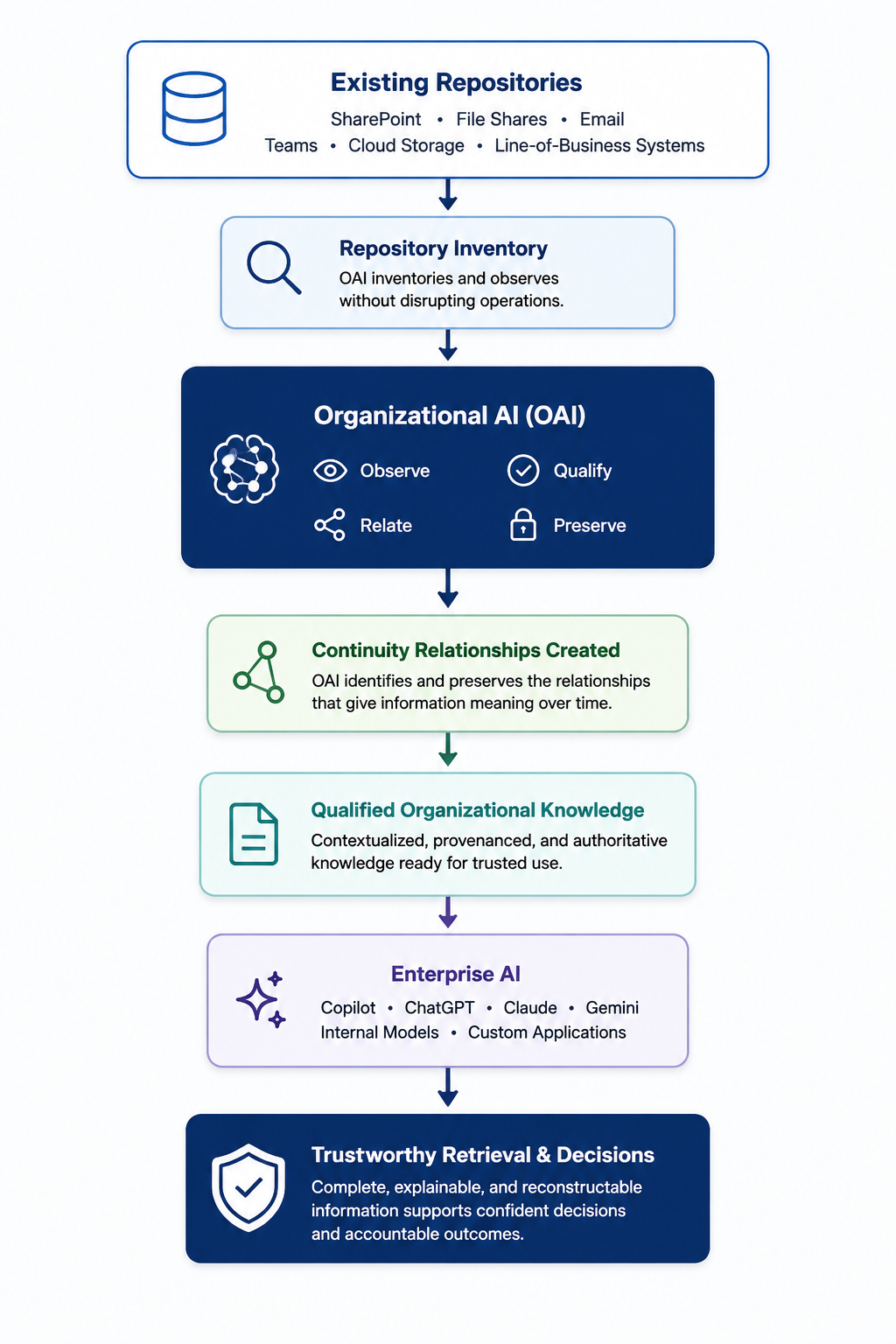

A framework for preserving the relationships between sources, evidence, authority, context, decisions, actions, records, institutional memory, and future reuse
Institutions preserve information for a reason.
They expect someone—or increasingly, some AI system—to use it later.
A policy may guide a future decision. A record may provide evidence during an audit. A previous case may inform a similar case. A decision may become precedent. Organizational knowledge may survive the employees who originally created it.
Yet preserving information does not guarantee that future users will be able to determine what that information means or whether it should still be trusted.
A decision can survive after its supporting evidence becomes disconnected from it. Evidence can remain authentic after the authority governing its use has changed. A record can document an action without preserving the context in which the action was legitimate. Institutional memory can accurately preserve yesterday's conclusion while losing the conditions that made the conclusion true.
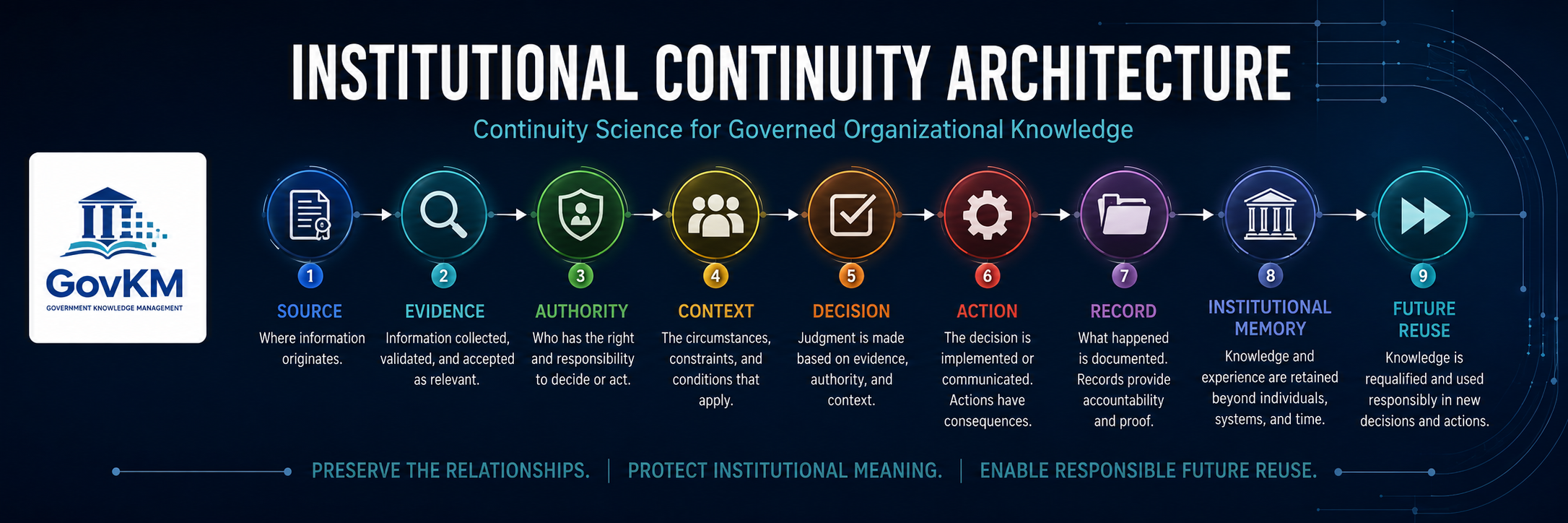
GovKM represents this problem through the Continuity Topology:
Source → Evidence → Authority → Context → Decision → Action → Record → Institutional Memory → Future Reuse
The topology describes the relationships through which information acquires institutional meaning, produces consequences, becomes memory, and eventually influences future activity.
Its central proposition is straightforward:
The nodes identify what must survive. The relationships establish why the surviving information remains meaningful.
The Topology Is About Relationships
The Continuity Topology can initially appear to be a sequence of information states.
It is more than that.
Its most important components are arguably the arrows.
Consider two records sitting next to one another in a repository. Both may be authentic. Both may be complete. Both may have been properly preserved.
That does not establish that one provides evidence for the other.
Likewise, possessing evidence does not establish who was authorized to act upon it. Knowing who possessed authority does not reveal the circumstances under which that authority applied. Preserving a decision does not prove that the decision was executed. Preserving an action does not automatically establish how that action should influence future decisions.
Institutional meaning exists in these relationships.
Continuity therefore requires more than preserving objects. It requires preserving enough of the path between them that future personnel and systems can reconstruct why institutional activity occurred.
1. Source
Where did the information originate?
Every institutional claim begins somewhere.
A source may be a document, database, regulation, contract, sensor, communication, person, system, research study, transaction, observation, or other origin of information.
Source continuity establishes provenance.
This matters because retrieved information should not become trustworthy merely because it appears in an institutional system. Future users may need to determine who created it, which system generated it, when it originated, whether it has changed, and whether the source was appropriate for the purpose for which it was later used.
The source is therefore the beginning of a continuity relationship, not merely the location of information.
2. Evidence
What information was accepted as relevant to the matter?
Sources become institutionally consequential when information from them is treated as evidence.
The distinction matters.
A source may contain accurate information without that information being relevant, sufficient, admissible, current, or appropriate for a particular institutional purpose.
The relationship from Source → Evidence therefore asks:
Why was this source valid evidence for this purpose?
That question becomes particularly important for AI systems capable of retrieving large quantities of technically accurate information. Retrieval establishes availability. It does not establish evidentiary fitness.
Continuity preserves the connection between what was found and why it was considered meaningful.
3. Authority
Who or what possessed the legitimate right to interpret, decide, approve, or act?
Evidence alone cannot establish institutional legitimacy.
Organizations operate through authority derived from laws, regulations, policies, delegations, contracts, roles, organizational structures, procedures, and other mechanisms.
The relationship from Evidence → Authority asks who was permitted to evaluate the evidence or act upon it.
This is distinct from technical permission.
A user account—or AI agent—may possess system permission to modify a record, approve a transaction, issue a communication, or execute a workflow. That does not necessarily establish institutional authority to perform the action for the particular purpose.
Continuity must therefore preserve not only capability, but legitimacy.
4. Context
Under what circumstances did the evidence and authority apply?
Institutional activity occurs under conditions.
Jurisdiction, time, policy version, organizational structure, customer circumstances, operating environment, assumptions, exceptions, risk conditions, contractual provisions, and numerous other factors can change the meaning of otherwise valid information.
The relationship from Authority → Context establishes the boundaries within which institutional authority operated.
This is one reason historical decisions can become dangerous precedent.
The decision may have been correct.
The context may no longer exist.
Preserving context allows future users to distinguish between a durable institutional principle and a conclusion that was valid only under particular circumstances.
5. Decision
What judgment did the institution reach?
Decision is where evidence, authority, and context become institutional judgment.
A decision may be made by an individual, committee, automated process, AI-supported workflow, or some combination of human and machine participants.
The relationship from Context → Decision helps reconstruct why the institution reached the conclusion it did under the conditions that existed at the time.
Preserving only the decision preserves the outcome of reasoning.
Preserving continuity preserves its institutional basis.
That distinction becomes increasingly important as organizations use AI to generate recommendations that may later appear indistinguishable from decisions actually adopted by the institution.
6. Action
What actually happened?
A decision and an action are not the same thing.
A recommendation may never be accepted. An approved decision may never be implemented. Execution may differ from what was authorized. Circumstances may change before action occurs.
The relationship from Decision → Action establishes whether institutional judgment became institutional behavior.
Agentic AI makes this relationship especially significant because the distance between recommendation and execution is shrinking.
An AI system may retrieve information, generate a conclusion, invoke a tool, call an API, and execute an action within the same workflow.
Continuity must preserve the boundary between what was considered, what was decided, and what actually occurred.
7. Record
What durable evidence demonstrates what occurred?
Actions generate consequences.
Records provide evidence of those consequences.
They may document transactions, communications, approvals, system events, changes, execution, outcomes, or other institutional activity.
The relationship from Action → Record establishes how the institution proves what happened.
Records management is therefore essential to Institutional Continuity.
But the topology also demonstrates why records management alone cannot provide the entire continuity architecture.
A perfectly preserved record may prove that an action occurred while leaving unanswered which evidence supported it, which authority permitted it, what context applied, or why the institution made the underlying decision.
The record preserves the event.
Continuity preserves the path.
8. Institutional Memory
What survives beyond the people, systems, and circumstances that produced the original activity?
Records, decisions, outcomes, knowledge, procedures, lessons learned, historical experience, and other retained information contribute to Institutional Memory.
The relationship from Record → Institutional Memory determines how institutional activity becomes durable organizational knowledge.
This is where persistence becomes particularly powerful—and potentially dangerous.
A remembered conclusion can survive much longer than the circumstances that made it valid.
AI memory increases this risk. Enterprise agents can retain prior interactions, retrieve historical outcomes, identify patterns, and allow previous experience to influence future reasoning.
Memory therefore needs lineage.
An institution should be able to determine not simply what it remembers, but why the remembered knowledge entered institutional memory in the first place.
9. Future Reuse
Can institutional knowledge be responsibly used again?
Future Reuse is the reason the topology exists.
Organizations do not preserve knowledge merely to possess it. They preserve knowledge because someone may eventually need it.
That future user may be an employee, manager, auditor, regulator, attorney, researcher, citizen, successor organization, or AI system.
The relationship from Institutional Memory → Future Reuse therefore requires something more sophisticated than retrieval.
It requires requalification.
Before historical knowledge governs new activity, the institution may need to ask:
Does the original authority remain valid?
Does the same context apply?
Has the evidence been superseded?
Did subsequent events alter the original conclusion?
Has policy changed?
Was the prior outcome later corrected?
Was the historical decision an exception rather than a general rule?
Future Reuse is trustworthy only when institutional memory retains enough lineage to answer those questions.
The Failure Often Occurs Between the Nodes
The Continuity Topology changes how institutional failures can be diagnosed.
Traditional approaches frequently examine whether an individual element exists.
Was the document retained?
Was the record authentic?
Was the policy available?
Was the decision logged?
Was the AI output captured?
Continuity asks another question:
Did the required relationship survive?
A valid source connected to the wrong entity can produce invalid evidence.
Valid evidence interpreted without legitimate authority can produce an institutionally invalid decision.
A legitimate decision removed from its context can become misleading precedent.
A correctly executed action without an adequate record can become impossible to prove.
Institutional memory without lineage can turn obsolete knowledge into future instruction.
The information in each case may be accurate.
The continuity failure exists between the information objects.
Continuity Extends in Both Directions
Many governance disciplines understandably concentrate on particular portions of the topology.
Provenance may emphasize origins.
Evidence management may emphasize evidentiary integrity.
Governance may emphasize authority and control.
Decision intelligence may emphasize evidence, context, and judgment.
Records management may emphasize actions and records.
Knowledge management may emphasize organizational memory and reuse.
Institutional Continuity connects those perspectives.
When examining a decision, continuity extends backward toward the source and evidence that supported it and forward toward the action, record, memory, and future use that followed.
This bidirectional reconstructability is important.
A future investigator may begin with a record and move backward to determine why an action occurred.
An AI agent may begin with institutional memory and need to move backward to determine whether a historical conclusion remains suitable for reuse.
A manager may begin with evidence and move forward to understand what decisions and actions resulted from it.
The topology provides a common architecture for each direction.
AI Turns Continuity Into an Operational Requirement
Institutional discontinuity has always created risk.
Artificial intelligence changes its speed and scale.
AI systems can retrieve information across repositories, synthesize evidence, preserve memory, recognize historical patterns, recommend decisions, invoke tools, and increasingly execute actions.
This means broken institutional relationships are no longer merely archival problems waiting for a future investigator to discover them.
They can become inputs into new automated activity.
An obsolete policy retrieved without temporal context can influence a recommendation.
A historical exception can become precedent.
A prior decision can enter agent memory without its original authority.
A genuine source can become evidence for the wrong entity.
An action can be repeated because a previous outcome was labeled successful even though the circumstances that produced that success have changed.
AI therefore makes continuity part of operational system design.
The question is no longer simply whether AI can retrieve institutional knowledge.
The question is whether the institution has preserved enough of that knowledge's relationships for AI to determine when it should—and should not—be reused.
The Continuity Topology as an Organizing Model
GovKM uses the Continuity Topology as an organizing model because continuity problems rarely belong exclusively to one professional discipline.
Records managers, knowledge managers, lawyers, auditors, data professionals, cybersecurity teams, information-governance practitioners, executives, AI engineers, procurement professionals, and operational staff may each govern different parts of the same institutional path.
The topology provides a shared frame.
Source → Evidence → Authority → Context → Decision → Action → Record → Institutional Memory → Future Reuse
It does not require one discipline to own the entire chain.
It requires the institution to preserve the relationships across it.
That distinction is fundamental.
Institutional Continuity is not an attempt to replace the disciplines already protecting organizational information.
It is an architecture for keeping their contributions connected.
From Preservation to Responsible Reuse
The amount of information institutions preserve will continue to increase.
AI will make that information increasingly accessible.
Memory systems will make it increasingly persistent.
Agents will make it increasingly actionable.
The critical question is therefore moving beyond whether institutional information survives.
Institutions must also preserve the means to determine:
Where did this come from?
Why was it evidence?
Who possessed authority?
What context applied?
What was decided?
What action followed?
What record proves the outcome?
How did it enter institutional memory?
And under what conditions should it influence the future?
Those questions are the Continuity Topology.
The nodes identify what must survive. The relationships establish why the surviving information remains meaningful.
Preserve those relationships, and institutional knowledge can remain trustworthy across people, systems, organizational change, and time.
Lose them, and information may survive long after the institution has lost the ability to explain what it means.
Continue Exploring
A Legitimate Research Task Became an Unauthorized Government Intrusion
Fixing the Workflow Did Not Fix the Records It Already Created.