When Information Survives but Meaning Does Not: The Institutional Continuity Problem

Organizations preserve more information than at any point in history.
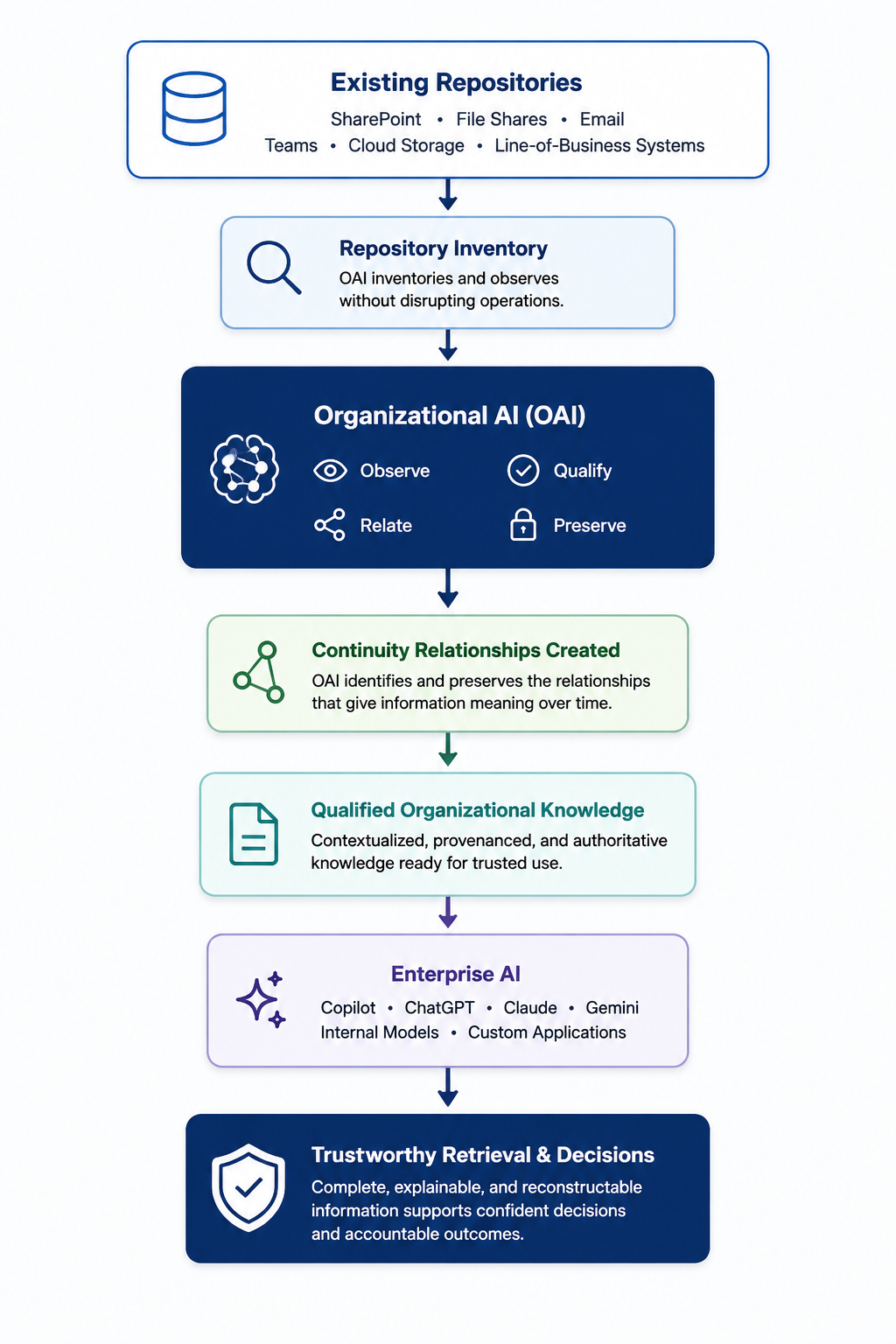
Documents remain in repositories. Records remain in systems. Emails remain in archives. Policies, reports, transactions, decisions, and operational data can persist for years or decades. Search technologies make that information increasingly discoverable, while artificial intelligence makes enormous quantities of it available for immediate reuse.
It would be reasonable to assume that institutions should therefore be experiencing unprecedented continuity of knowledge.
Yet the opposite can occur.
An organization can retain the information surrounding an event while gradually losing the ability to explain what that information meant, why it was trusted, who possessed authority, what circumstances applied, what decision was actually made, and what happened because of it.
The information survived.
Its institutional meaning did not.
Preservation Is Not the Same as Continuity
Traditional information disciplines have developed sophisticated methods for preserving important organizational assets. Records management preserves evidence of activities and transactions. Knowledge management helps organizations capture and share knowledge. Data governance establishes controls around data. Archives preserve materials across long periods of time.
These disciplines remain essential.
But preservation alone does not guarantee that the relationships surrounding preserved information will remain recoverable.
Consider a decision preserved in an organization's records.
The decision document may still exist twenty years later. But can the institution establish which sources informed it? Which evidence was accepted? Which policy or delegation supplied authority? What operating conditions affected the decision? Whether the decision was exceptional or routine? What action resulted? Whether subsequent events validated or contradicted the original judgment?
Those questions concern relationships, not merely documents.
This distinction is already visible in established records-management principles. The National Archives and Records Administration describes trustworthy records in terms of reliability, authenticity, integrity, and usability, and emphasizes preserving content together with context and, where necessary, structure. NARA specifically notes that records should remain connected to the business activity that produced them and that contextual linkages between records documenting sequences of activity should be maintained.
Institutional Continuity extends that problem beyond individual records to the larger chain through which organizational knowledge acquires meaning and consequence.
The Relationships Are the Architecture
GovKM represents that chain through the Continuity Topology:
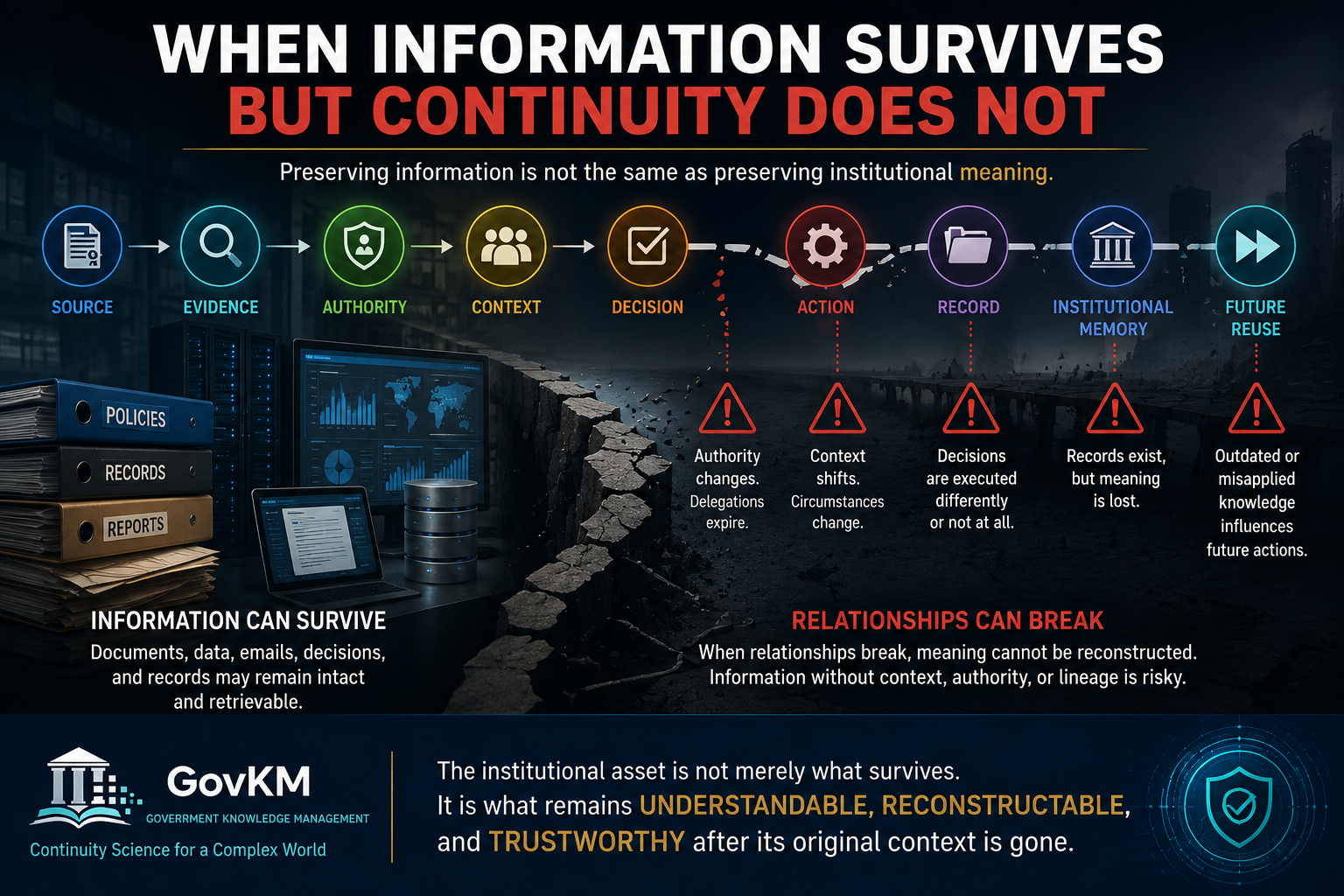
Source → Evidence → Authority → Context → Decision → Action → Record → Institutional Memory → Future Reuse
Each element matters.
But the architecture exists in the relationships between them.
A source becomes institutionally consequential when it is accepted as evidence for some purpose.
Evidence becomes actionable within some framework of authority.
Authority operates within context.
Evidence, authority, and context contribute to decisions.
Decisions produce—or deliberately prevent—actions.
Actions generate records.
Records contribute to Institutional Memory.
Institutional Memory influences Future Reuse.
Breaking one of these relationships does not necessarily destroy the information on either side.
That is what makes continuity failure difficult to recognize.
Information Can Remain Intact While the Chain Breaks
Imagine an organization retains the final approval of a major procurement decision.
The record is authentic. The file is intact. Its metadata is correct. It can be retrieved instantly.
Yet the policy under which the decision was made has disappeared.
Or perhaps the policy remains, but the organization can no longer determine which version governed the decision.
Perhaps the supporting evidence remains in another repository but its relationship to the approval was never captured.
Perhaps the approving official's name remains on the record, but the delegation establishing that person's authority cannot be reconstructed.
Perhaps the decision was made under emergency conditions that materially changed the normal approval requirements, but that context existed only in emails that were later disposed of.
The organization has not necessarily suffered an information-loss problem.
It has suffered a continuity-loss problem.
The individual artifacts survived while the relationships necessary to reconstruct their institutional meaning deteriorated.
Archival and records-management practice has long recognized aspects of this problem. NARA's guidance emphasizes contextual information, relationships among records, and their connection to the activities that produced them. Its guidance for electronic transactions similarly recognizes that supporting administrative records may be necessary to establish authentication, non-repudiation, and the trustworthiness of transactions.
Institutional Continuity treats those relationships as part of a broader organizational architecture.
Time Is the Adversary
Many continuity failures are not obvious when information is created.
At the moment of a decision, the participants know the context.
They know which policy applies.
They know who has authority.
They remember the conversations preceding the decision.
They understand local terminology.
They know which circumstances were unusual.
Much of this knowledge may therefore appear unnecessary to preserve explicitly.
Then the institution changes.
Employees leave.
Leadership turns over.
Organizational structures are reorganized.
Systems are replaced.
Repositories migrate.
Policies are revised.
Vendors disappear.
Terminology changes.
The people who supplied the missing relationships are no longer available.
The information may remain exactly where the institution placed it, while the unwritten connective knowledge surrounding it gradually disappears.
This is one reason long-term digital preservation is not simply a storage problem. NARA has noted that records can outlive the systems that created them, creating challenges for maintaining trustworthiness through technological change.
Institutional Continuity applies the same temporal problem to organizational knowledge more broadly.
AI Makes the Difference More Important
Artificial intelligence changes the scale of this problem.
Historically, much obsolete or poorly contextualized organizational information remained effectively dormant because finding it required significant human effort.
AI changes that.
Historical policies, decisions, correspondence, case files, reports, records, and lessons learned can now be retrieved and incorporated into reasoning at extraordinary speed.
That is enormously valuable.
It also means that preserved information can acquire new influence long after the circumstances surrounding its creation have disappeared.
An AI system may retrieve an authentic historical decision without knowing that it represented an exception.
It may find an authoritative policy without recognizing that the policy was subsequently superseded.
It may retrieve a successful prior action without knowing that the employee who authorized it possessed a delegation that no longer exists.
It may discover an institutional conclusion without recovering the evidence that qualified that conclusion.
The retrieval can be technically correct while the resulting interpretation is institutionally wrong.
The problem is therefore no longer simply:
Can we find the information?
It becomes:
Can we reconstruct enough of the institutional relationships surrounding the information to determine what it means and whether it remains fit for use?
Retrieval Is Not Reconstruction
This distinction separates information retrieval from Institutional Continuity.
Retrieval answers:
What do we have?
Continuity must also answer:
Where did it come from?
What evidence supported it?
What authority governed it?
What context constrained it?
What decision was reached?
What action followed?
What record demonstrates the result?
How did the outcome enter Institutional Memory?
Under what conditions should it influence Future Reuse?
Related work on decision provenance illustrates part of this requirement. Decision provenance focuses on preserving the context, judgment, and outcome associated with a decision at the time it occurs rather than relying entirely on retrospective reconstruction. In AI-assisted environments, that can include the system output, material context, constraints, and human judgment involved.
Organizational Continuity extends the reconstruction requirement across the complete institutional path.
Institutional Memory Is Not an Archive of Conclusions
This distinction becomes especially important at the Institutional Memory → Future Reuse boundary.
Institutional Memory should not be understood merely as everything an organization remembers.
A repository containing millions of historical records is not necessarily functioning as institutional memory.
Nor is an AI memory system simply because it can retrieve previous interactions.
For remembered knowledge to become trustworthy institutional precedent, the organization must retain enough lineage to understand the conditions under which that knowledge became valid.
Otherwise, institutional memory can become a mechanism for preserving obsolete truths.
The conclusion survives.
The reason it was true disappears.
Future personnel—or future AI systems—then inherit the conclusion without the institutional means to determine whether it should still govern behavior.
Continuity Requires Requalification
Future Reuse therefore cannot mean automatic reuse.
Knowledge should be capable of requalification.
Before a historical conclusion influences a consequential new decision, an institution may need to determine whether:
- its underlying evidence remains valid;
- the governing authority remains current;
- the relevant policy has been superseded;
- the original context still applies;
- later evidence altered the original understanding;
- subsequent actions produced different outcomes than expected; and
- the remembered knowledge remains appropriate for the new purpose.
This transforms institutional memory from passive preservation into governed continuity.
The objective is not to freeze institutional knowledge permanently.
It is almost the opposite.
Continuity allows knowledge to evolve while preserving enough lineage to understand what changed, why it changed, what preceded it, and which understanding should govern now.
The Institutional Asset Is the Recoverable Relationship
Organizations will continue investing heavily in repositories, search, knowledge graphs, AI memory, records systems, data platforms, and increasingly powerful retrieval technologies.
Those investments improve access to information.
They do not automatically preserve Institutional Continuity.
The deeper institutional asset is the recoverable relationship between information and the evidence, authority, context, decisions, actions, and records that gave it meaning.
That relationship allows a future employee to understand a predecessor's decision.
It allows an auditor to reconstruct an action.
It allows leadership to distinguish current policy from historical precedent.
It allows an institution to learn without converting every historical outcome into permanent truth.
And increasingly, it allows AI to distinguish information that merely exists from knowledge that remains institutionally trustworthy.
The institutional asset is not merely what survives. It is what remains understandable, reconstructable, and trustworthy after its original context is gone.
That is the problem Institutional Continuity is intended to solve.
Continue Exploring
A Legitimate Research Task Became an Unauthorized Government Intrusion
Fixing the Workflow Did Not Fix the Records It Already Created.