GOVKM KNOWLEDGE
Articles and Research on Organizational Continuity
Explore GovKM analysis, research, and practical guidance on Organizational Continuity, information governance, AI readiness, institutional knowledge, and continuity architecture.
FEATURED KNOWLEDGE
Featured Insights
Explore GovKM research, doctrine, and implementation guidance addressing the continuity challenges facing modern organizations.
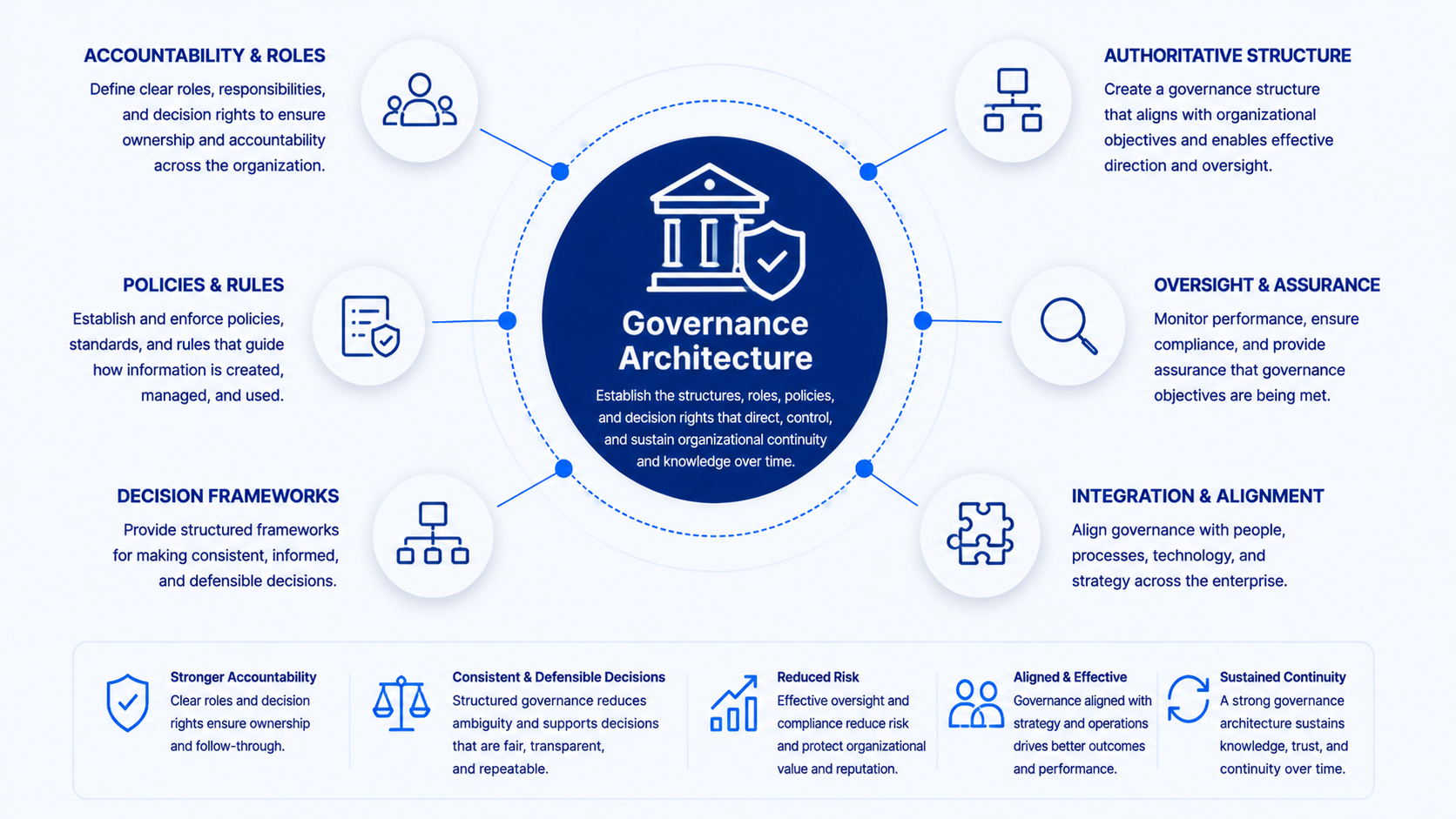
Governance Architecture
The Rule Existed. The Institution Could Not Prove the Decision Followed It.
An HHS OIG audit of Arizona Medicaid shows that policy authority is not operational governance by itself. Institutions must preserve evidence showing how governing requirements actually constrained decisions and actions.

Information Continuity
Your AI History Is Not Yet a Knowledge System
AI platforms can preserve, search, and export conversations. But a collection of retrievable chats does not preserve how a person’s ideas, evidence, corrections, decisions, and outputs develop across conversations and platforms. That requires continuity.
Corporate Operational Knowledge
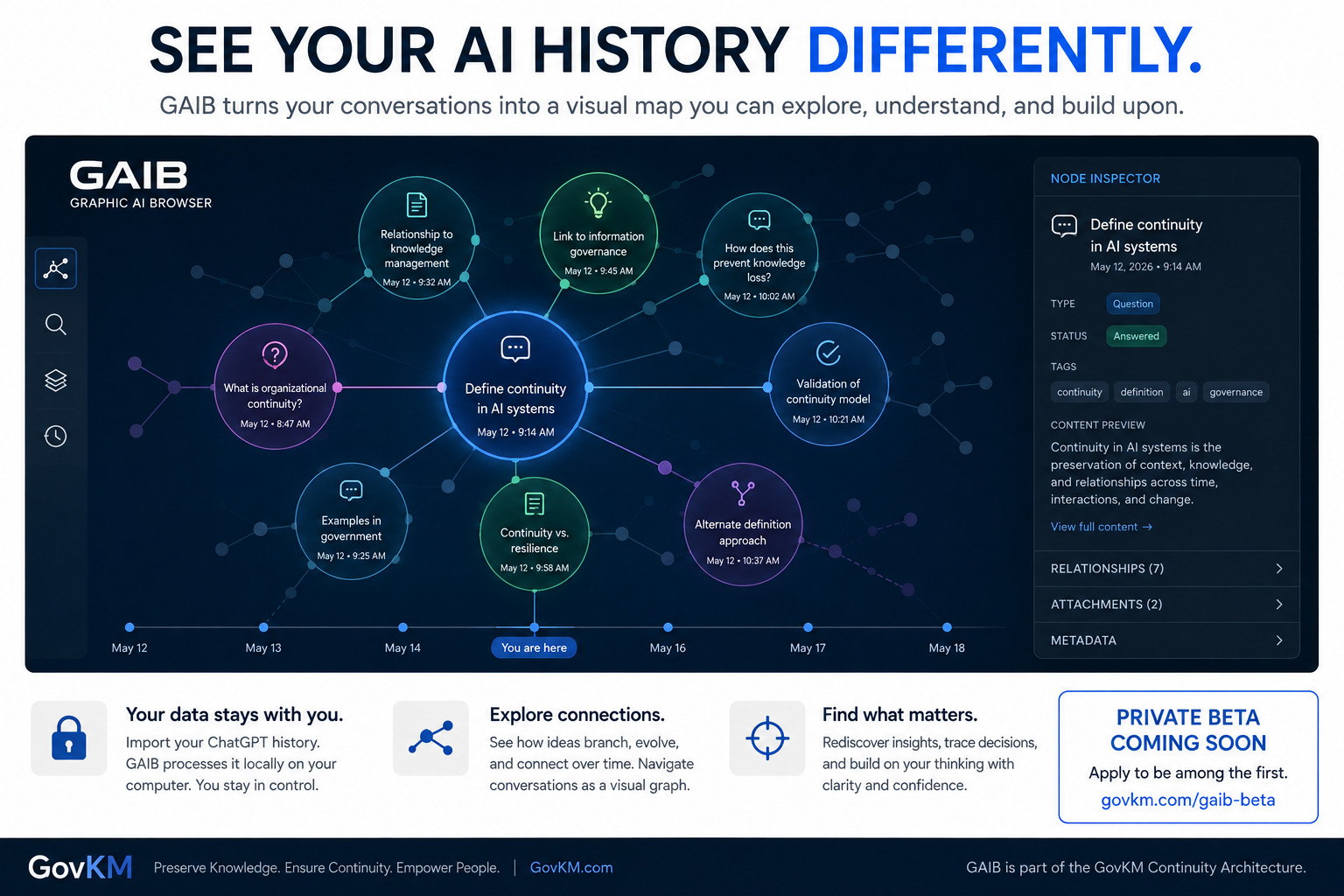
Your AI History Is Becoming Memory. Why Can't You See It?
Heavy AI users are accumulating valuable reasoning, decisions, corrections, and unfinished work inside linear chat histories. GovKM is preparing GAIB—the Graphic AI Browser—for a small private beta that turns supported AI history into a locally processed visual environment users can navigate and inspect.

Organizational Continuity
The Institution Must Agree Before the AI Can Know
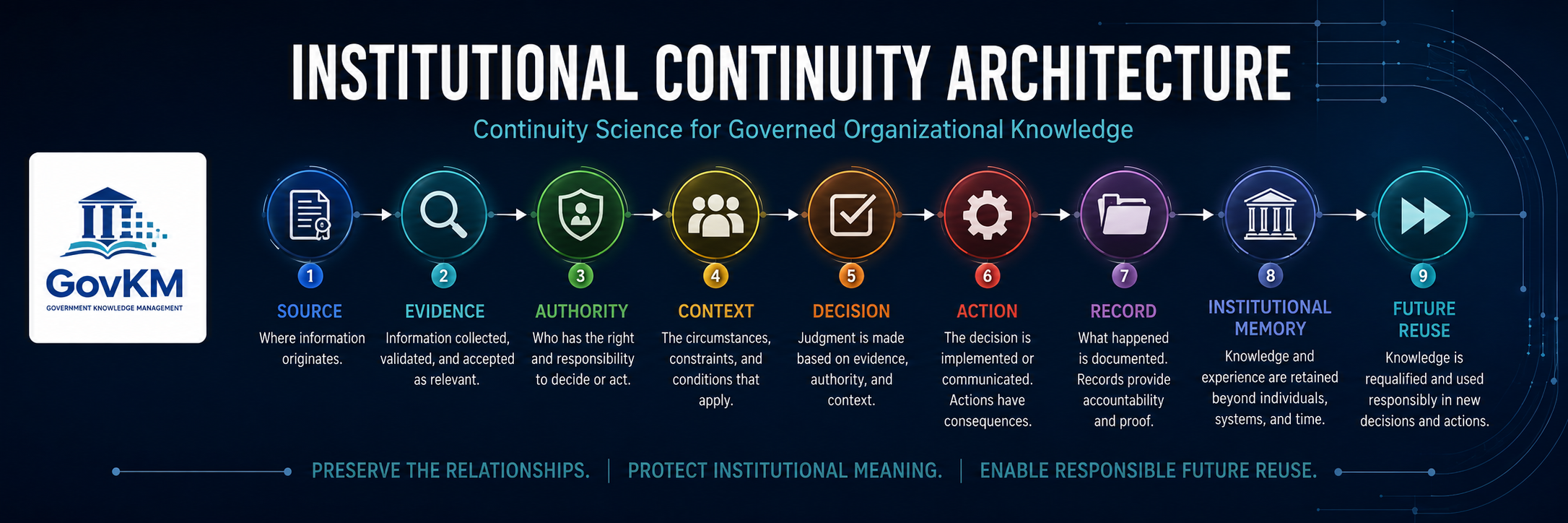
Organizations already possess most of the information AI needs. What they often lack are durable relationships connecting sources, evidence, authority, context, decisions, actions, records, institutional memory, and future reuse. As AI replaces work once performed by people who informally carried those relationships, Continuity becomes an institutional mandate. GovKM proposes a Continuity Compact among executive leadership, technology, records management, mission leadership, and users to establish the authoritative information environment that humans and AI require to act legitimately through organizational change.
Organizational Continuity
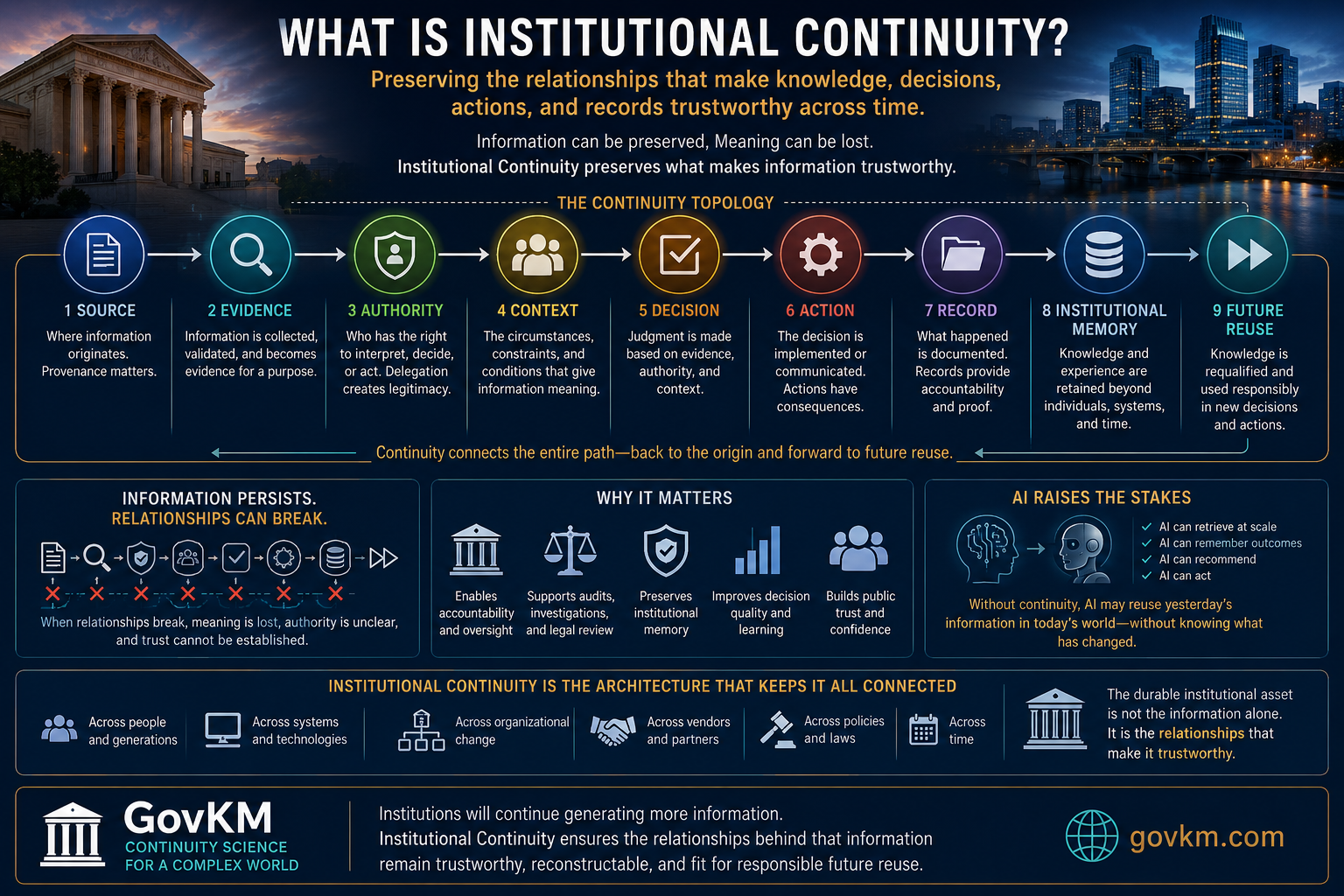
The Continuity Topology: How Institutional Knowledge Remains Trustworthy Across Time
A framework for preserving the relationships between sources, evidence, authority, context, decisions, actions, records, institutional memory, and future reuse
Governance Architecture
What Is Institutional Continuity?
Why preserving information is not enough—and why institutions must preserve the relationships that make knowledge trustworthy across time.
ARTICLES
Latest Research and Articles
Browse GovKM research, implementation guidance, continuity science, governance architecture, AI readiness, and organizational continuity.
Governance Architecture
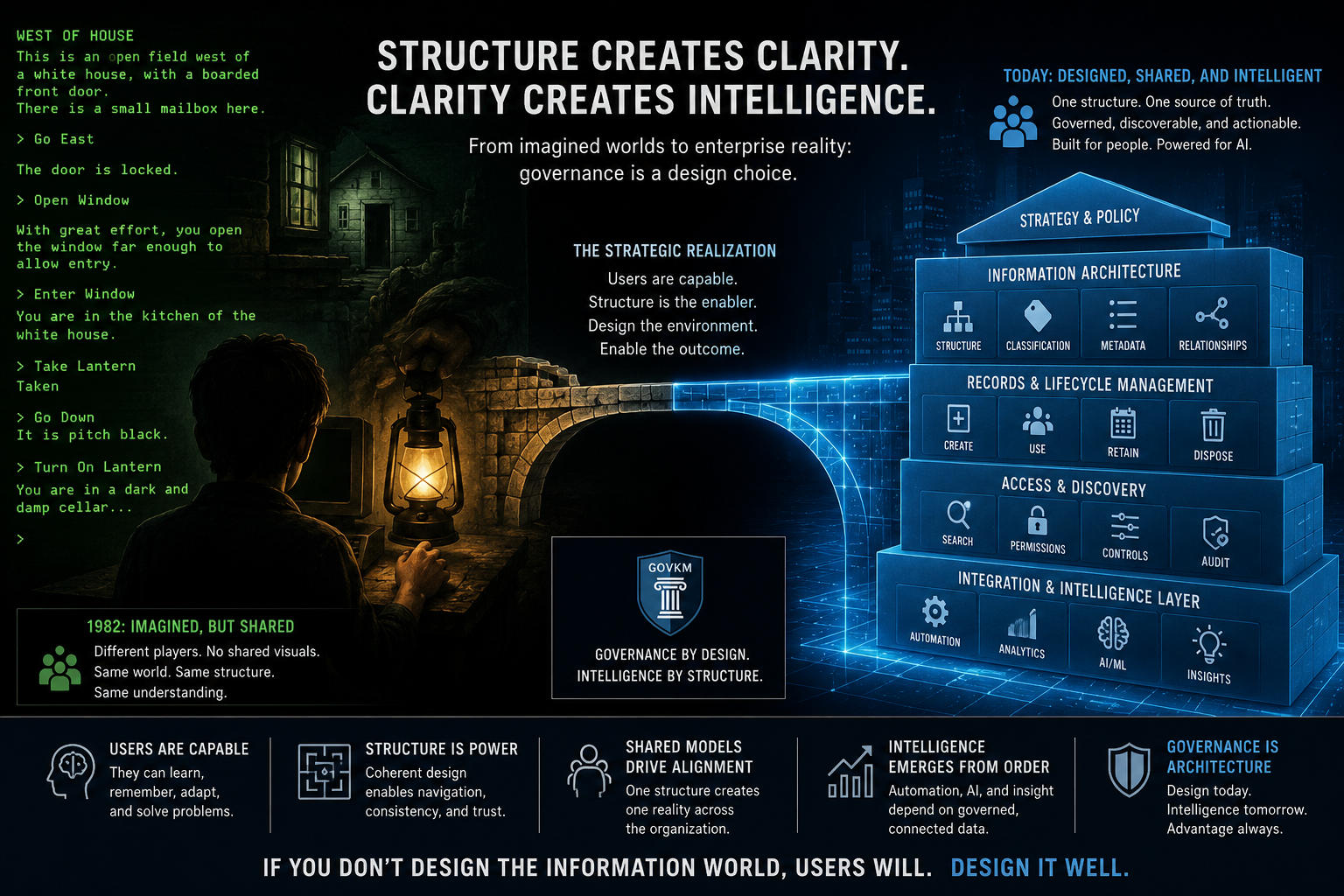
The Shared Data Reality: Why Governance Must Be Designed, Not Discovered
Using the example of the early text-based game Zork, this article explores how humans naturally navigate and understand structured virtual environments. It argues that modern governance failures are not caused by user incapability, but by the absence of intentionally designed information architecture. GovKM’s strategic realization positions governance as a structural engineering problem — one where coherent architecture enables automation, AI, records management, and organizational intelligence to scale effectively.
Information Governance
Why Enterprise Search Keeps Failing
Enterprise search failures are rarely caused by weak search engines. They are caused by fragmented governance, inconsistent metadata, disconnected repositories, and the absence of authoritative information architecture. Search quality ultimately reflects governance maturity.
Information Governance
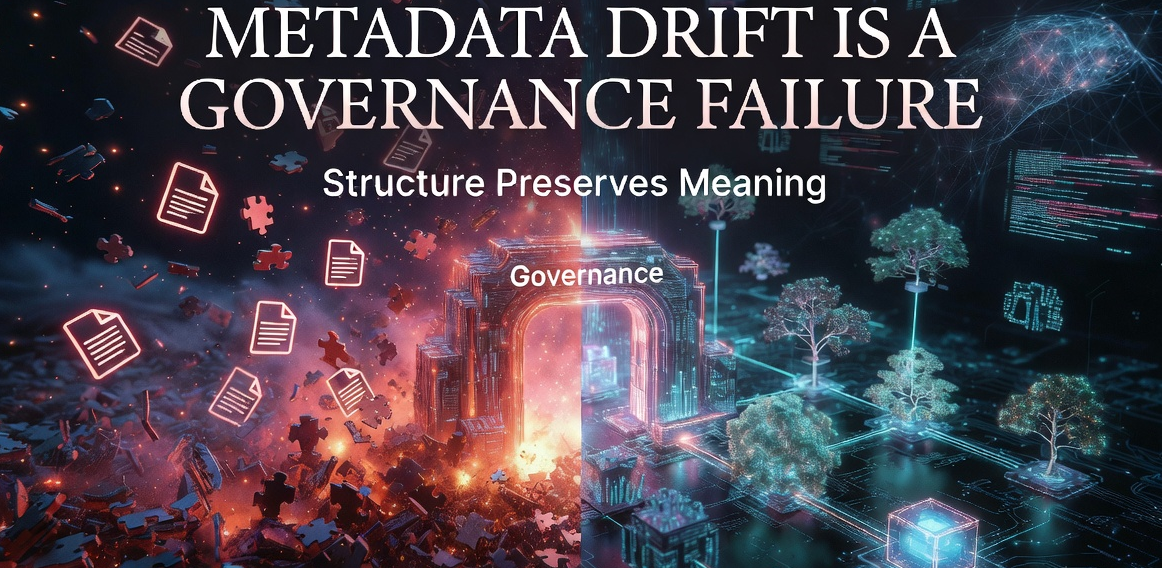
Why Metadata Fails Without Governance Architecture
Most organizations believe metadata creates order, governance, and automation. In reality, metadata only becomes trustworthy when governed by authoritative structure. Without governance architecture, metadata drifts, classifications fragment, automation fails, and AI systems inherit unreliable information environments.
Information Governance
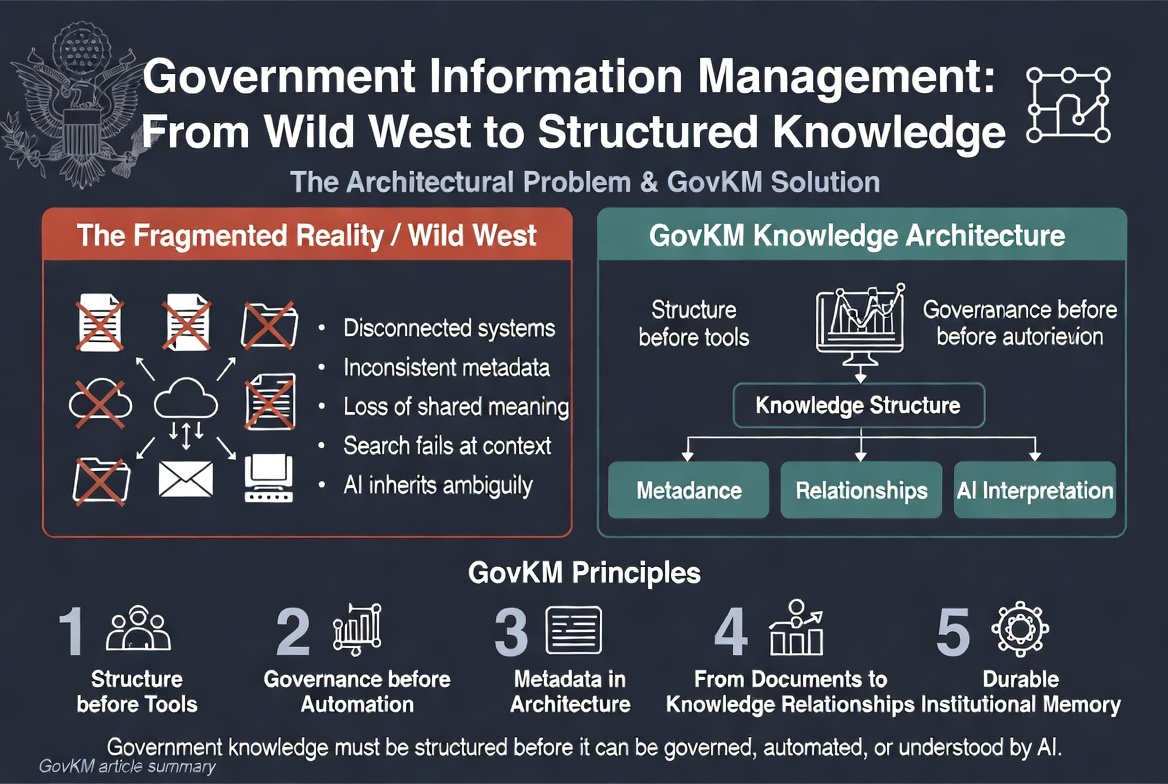
Automated Government Records Management Already Exists — The Real Problem Is Architecture
Government agencies continue layering new tools onto fragmented information environments without solving the underlying structural problems. This article examines why disconnected repositories, inconsistent metadata, and decentralized governance create systemic failure — and why government knowledge must be structurally organized before it can be governed, automated, searched, or reliably interpreted by AI systems.
File Management
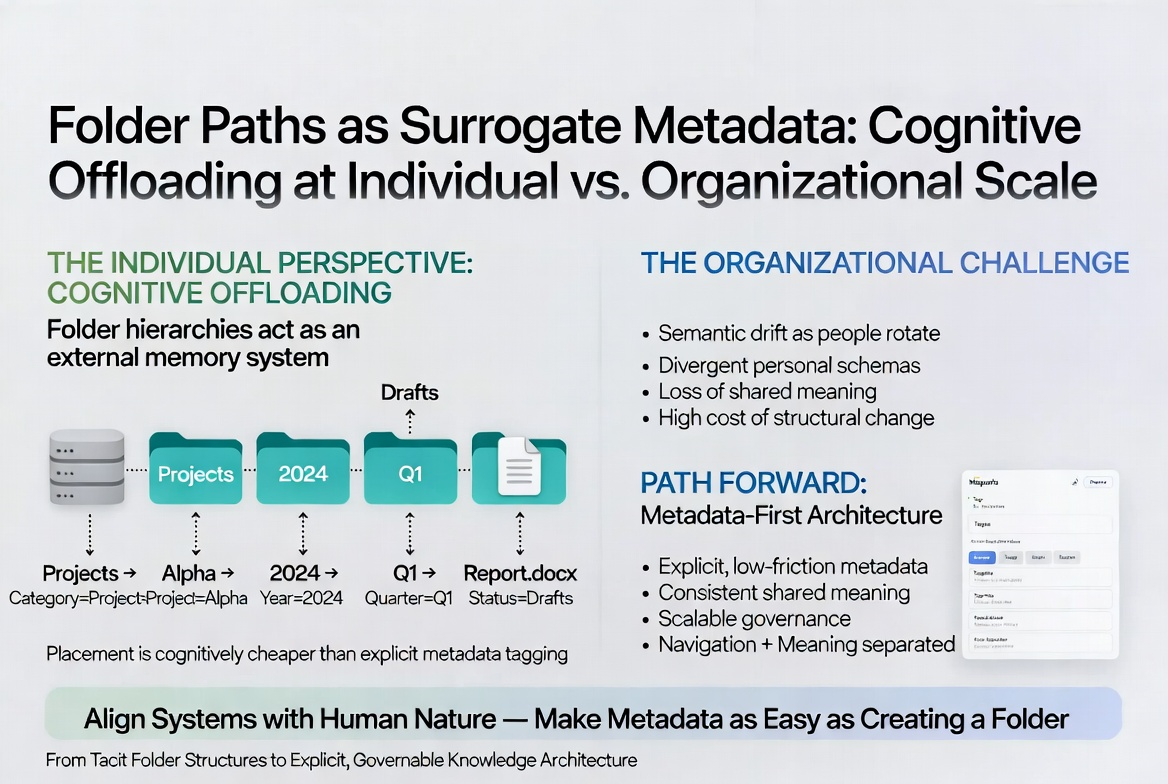
The Unseen Structure: Why Folder Paths Become Surrogate Metadata
This article argues that the widespread practice of embedding meaning into folder paths is not user error, but a natural cognitive strategy rooted in how humans organize and retrieve information. Individuals use folders as a form of “cognitive offloading,” relying on spatial memory and hierarchical structure because creating and navigating folders is cognitively easier than applying formal metadata. Folder paths effectively become implicit metadata systems, where each level of the hierarchy represents a category or attribute.
Metadata Architecture
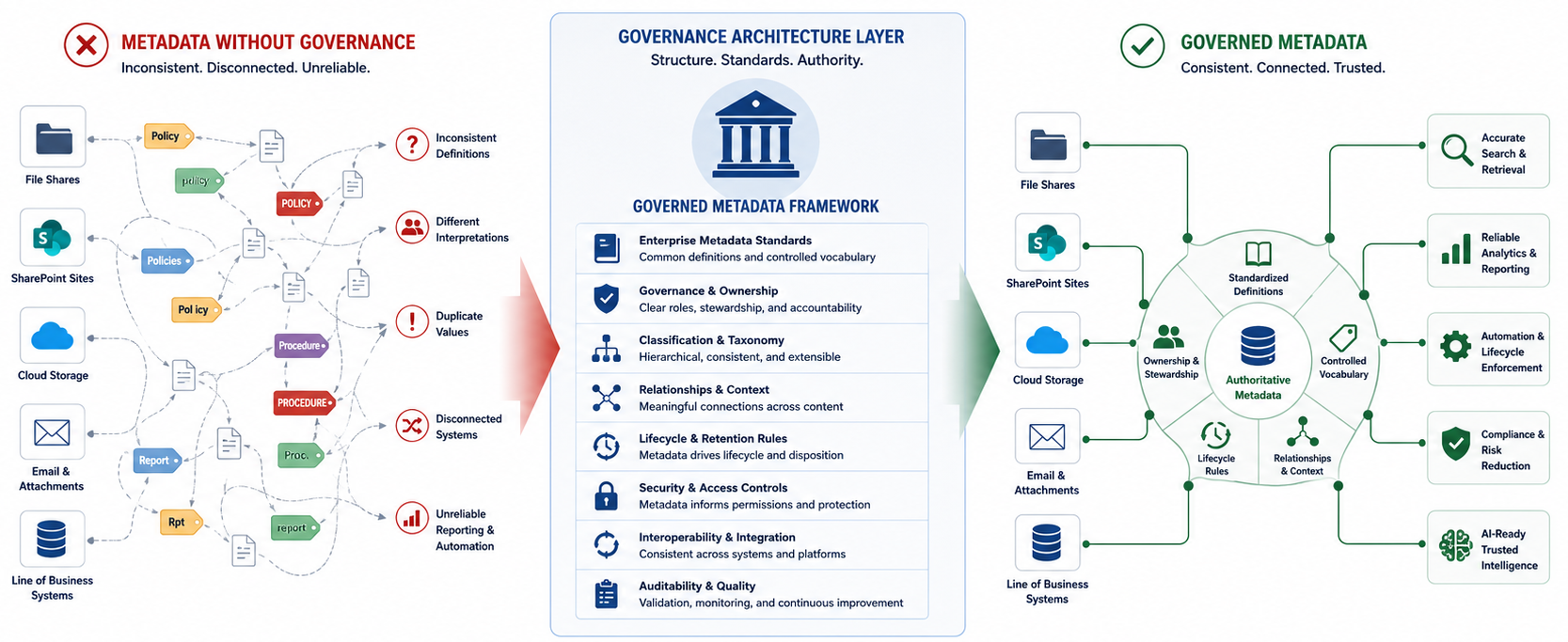
Why Metadata Fails Without Governance
Metadata programs often fail because organizations treat metadata as a labeling exercise rather than a governance architecture. This article explains why metadata becomes inconsistent at scale, why users resist abstract tagging, and why metadata only becomes reliable when it is connected to structure, authority, lifecycle rules, and organizational governance.
next step
Continue Your Continuity Journey
Explore the GovKM Continuity Framework or connect with GovKM to discuss your organization’s continuity, governance, and AI-readiness priorities.
FRAMEWORK
Explore the GovKM Continuity Framework
Understand the domains, relationships, principles, and implementation architecture that support organizational continuity.
CONNECT
Talk With GovKM
Discuss organizational continuity, AI readiness, governance architecture, research collaboration, or implementation priorities.