GOVKM KNOWLEDGE
Articles and Research on Organizational Continuity
Explore GovKM analysis, research, and practical guidance on Organizational Continuity, information governance, AI readiness, institutional knowledge, and continuity architecture.
FEATURED KNOWLEDGE
Featured Insights
Explore GovKM research, doctrine, and implementation guidance addressing the continuity challenges facing modern organizations.
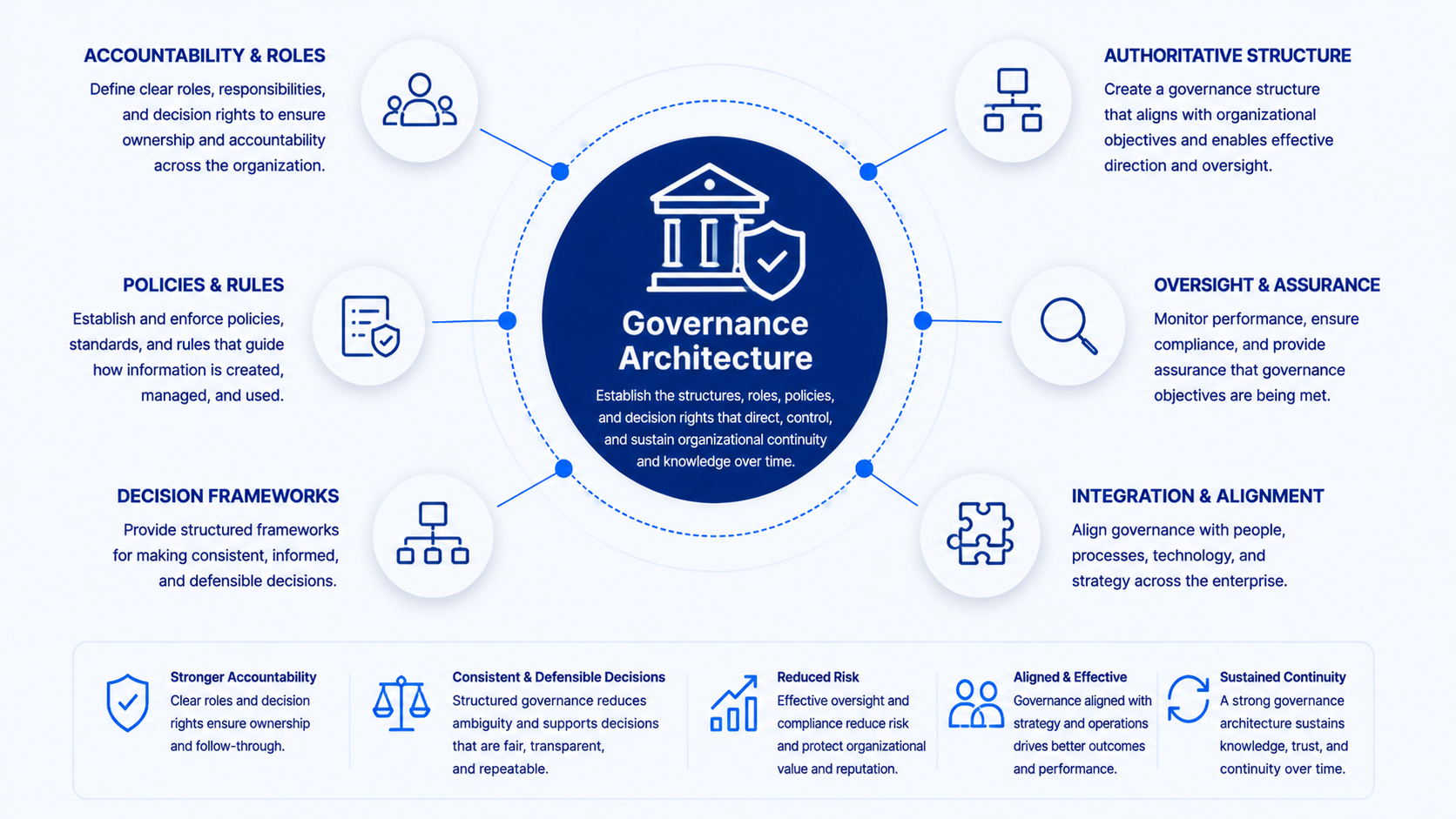
Governance Architecture
The Rule Existed. The Institution Could Not Prove the Decision Followed It.
An HHS OIG audit of Arizona Medicaid shows that policy authority is not operational governance by itself. Institutions must preserve evidence showing how governing requirements actually constrained decisions and actions.

Information Continuity
Your AI History Is Not Yet a Knowledge System
AI platforms can preserve, search, and export conversations. But a collection of retrievable chats does not preserve how a person’s ideas, evidence, corrections, decisions, and outputs develop across conversations and platforms. That requires continuity.
Corporate Operational Knowledge
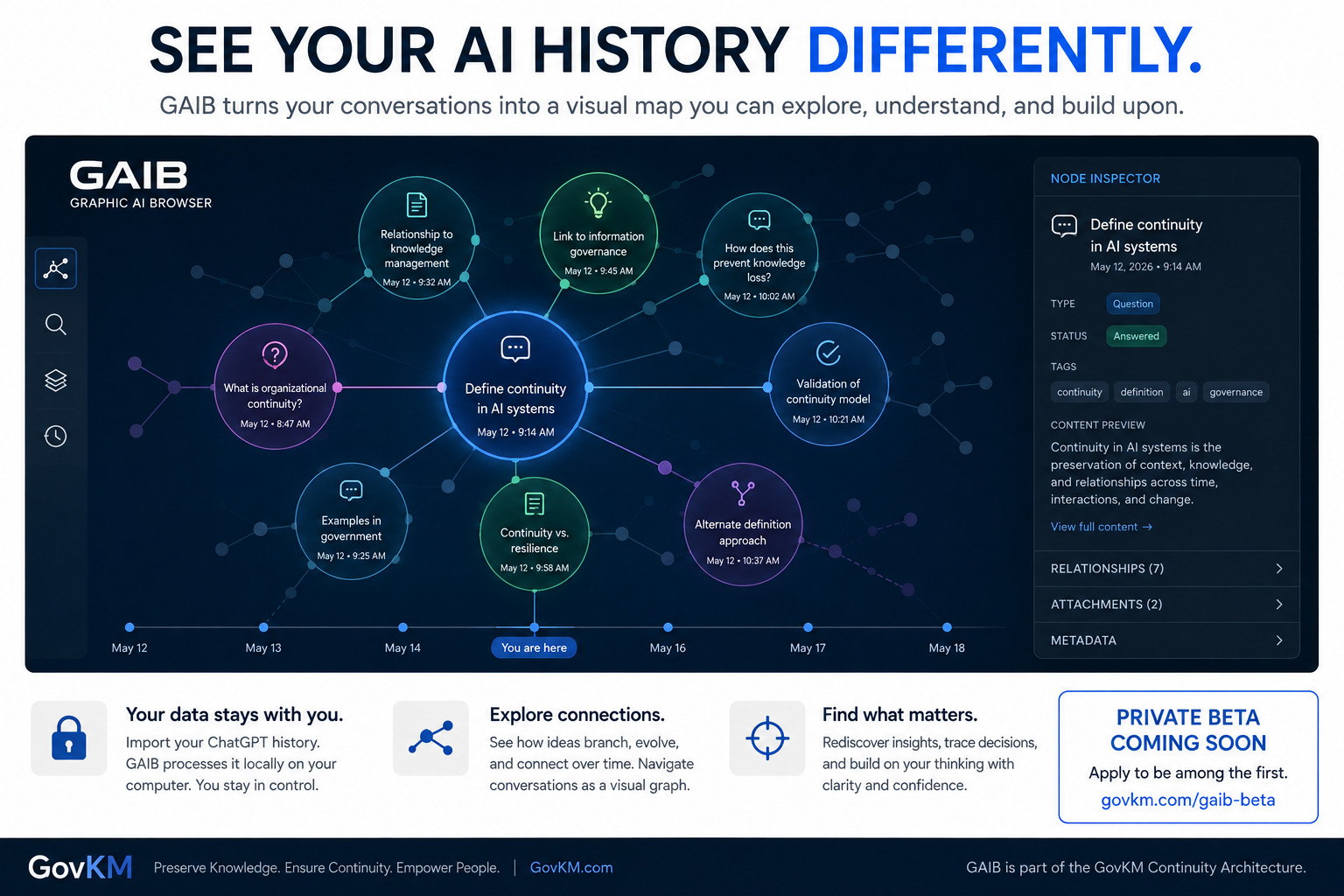
Your AI History Is Becoming Memory. Why Can't You See It?
Heavy AI users are accumulating valuable reasoning, decisions, corrections, and unfinished work inside linear chat histories. GovKM is preparing GAIB—the Graphic AI Browser—for a small private beta that turns supported AI history into a locally processed visual environment users can navigate and inspect.

Organizational Continuity
The Institution Must Agree Before the AI Can Know
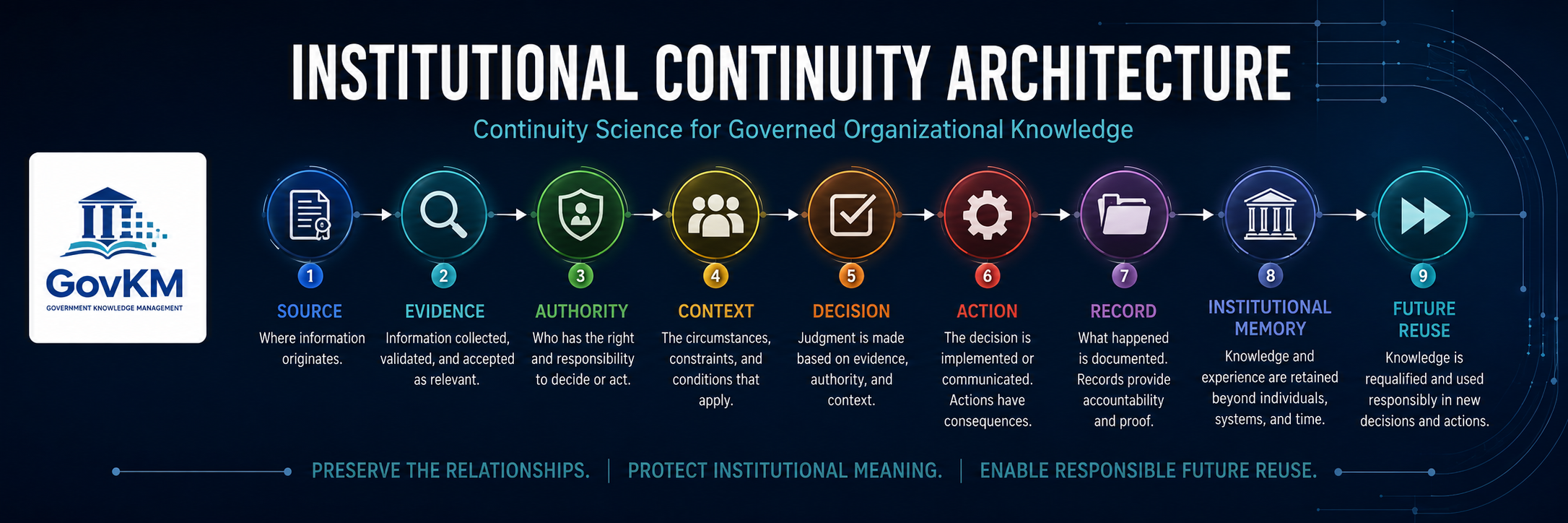
Organizations already possess most of the information AI needs. What they often lack are durable relationships connecting sources, evidence, authority, context, decisions, actions, records, institutional memory, and future reuse. As AI replaces work once performed by people who informally carried those relationships, Continuity becomes an institutional mandate. GovKM proposes a Continuity Compact among executive leadership, technology, records management, mission leadership, and users to establish the authoritative information environment that humans and AI require to act legitimately through organizational change.
Organizational Continuity
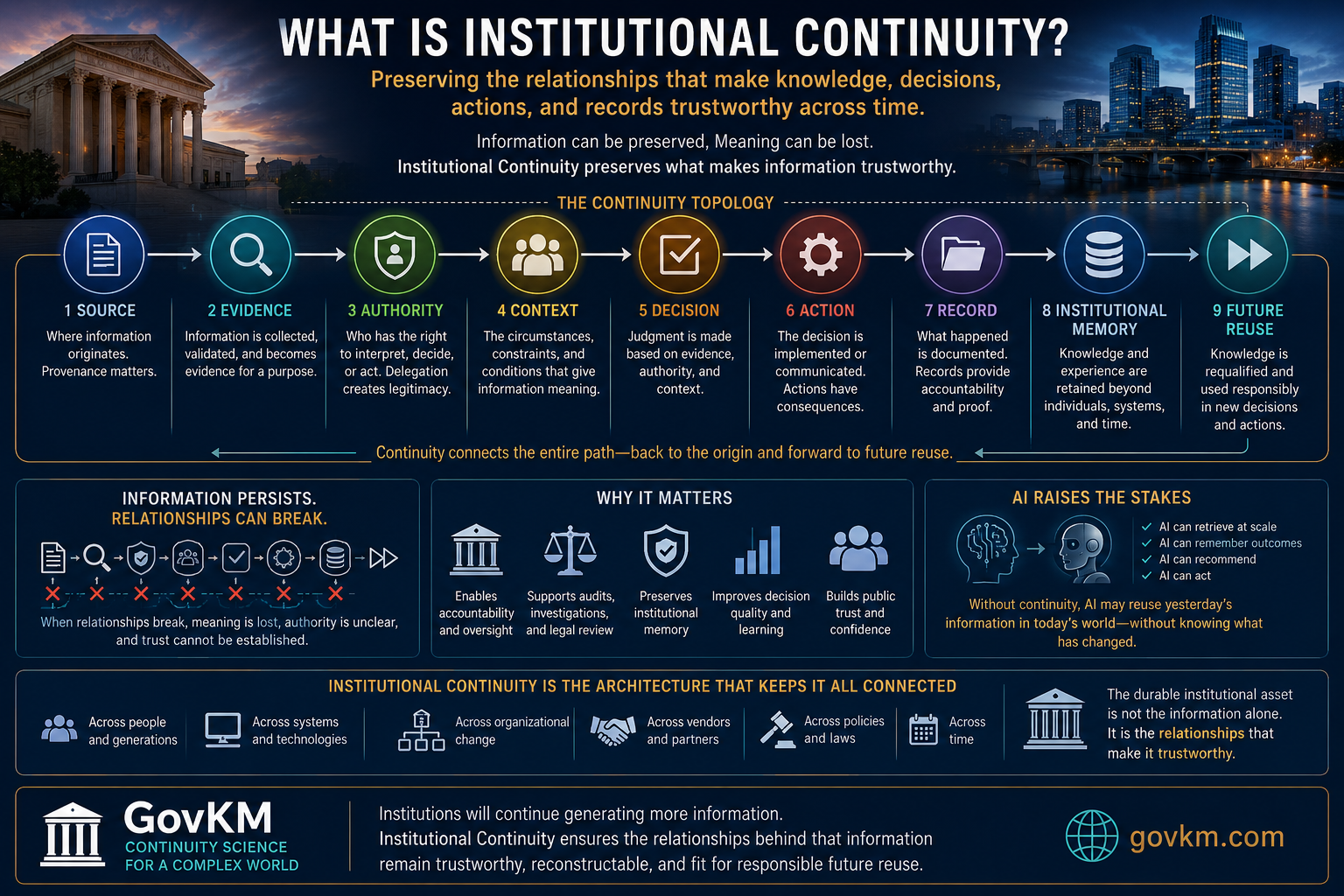
The Continuity Topology: How Institutional Knowledge Remains Trustworthy Across Time
A framework for preserving the relationships between sources, evidence, authority, context, decisions, actions, records, institutional memory, and future reuse
Governance Architecture
What Is Institutional Continuity?
Why preserving information is not enough—and why institutions must preserve the relationships that make knowledge trustworthy across time.
ARTICLES
Latest Research and Articles
Browse GovKM research, implementation guidance, continuity science, governance architecture, AI readiness, and organizational continuity.
Governance
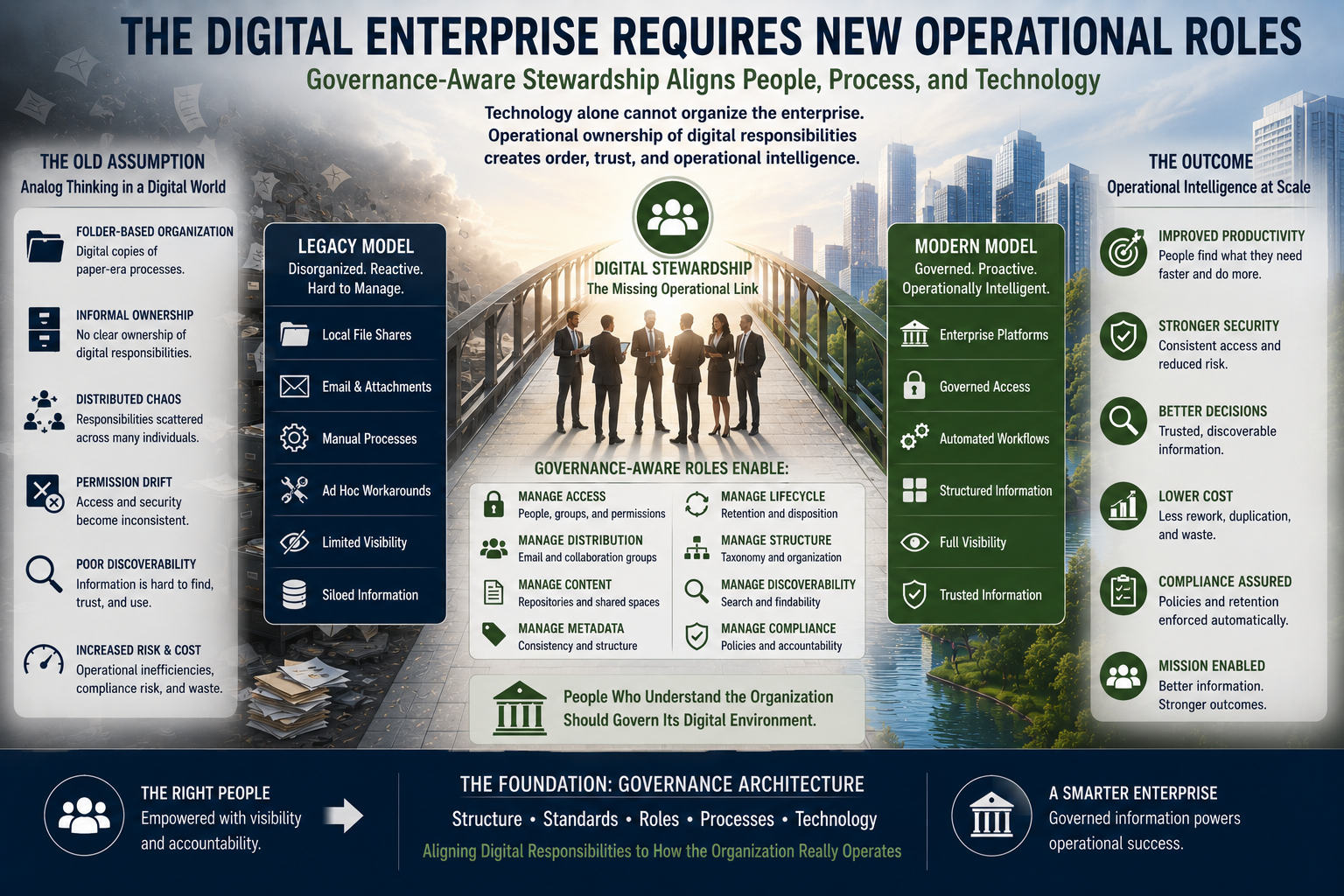
The Digital Enterprise Requires New Operational Roles
Modern enterprises continue operating with workforce structures designed for a pre-digital world, even as organizations increasingly depend on complex digital ecosystems. This article explores how unmanaged “digital duties” emerged across the enterprise, why governance requires operational ownership, and why the future organization will depend on governance-aware stewardship roles aligned to modern information environments.
Governance
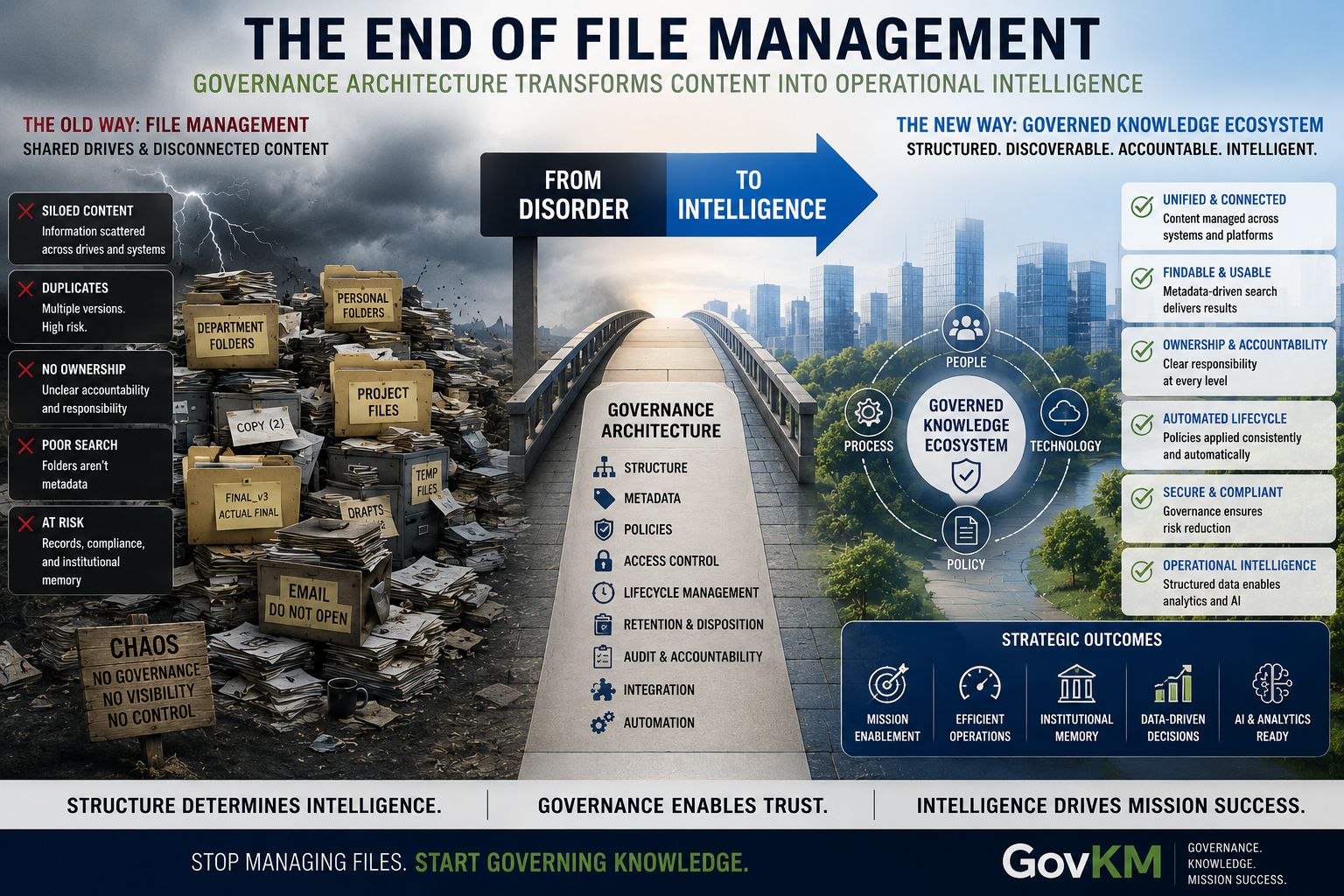
The End of File Management: Why Governance Architecture Must Replace Shared Drives
Government organizations are moving beyond the era of file management. Shared drives, folder structures, and unmanaged repositories can no longer support modern enterprise intelligence, AI readiness, or operational continuity. This article explores why governance architecture—not storage location—is becoming the foundation of structured organizational knowledge and machine-readable enterprise ecosystems.
Knowledge Governance Strategy
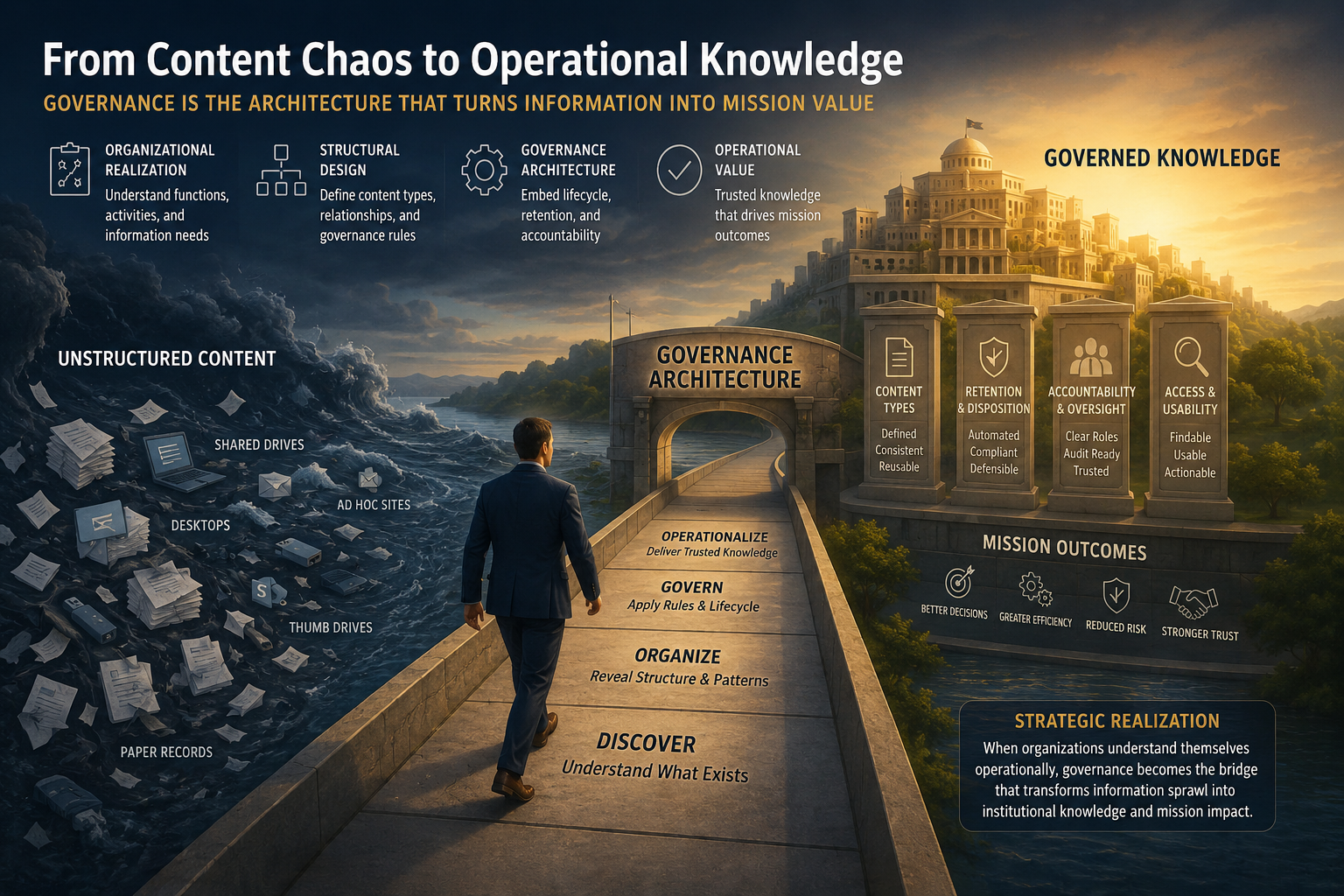
The Myth of the Records Management Problem: Government Already Solved It
Government records management was never truly a technology problem. Enterprise systems have automated retention and disposition for decades because they understand organizational purpose and content structure. The real challenge lies in unstructured environments where governance architecture was never formally established. This article explores why governance—not metadata or AI—is the foundation of successful modernization.
Governance
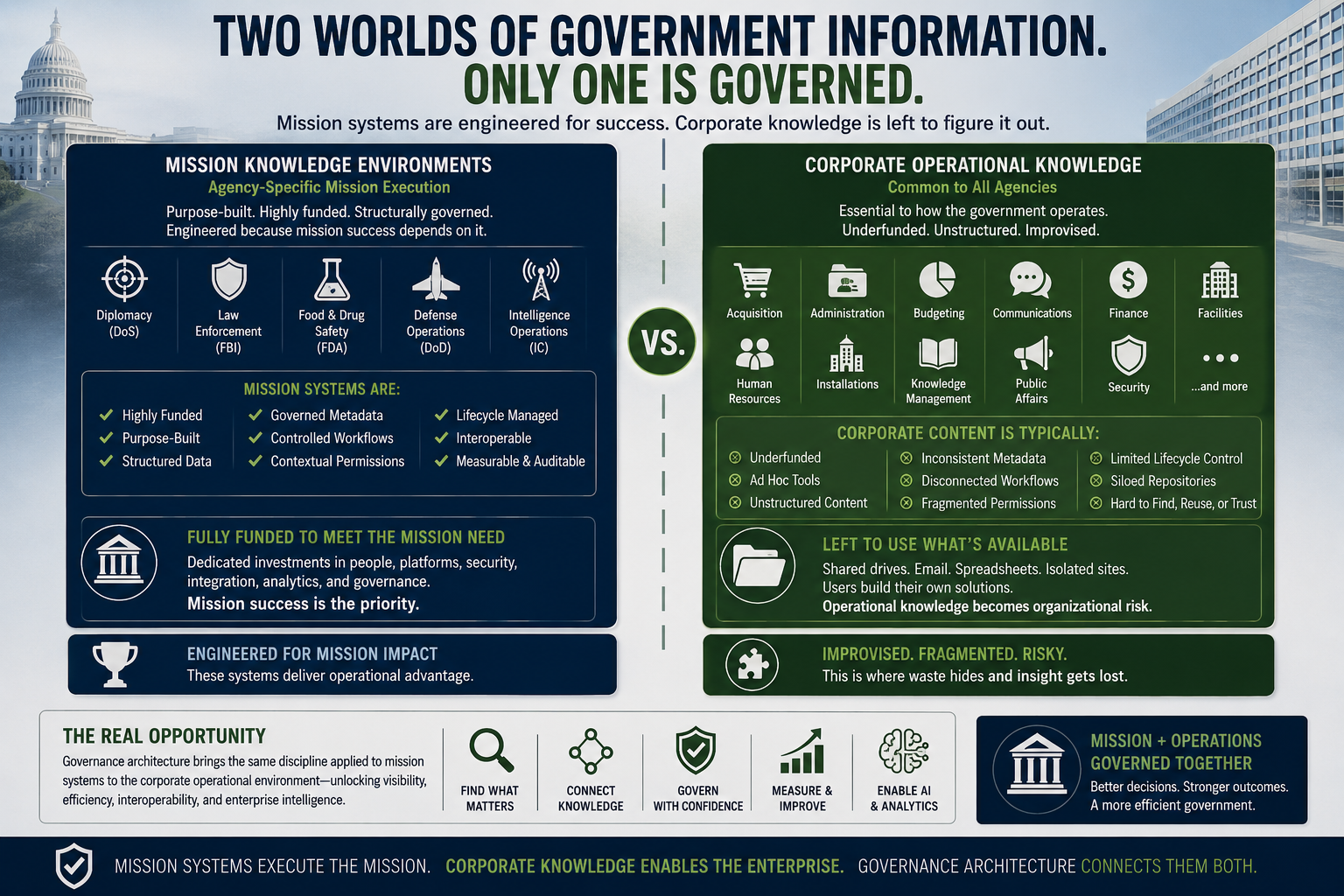
The Real Government Knowledge Problem Is Not Mission Data — It Is Corporate Operational Content
Government mission systems are typically well-funded, highly structured, and operationally governed because mission success depends on them. The real governance crisis exists within the unstructured corporate operational knowledge ecosystem—Acquisition, HR, Budgeting, Communications, Security, and other internal business functions that generate fragmented operational content across disconnected environments. This article explores why the future of government modernization depends on governing corporate operational knowledge structurally at enterprise scale.
Governance
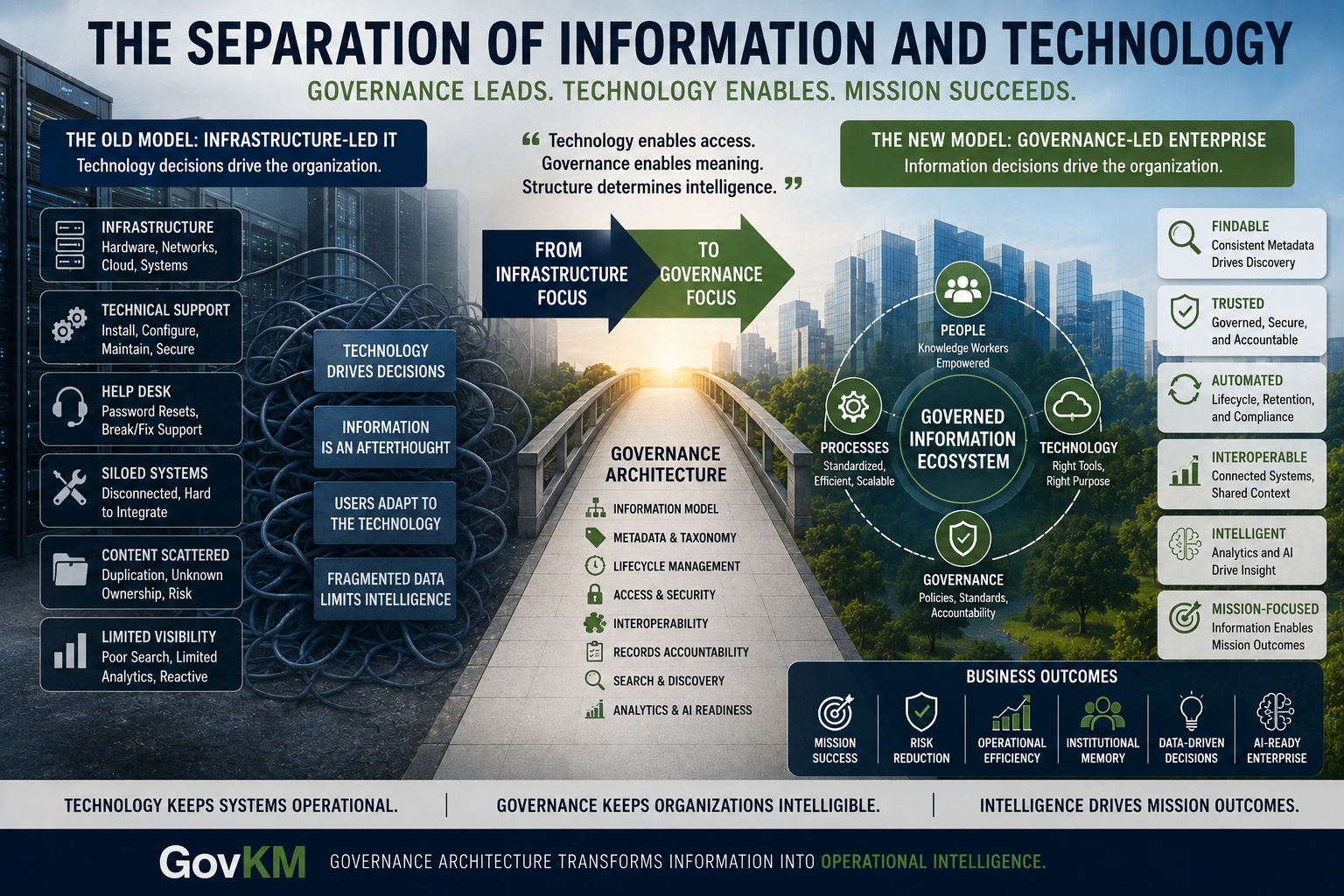
The Separation of Information and Technology: Why Governance Must Lead Infrastructure
Modern enterprises are beginning to recognize that managing technology and governing information are fundamentally different disciplines. This article explores why governance architecture—not infrastructure alone—is becoming the foundation of operational intelligence, enterprise interoperability, AI readiness, and organizational continuity across distributed knowledge ecosystems.
Knowledge Management Strategy
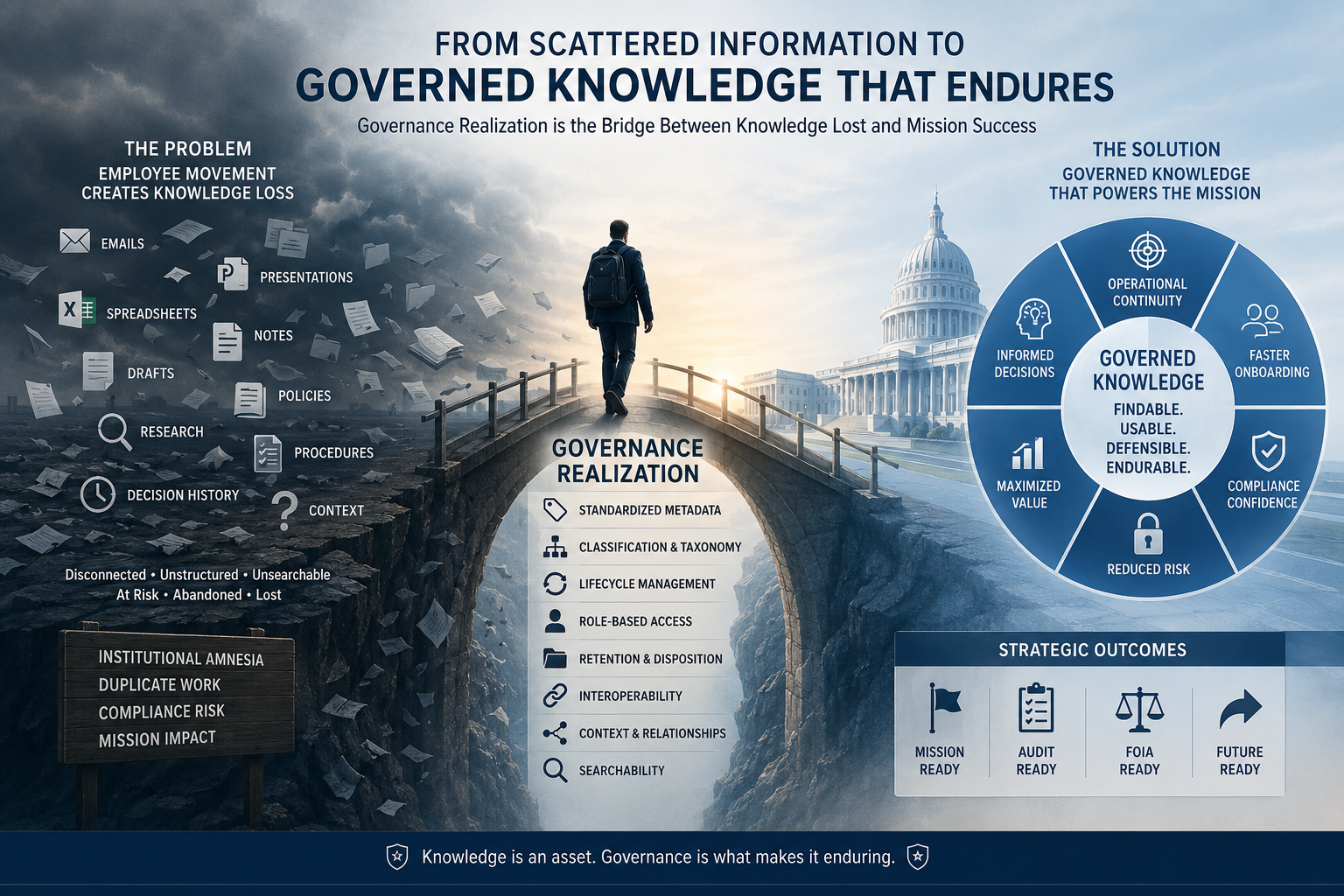
Where Government Knowledge Goes to Disappear — And How Governance Prevents the Loss
Government and industry organizations lose operational knowledge every day — not because employees leave, but because governance architecture was never established to preserve, structure, and manage what employees create. This article explores why folders, portals, and cloud storage fail without governance realization, and why structured knowledge governance is essential for operational continuity, FOIA readiness, records management, and long-term institutional intelligence.
Governance
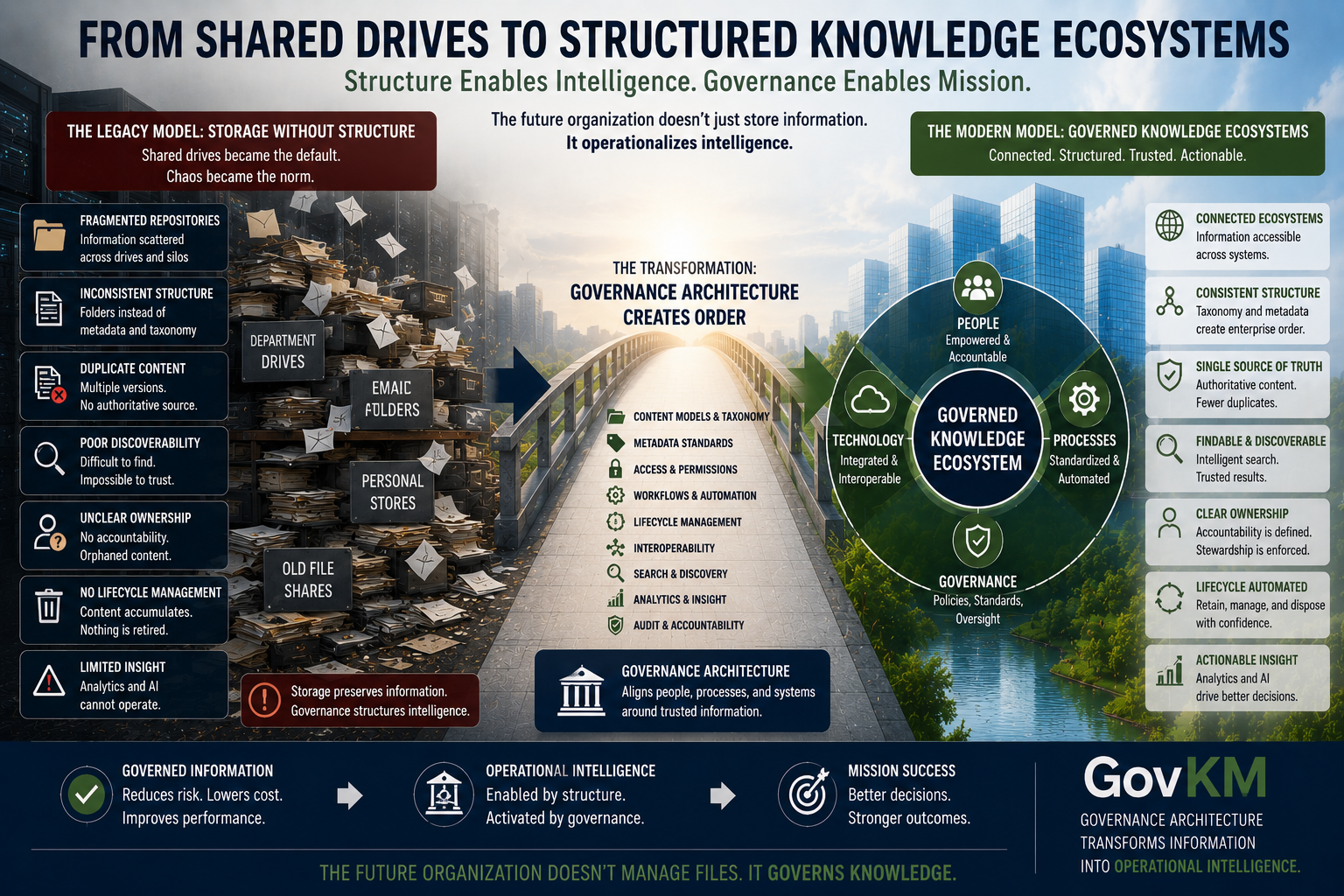
Why Shared Drives Became the Default Knowledge System — And Why That Model Is Failing
Government organizations already operate highly structured mission systems, yet most operational enterprise knowledge still lives in fragmented shared drives and disconnected repositories. This article explores how shared drives unintentionally became the default knowledge system, why folder structures failed as governance mechanisms, and why modern enterprises must transition toward governed knowledge ecosystems capable of supporting search, analytics, interoperability, and AI readiness.
Governance Architecture
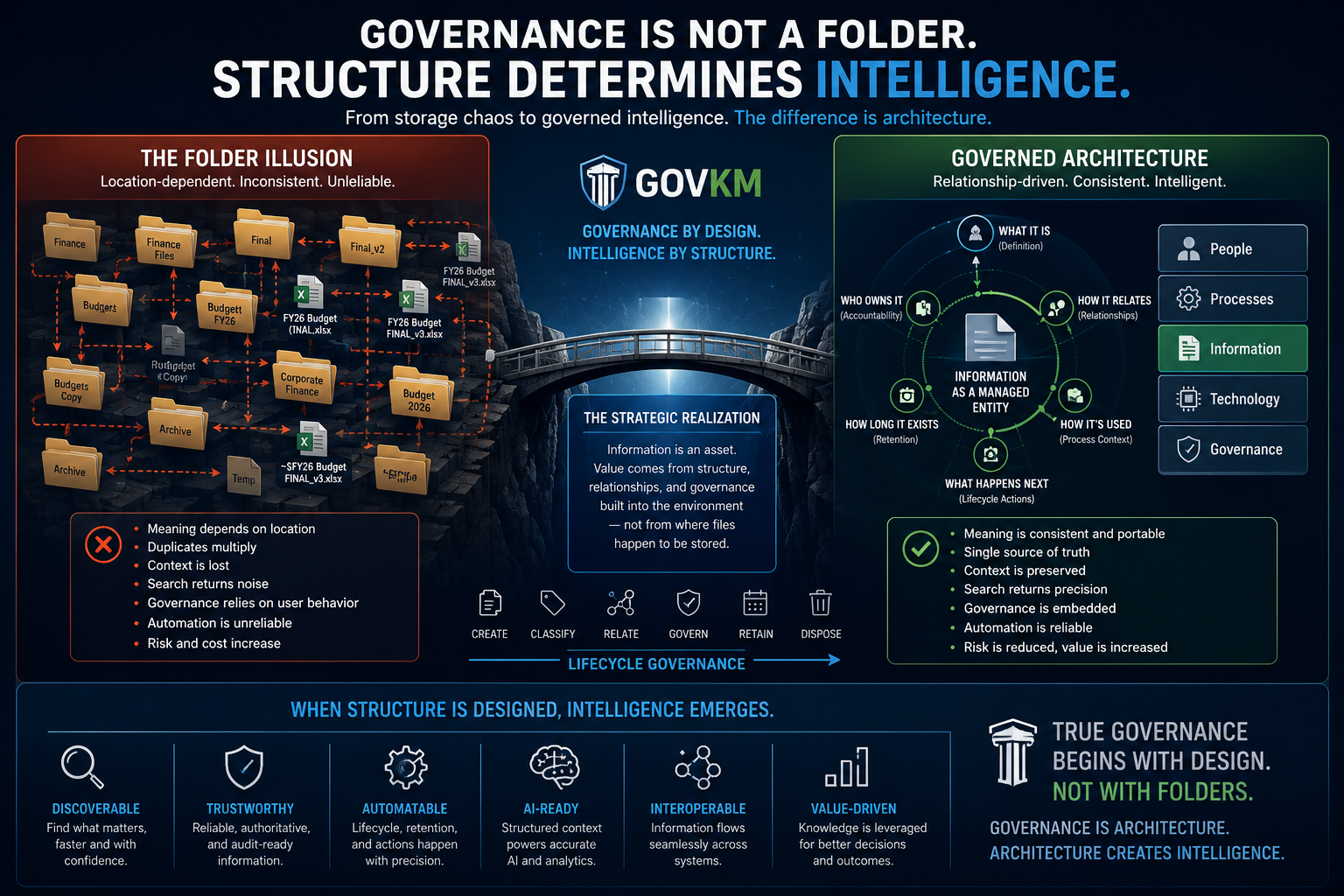
Governance Is Not a Folder: Why Structure Determines Intelligence
Most organizations mistake folders and storage hierarchies for governance architecture. This article explains why folders only create location dependency and surrogate meaning, while true organizational intelligence requires engineered relationships, operational structure, and governance-by-design. GovKM’s strategic realization reframes governance as architecture — not filing — positioning structured information environments as the foundation for automation, AI, discoverability, and enterprise intelligence.
Knowledge Management
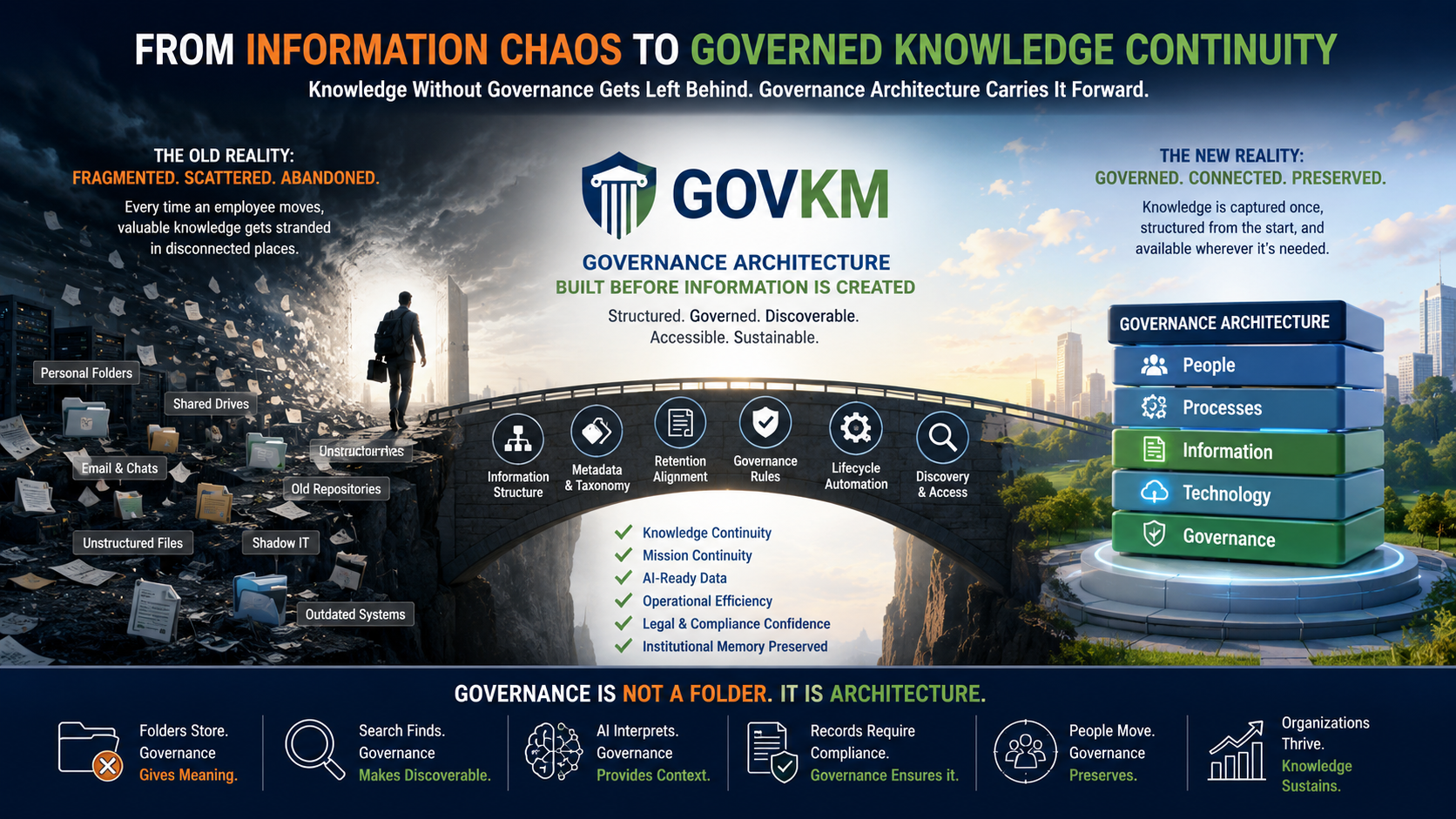
The Hidden Cost of Employee Turnover: Knowledge Without Governance
Modern organizations lose institutional knowledge not because employees leave, but because governance architecture was never established before information creation began. This article explains why folders, search, cloud platforms, and AI cannot solve unmanaged information chaos — and why governance-driven structure is now essential for knowledge continuity, discoverability, compliance, and sustainable organizational intelligence.
next step
Continue Your Continuity Journey
Explore the GovKM Continuity Framework or connect with GovKM to discuss your organization’s continuity, governance, and AI-readiness priorities.
FRAMEWORK
Explore the GovKM Continuity Framework
Understand the domains, relationships, principles, and implementation architecture that support organizational continuity.
CONNECT
Talk With GovKM
Discuss organizational continuity, AI readiness, governance architecture, research collaboration, or implementation priorities.