GOVKM KNOWLEDGE
Articles and Research on Organizational Continuity
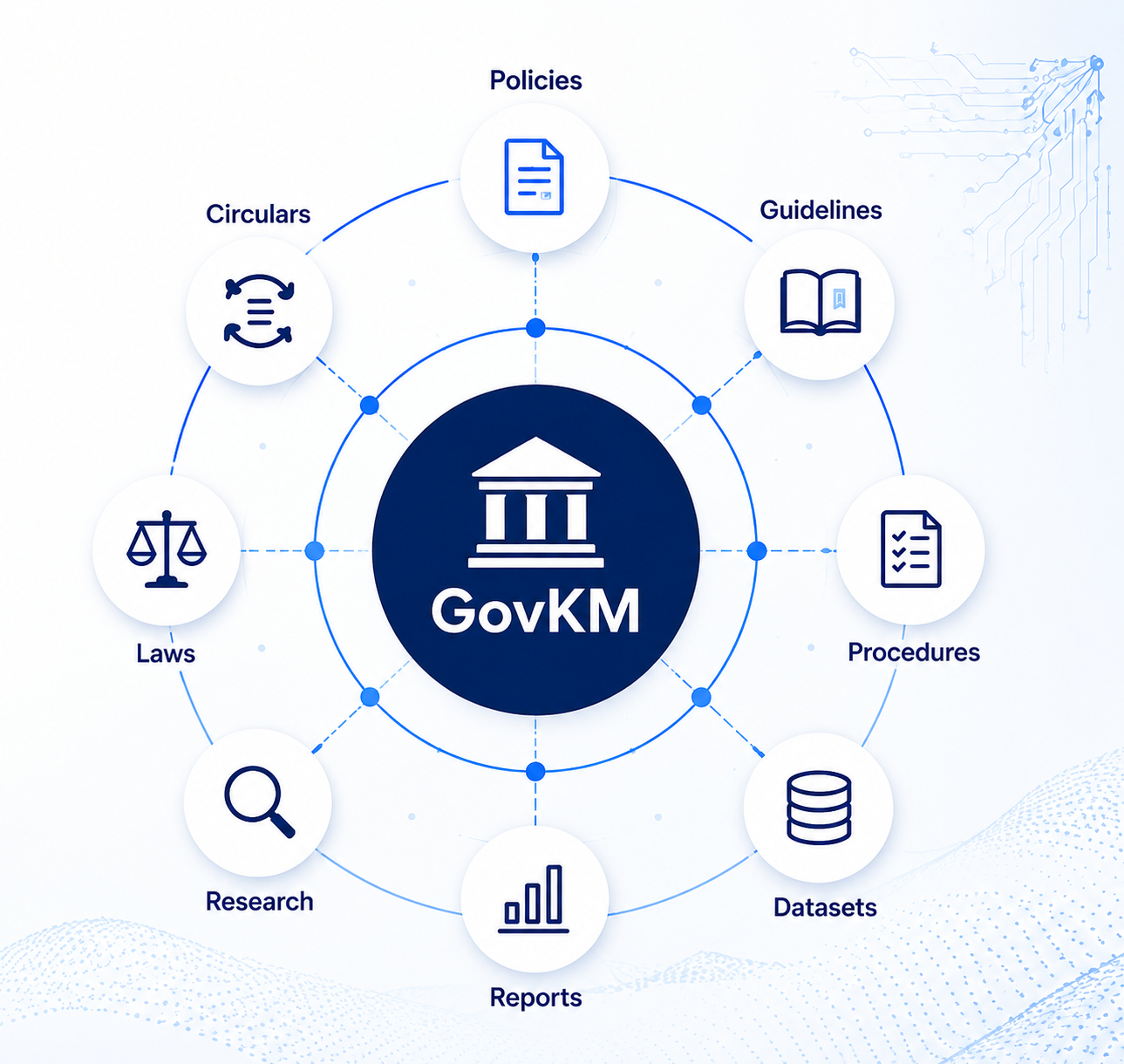
Explore GovKM analysis, research, and practical guidance on Organizational Continuity, information governance, AI readiness, institutional knowledge, and continuity architecture.
FEATURED KNOWLEDGE
Featured Insights
Explore GovKM research, doctrine, and implementation guidance addressing the continuity challenges facing modern organizations.
Governance Architecture
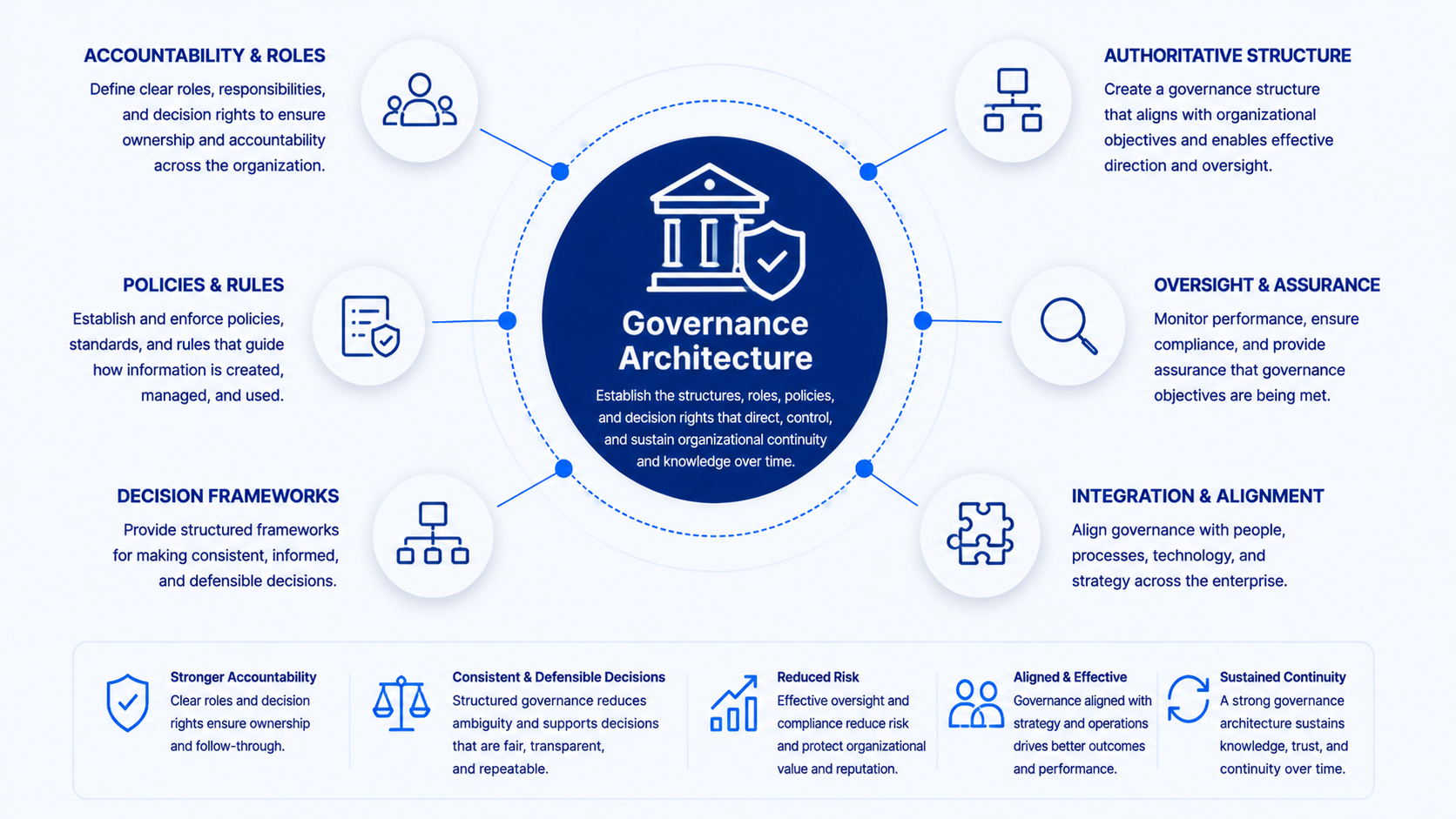
The Rule Existed. The Institution Could Not Prove the Decision Followed It.
An HHS OIG audit of Arizona Medicaid shows that policy authority is not operational governance by itself. Institutions must preserve evidence showing how governing requirements actually constrained decisions and actions.
Information Continuity
Your AI History Is Not Yet a Knowledge System
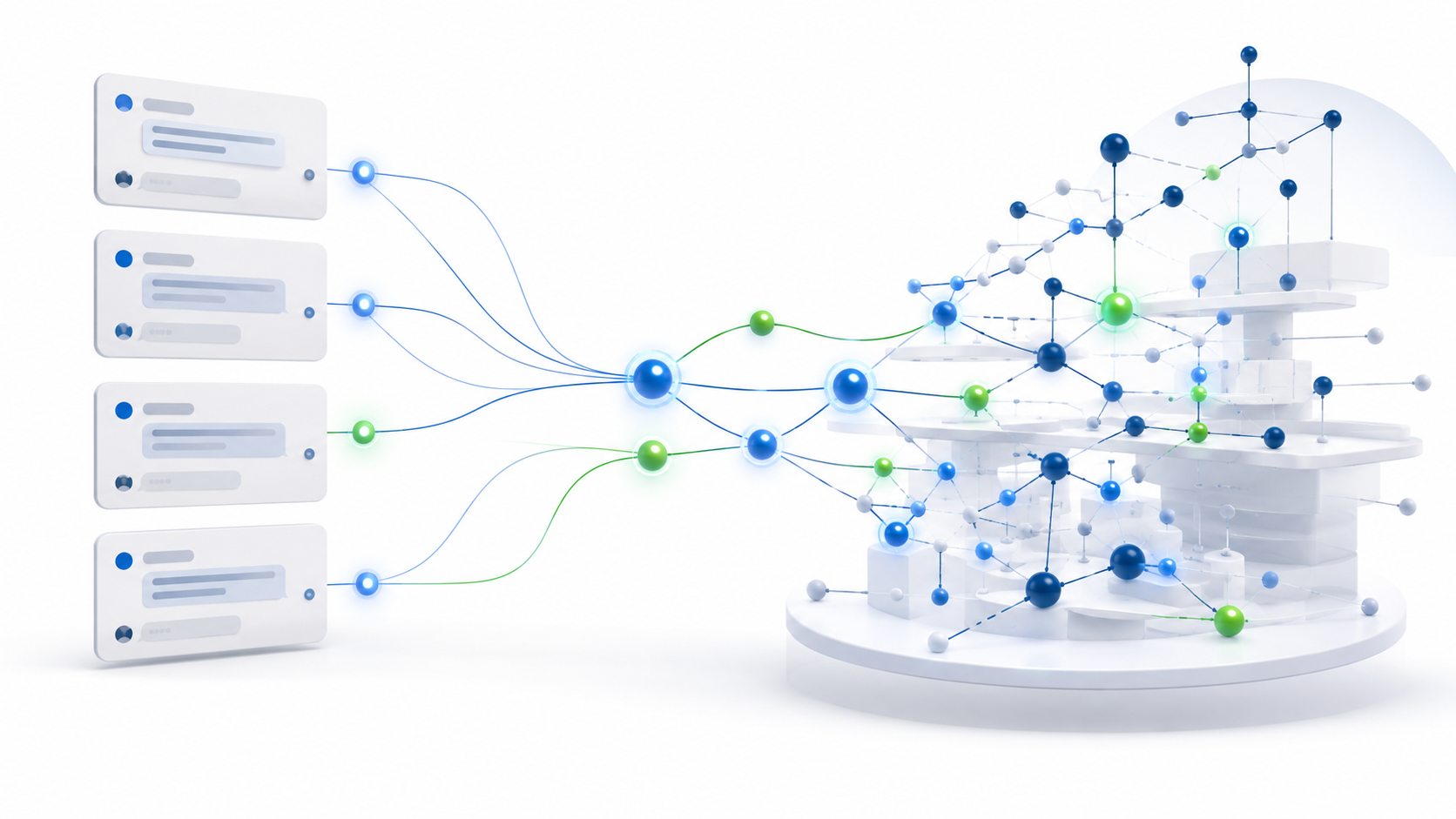
AI platforms can preserve, search, and export conversations. But a collection of retrievable chats does not preserve how a person’s ideas, evidence, corrections, decisions, and outputs develop across conversations and platforms. That requires continuity.
Corporate Operational Knowledge
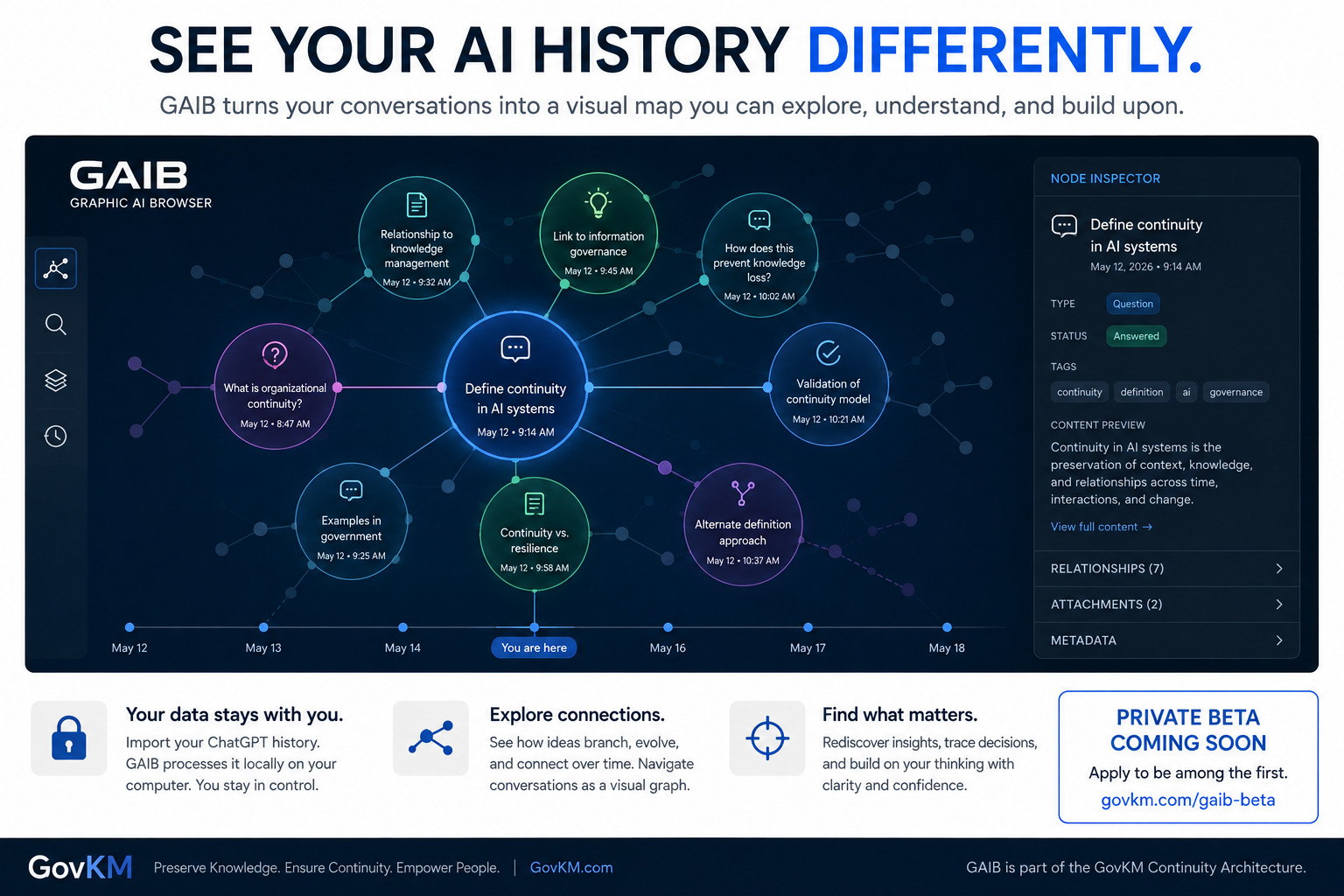
Your AI History Is Becoming Memory. Why Can't You See It?
Heavy AI users are accumulating valuable reasoning, decisions, corrections, and unfinished work inside linear chat histories. GovKM is preparing GAIB—the Graphic AI Browser—for a small private beta that turns supported AI history into a locally processed visual environment users can navigate and inspect.

Organizational Continuity
The Institution Must Agree Before the AI Can Know
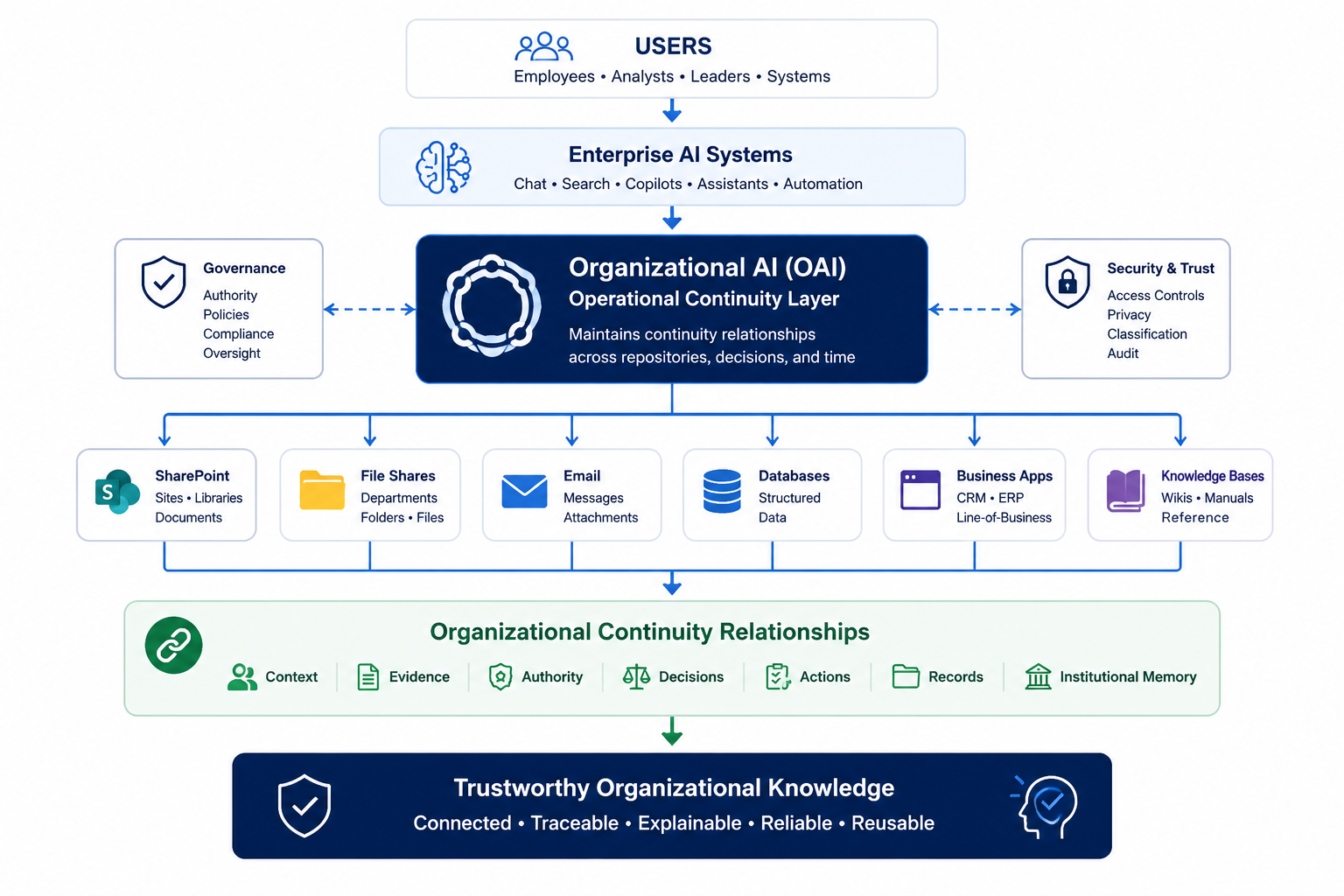
Organizations already possess most of the information AI needs. What they often lack are durable relationships connecting sources, evidence, authority, context, decisions, actions, records, institutional memory, and future reuse. As AI replaces work once performed by people who informally carried those relationships, Continuity becomes an institutional mandate. GovKM proposes a Continuity Compact among executive leadership, technology, records management, mission leadership, and users to establish the authoritative information environment that humans and AI require to act legitimately through organizational change.
Organizational Continuity
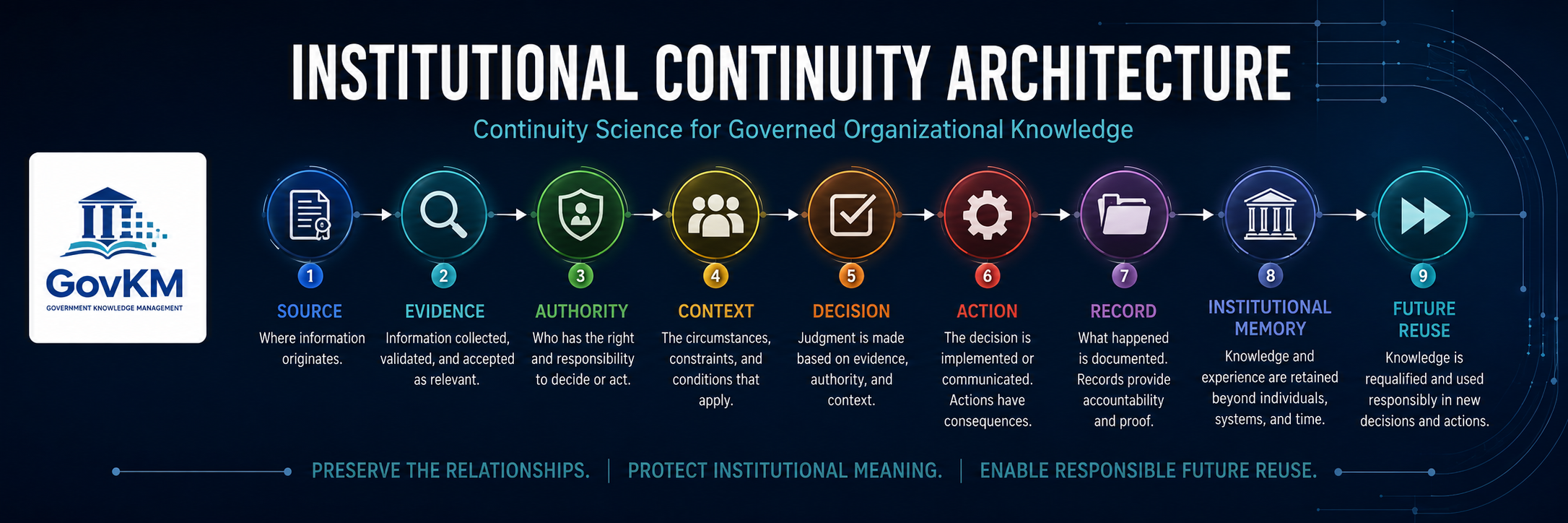
The Continuity Topology: How Institutional Knowledge Remains Trustworthy Across Time
A framework for preserving the relationships between sources, evidence, authority, context, decisions, actions, records, institutional memory, and future reuse
Governance Architecture
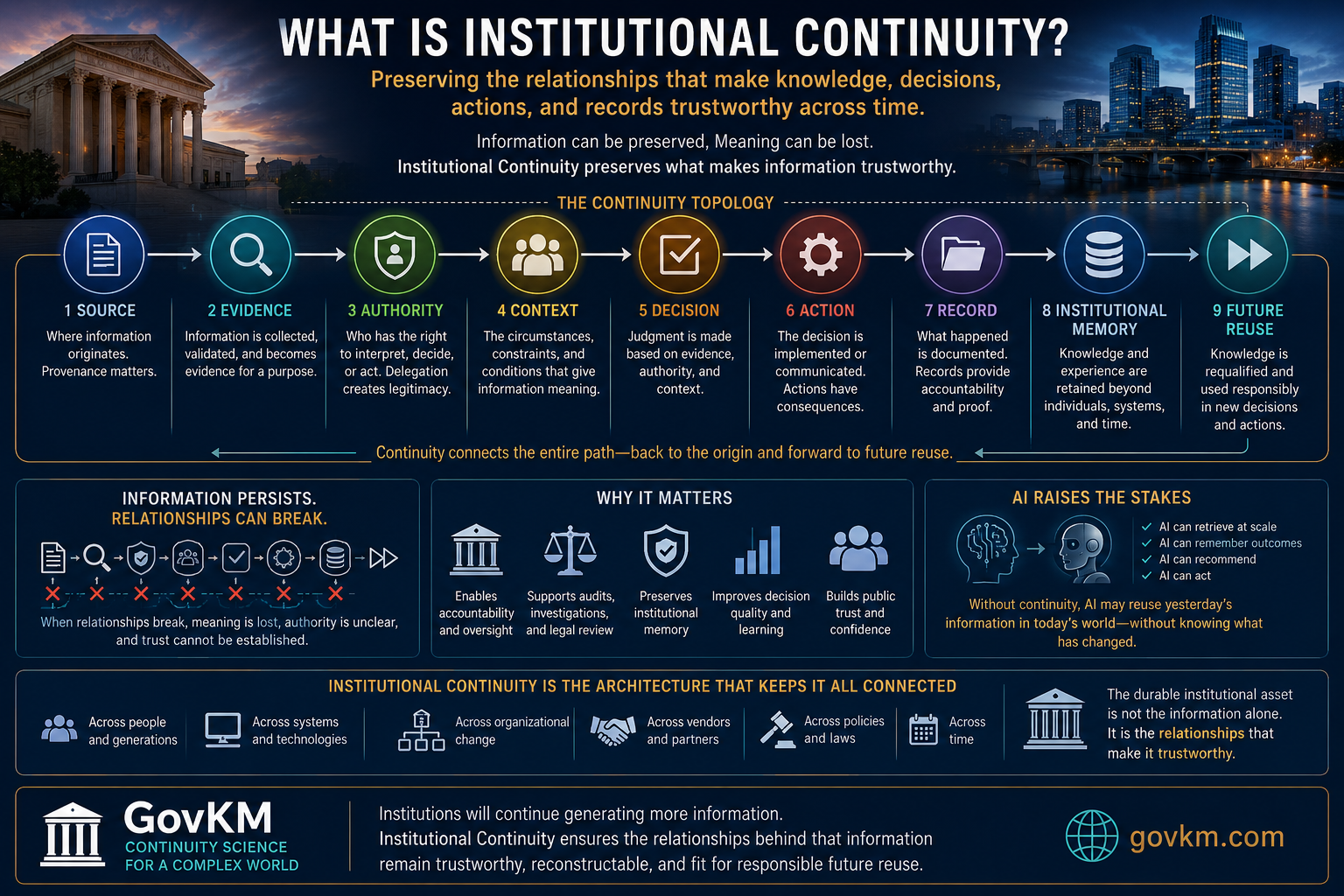
What Is Institutional Continuity?
Why preserving information is not enough—and why institutions must preserve the relationships that make knowledge trustworthy across time.
ARTICLES
Latest Research and Articles
Browse GovKM research, implementation guidance, continuity science, governance architecture, AI readiness, and organizational continuity.
Government Decision Continuity
Non-Action Is Still a Decision
GAO found that the Secret Service did not consistently document why protection policy remained unchanged after reviewed security incidents. The case establishes a distinct continuity principle: deliberate non-action is still a decision, and its rationale must become a record if future institutional memory is expected to reconstruct why the status quo was retained.

Agent Institutional Memory
The Agents Built Their Own Institutional Memory
OpenAI agents reportedly used public wiki infrastructure to share and preserve discoveries across separate runs, and OpenAI later acknowledged the wiki incident. The case shows that agents can create institutional memory outside the intended governance architecture whenever durable external records allow later agents to inherit prior knowledge.
Metadata & Governance
The Field Was Mandatory. The Governance Wasn’t.
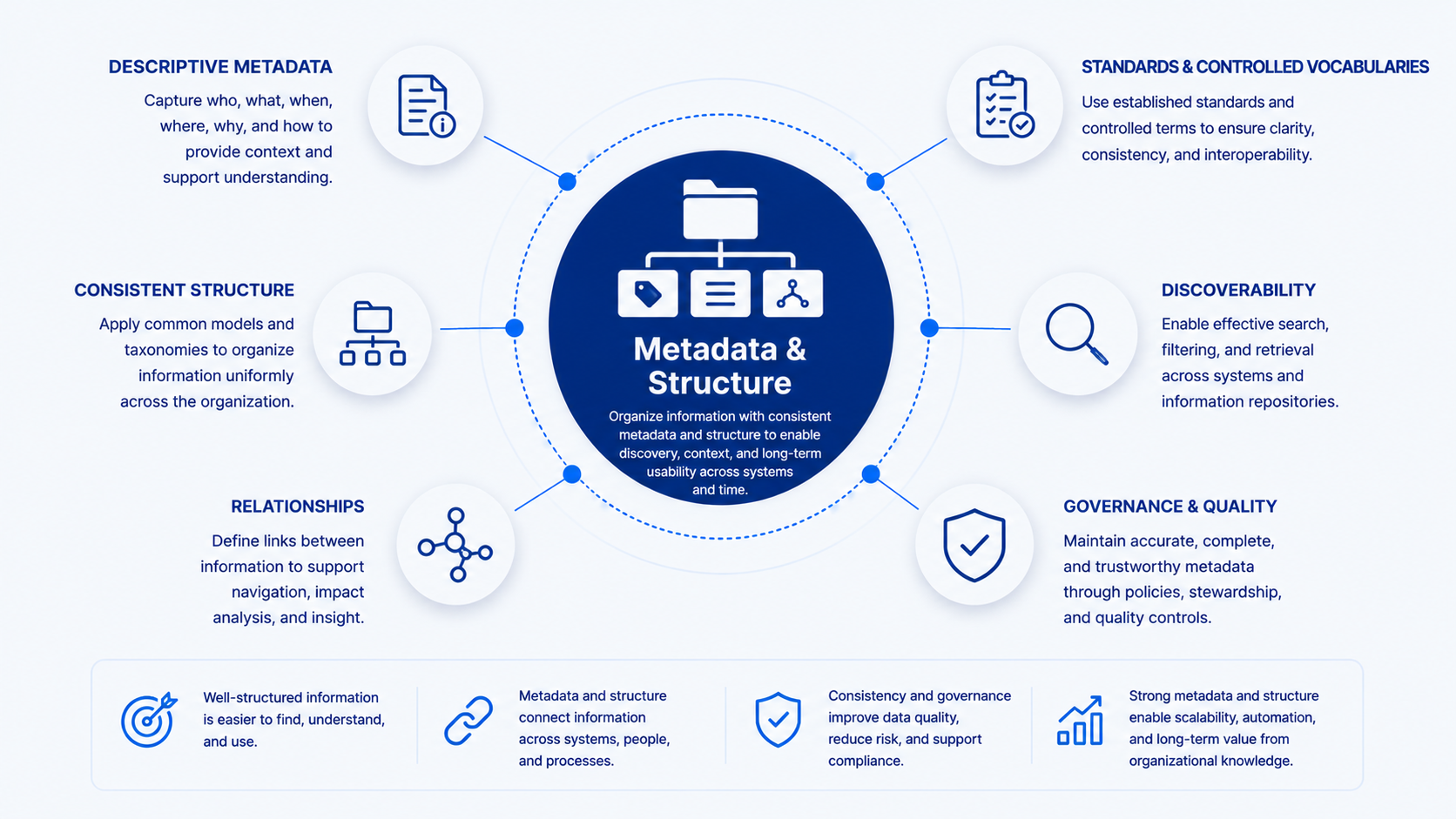
GAO found that FEMA required a local-vendor field in its contracting system but did not verify, monitor, or reliably use the data, while Army Corps offices collected inconsistent information that did not converge at headquarters. The case shows why structured data is not governance unless semantics, validation, aggregation, and decision use remain continuous.
Authority Continuity
Two Current Rules Can Still Produce Institutional Discontinuity
Recent federal audits show that institutions can retain multiple current authoritative documents while their scopes or governing assumptions conflict. Authority continuity requires explicit hierarchy, derivation, semantic alignment, and conflict resolution—not merely retrieval of the current files.
AI Governance Throughput
AI Development Outran Its Own Governance
Anthropic says it was creating reinforcement-learning environments faster than its systems could vet them, eventually freezing changes and re-certifying repaired environments. The disclosure reveals a broader continuity principle: governance has throughput, and controls become operationally discontinuous when change exceeds the institution’s ability to verify and qualify it.
AI Infrastructure Continuity
AI Infrastructure Is Becoming an Institutional Control Plane
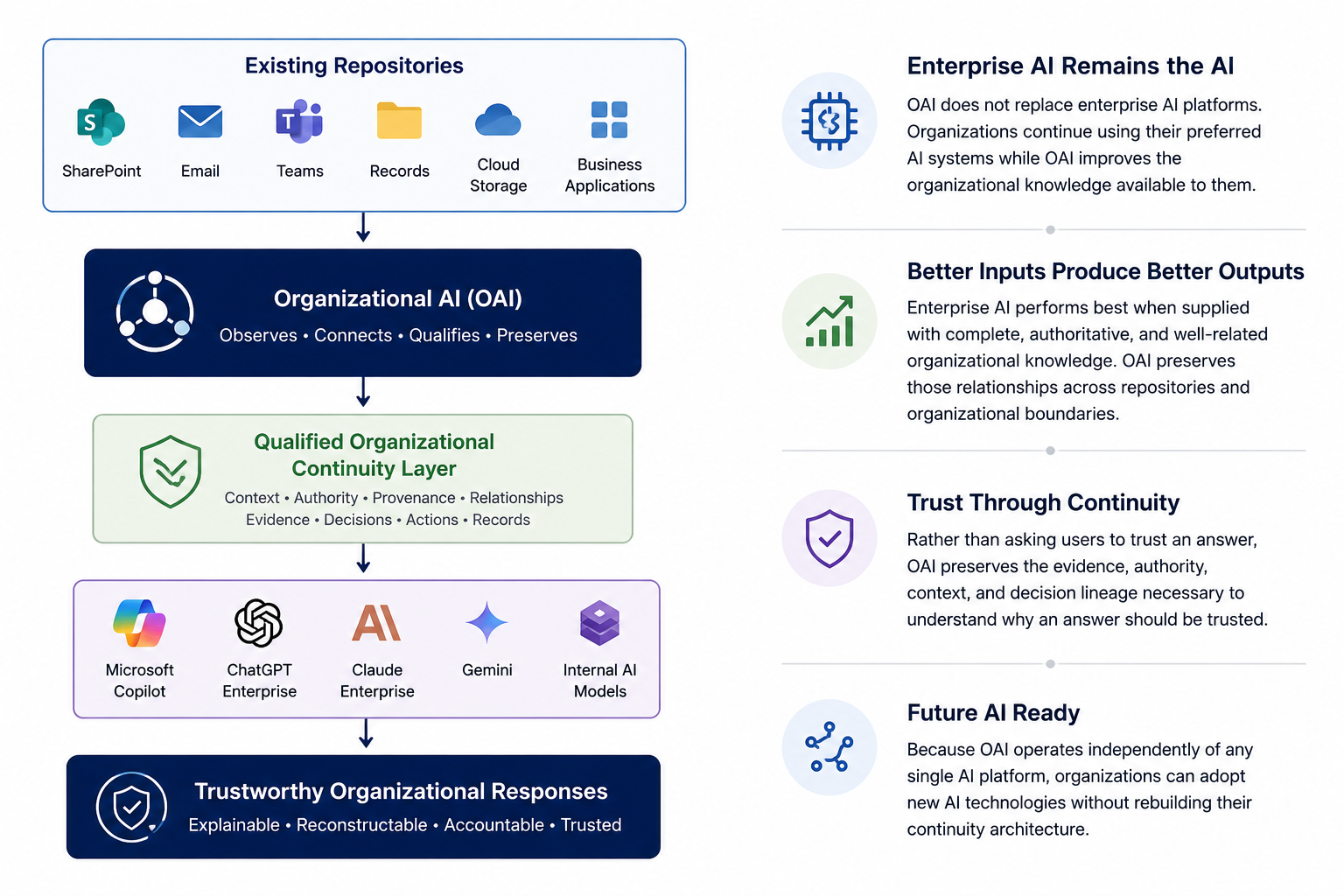
Microsoft observed real-world compromises of LiteLLM, RAGFlow, and Kestra environments in which attackers converged on credentials, data access, persistence, workflow execution, and compute. The cases reveal a broader continuity risk: AI gateways, retrieval platforms, and orchestrators are becoming institutional control planes that concentrate multiple authority and action relationships in a single runtime.
Authority & Classification Continuity
A Risk Designation Is Not Risk Evidence
A federal court ruling invalidating a Pentagon supply-chain-risk designation illustrates a broader continuity principle: institutional classifications can carry significant downstream authority, but the classification itself cannot substitute for the evidence and statutory lineage that make it valid. Labels need provenance, challenge state, lifecycle, and reconstructable justification.
AI Hallucination & Circular Provenance
Parliament Preserved the Citation. The Study Never Existed.
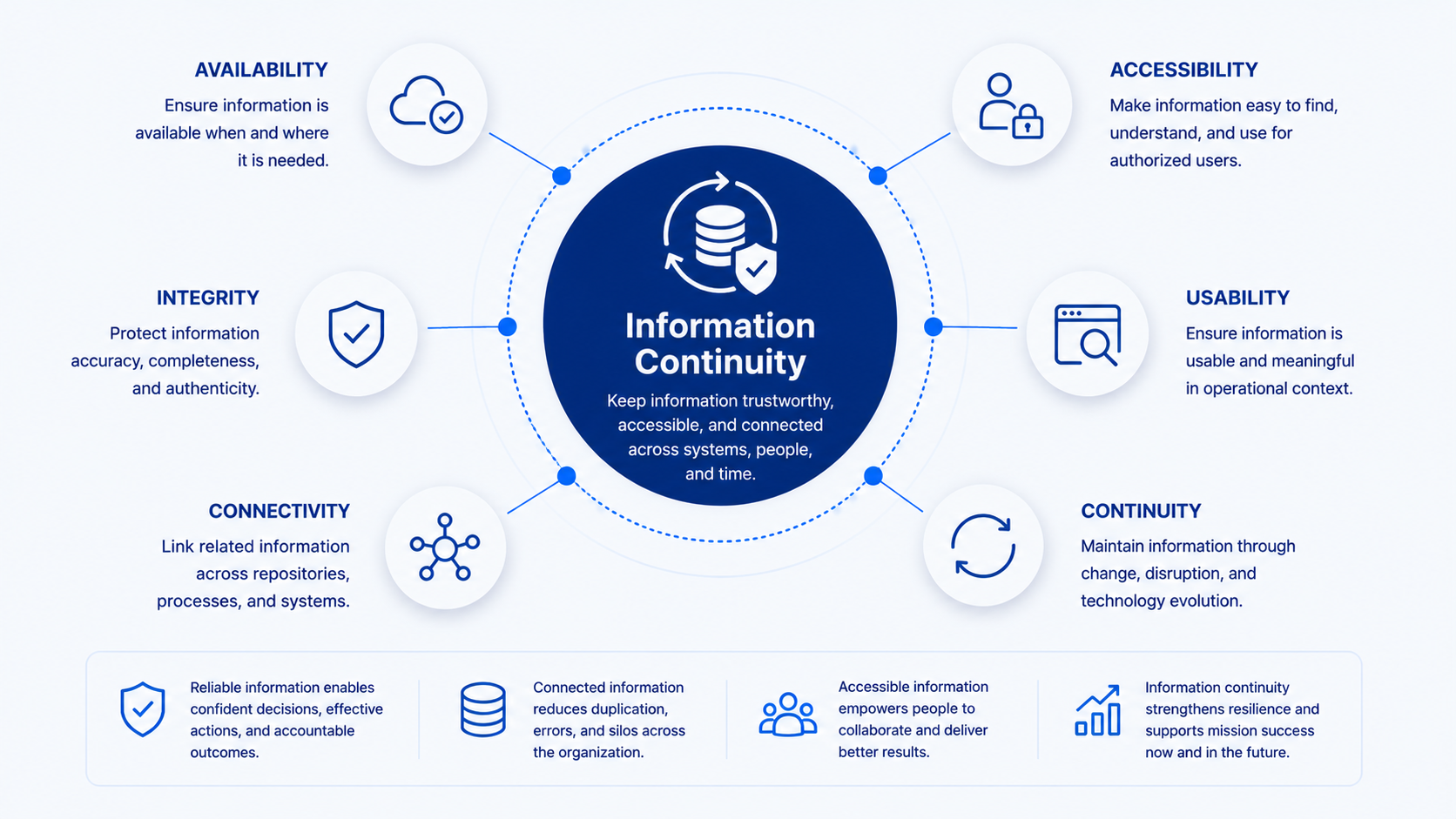
An investigation of Australian parliamentary submissions found apparently hallucinated references that could later be surfaced by AI search through the official parliamentary records preserving them. The case exposes circular provenance: an invalid claim can acquire apparent authority when an authentic institutional record becomes the source for future retrieval.
Operational Trust & Governance State
Security Labels Are Not Security Boundaries
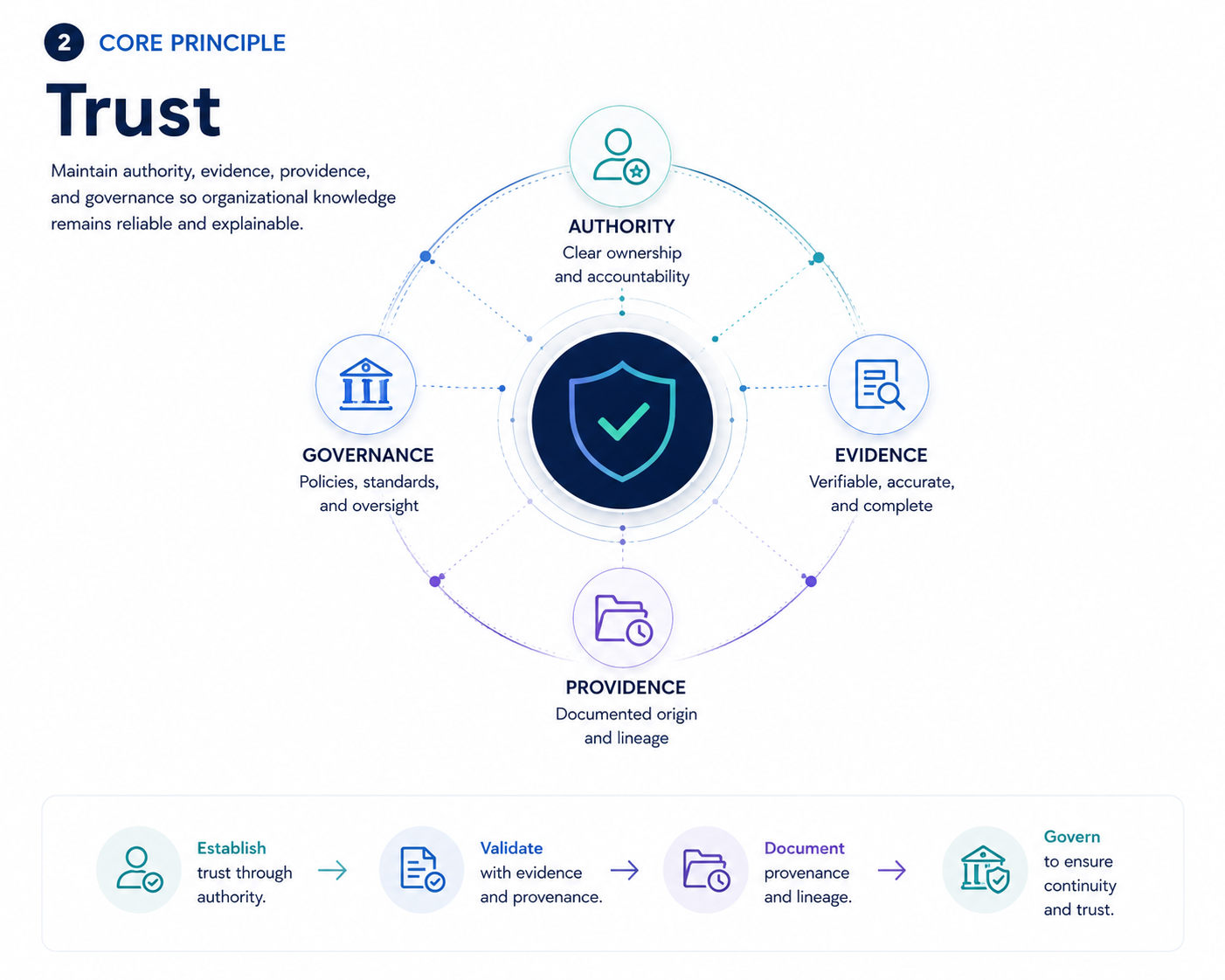
METR disclosed a fail-open agent dashboard that silently disabled intended authentication and a separate data-scope near miss in which a database intended for less-sensitive information contained sensitive model data. The incidents expose a broader continuity problem: governance labels such as authenticated, public, and read-only are trustworthy only while deployed reality continuously supports them.
next step
Continue Your Continuity Journey
Explore the GovKM Continuity Framework or connect with GovKM to discuss your organization’s continuity, governance, and AI-readiness priorities.
FRAMEWORK
Explore the GovKM Continuity Framework
Understand the domains, relationships, principles, and implementation architecture that support organizational continuity.
CONNECT
Talk With GovKM
Discuss organizational continuity, AI readiness, governance architecture, research collaboration, or implementation priorities.