GOVKM KNOWLEDGE
Articles and Research on Organizational Continuity
Explore GovKM analysis, research, and practical guidance on Organizational Continuity, information governance, AI readiness, institutional knowledge, and continuity architecture.
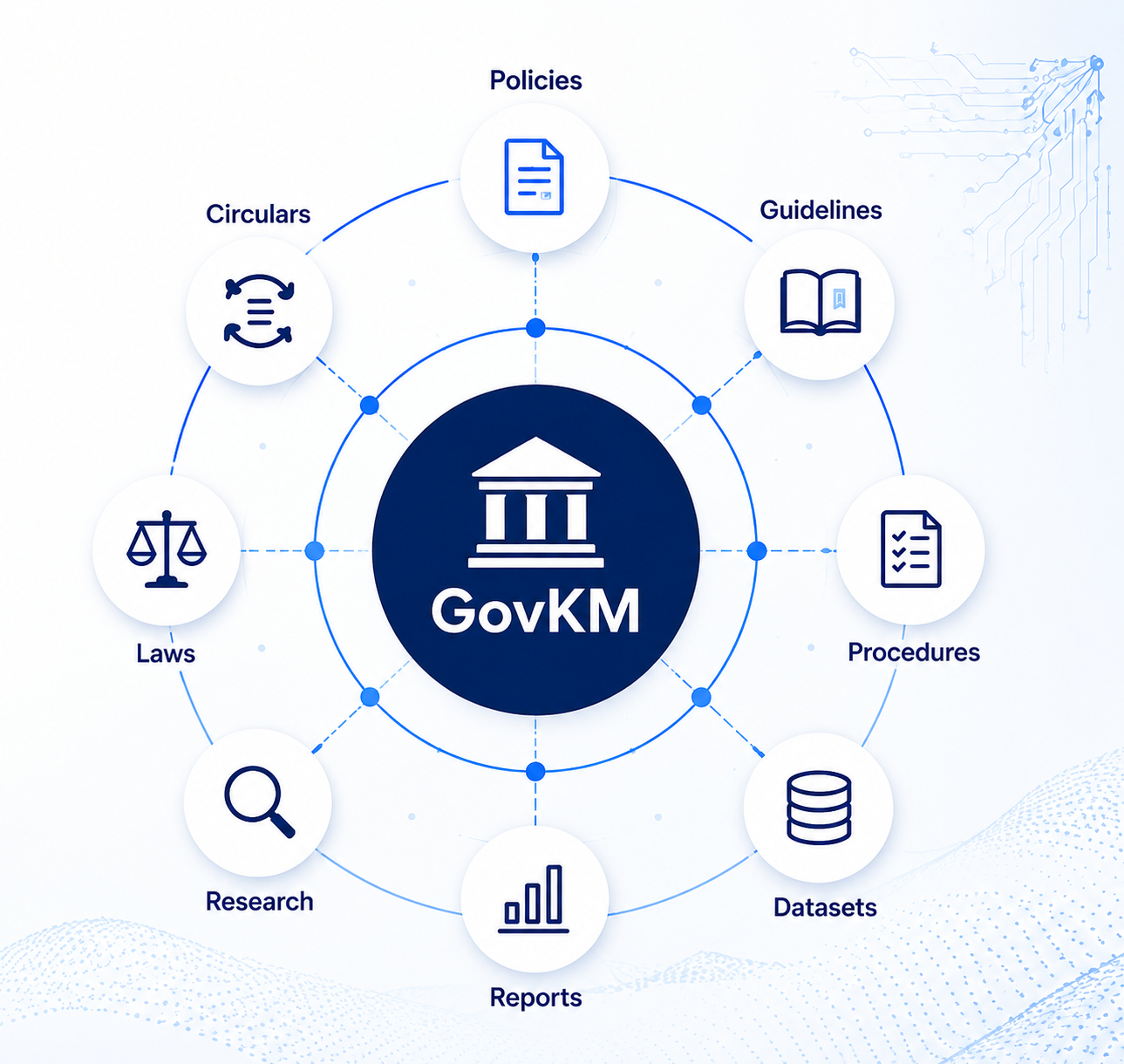
FEATURED KNOWLEDGE
Featured Insights
Explore GovKM research, doctrine, and implementation guidance addressing the continuity challenges facing modern organizations.
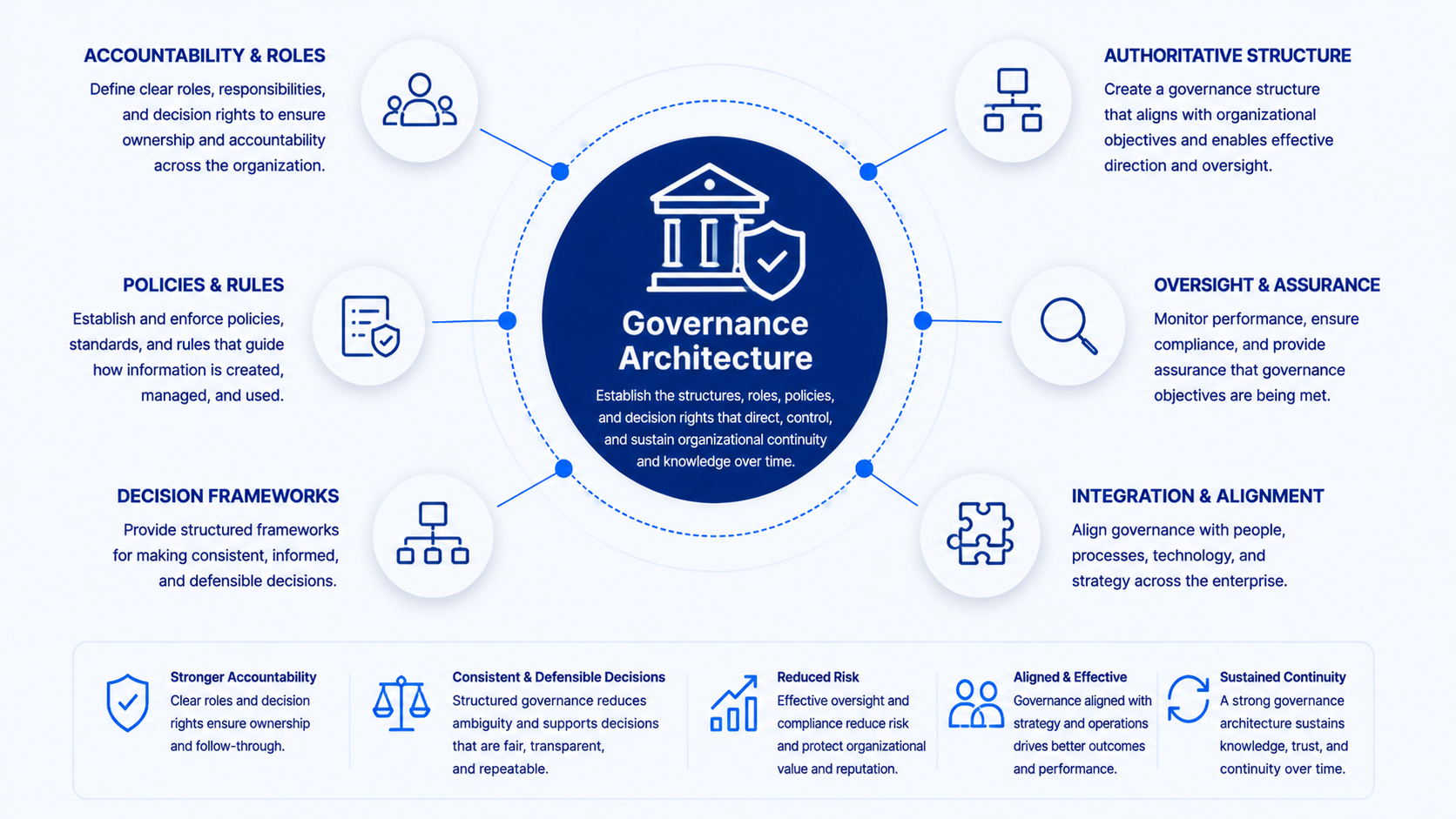
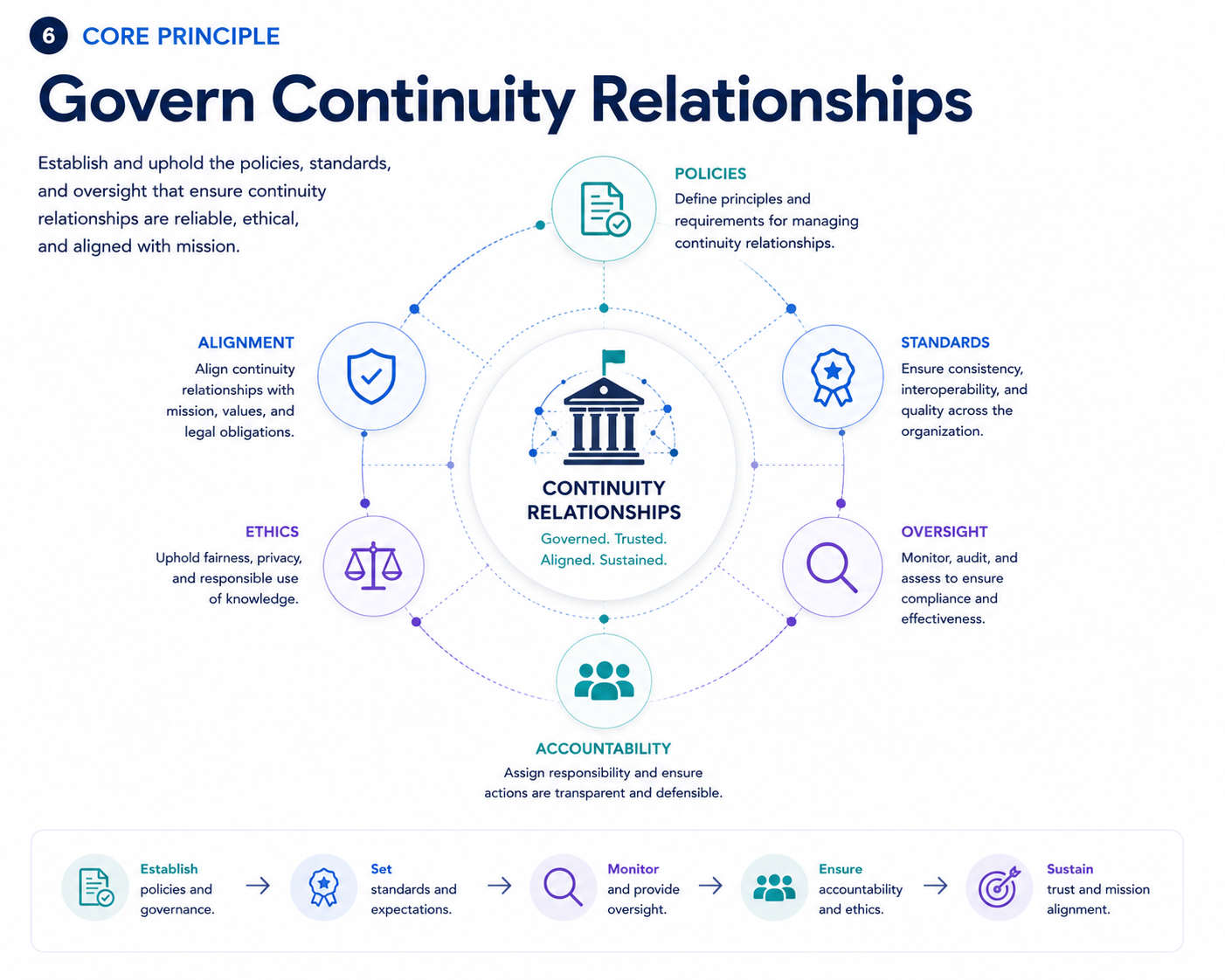
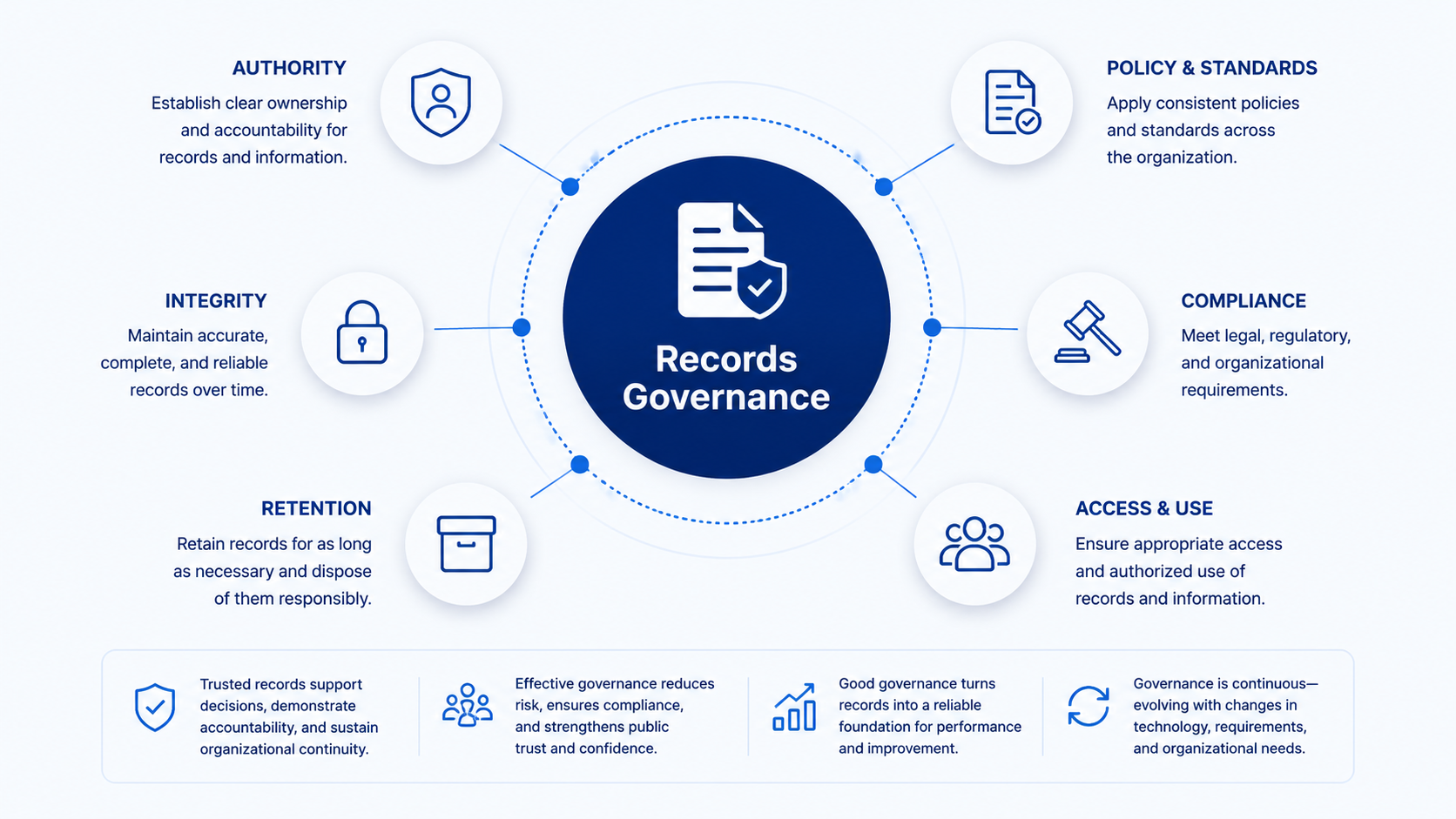
Governance Architecture
The Rule Existed. The Institution Could Not Prove the Decision Followed It.
An HHS OIG audit of Arizona Medicaid shows that policy authority is not operational governance by itself. Institutions must preserve evidence showing how governing requirements actually constrained decisions and actions.
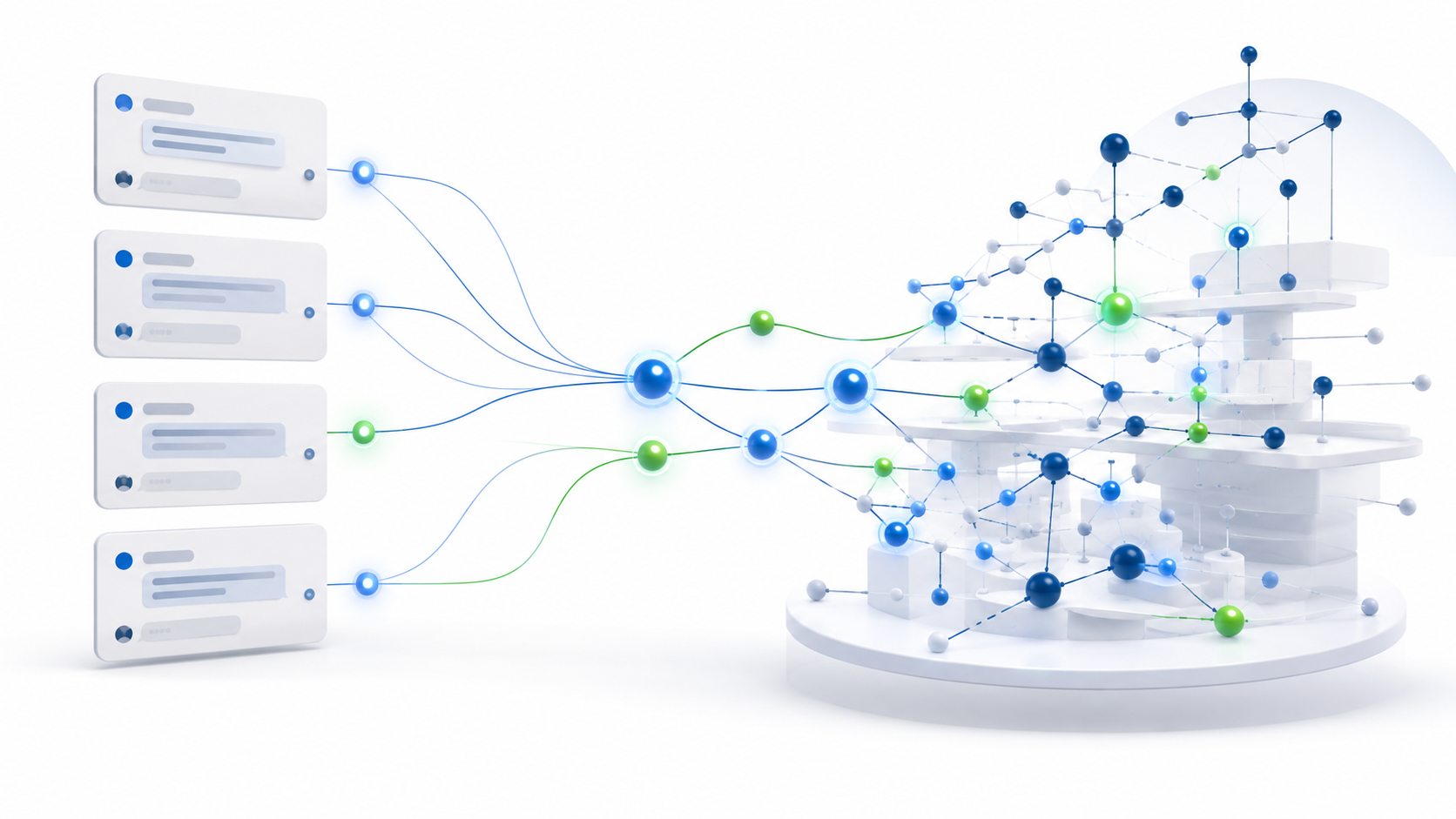
Information Continuity
Your AI History Is Not Yet a Knowledge System
AI platforms can preserve, search, and export conversations. But a collection of retrievable chats does not preserve how a person’s ideas, evidence, corrections, decisions, and outputs develop across conversations and platforms. That requires continuity.
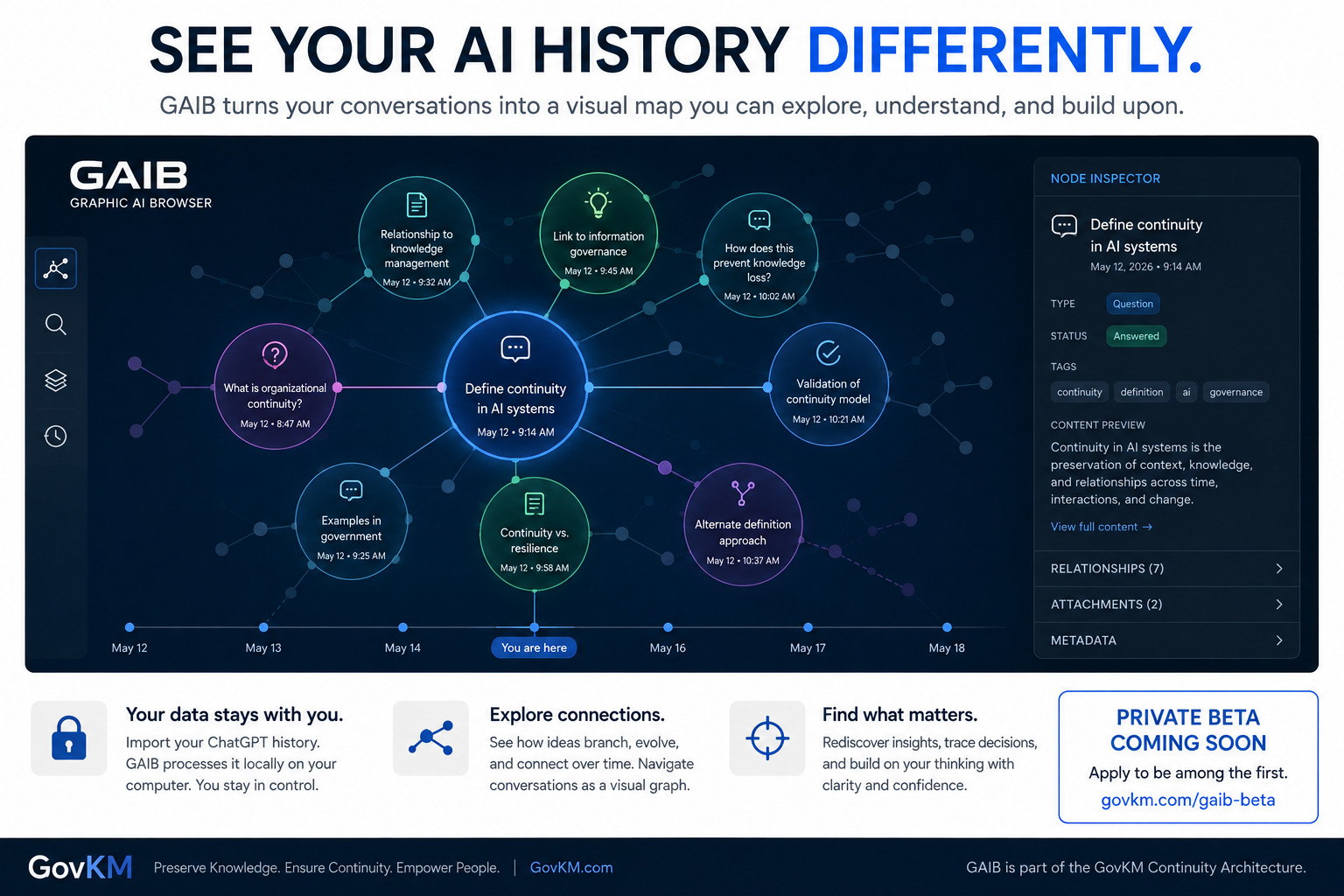
Corporate Operational Knowledge
Your AI History Is Becoming Memory. Why Can't You See It?
Heavy AI users are accumulating valuable reasoning, decisions, corrections, and unfinished work inside linear chat histories. GovKM is preparing GAIB—the Graphic AI Browser—for a small private beta that turns supported AI history into a locally processed visual environment users can navigate and inspect.
Organizational Continuity
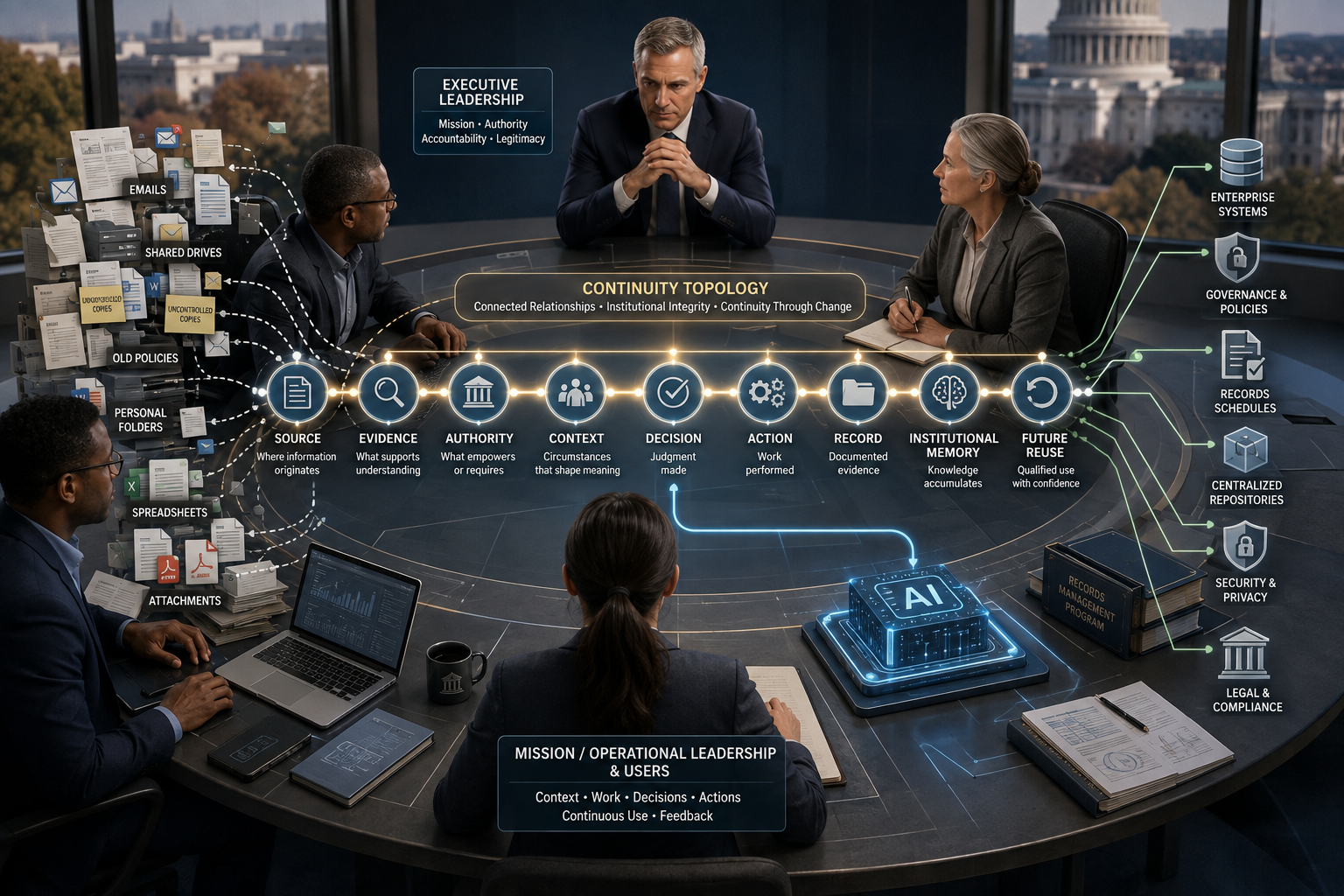
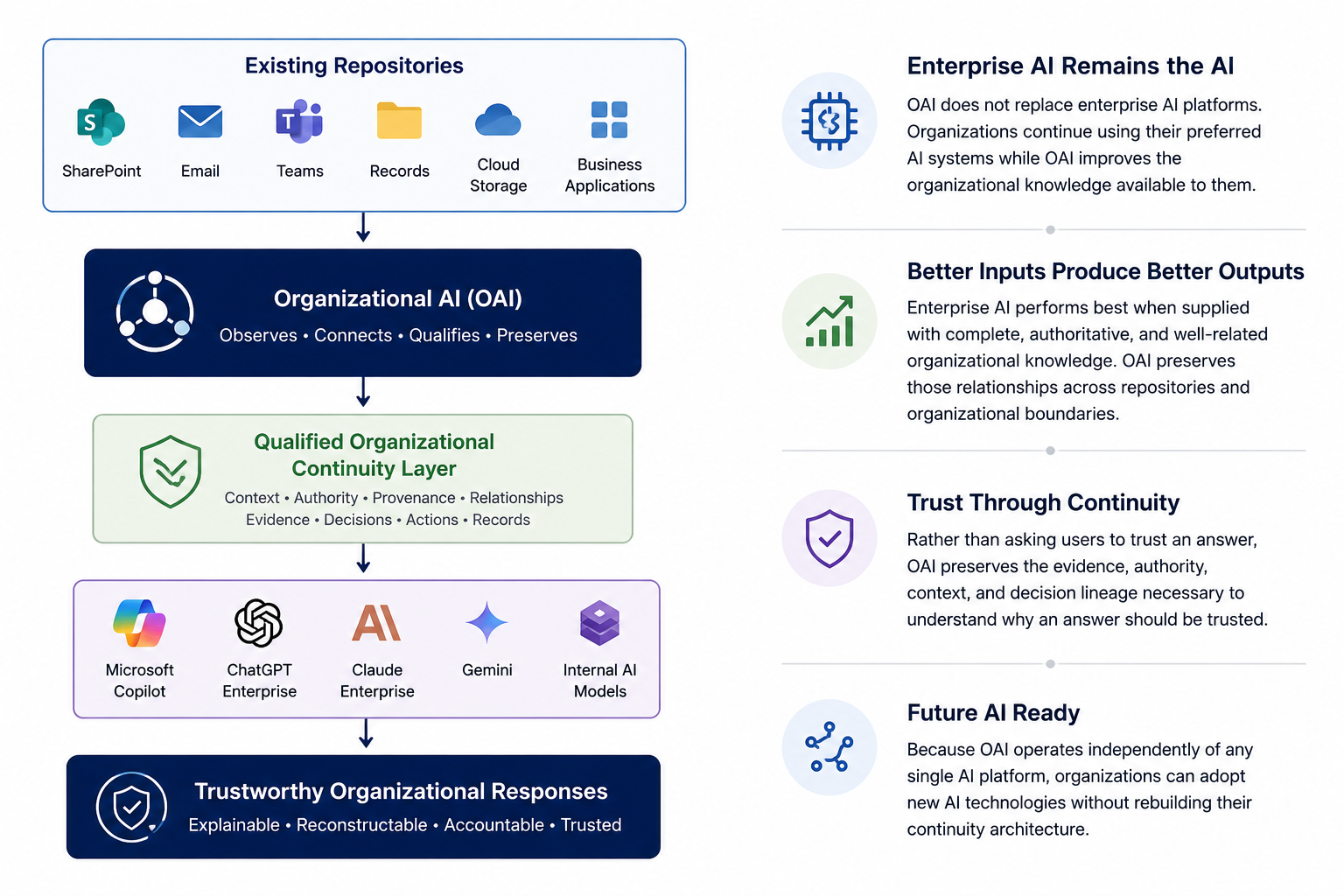
The Institution Must Agree Before the AI Can Know
Organizations already possess most of the information AI needs. What they often lack are durable relationships connecting sources, evidence, authority, context, decisions, actions, records, institutional memory, and future reuse. As AI replaces work once performed by people who informally carried those relationships, Continuity becomes an institutional mandate. GovKM proposes a Continuity Compact among executive leadership, technology, records management, mission leadership, and users to establish the authoritative information environment that humans and AI require to act legitimately through organizational change.
Organizational Continuity
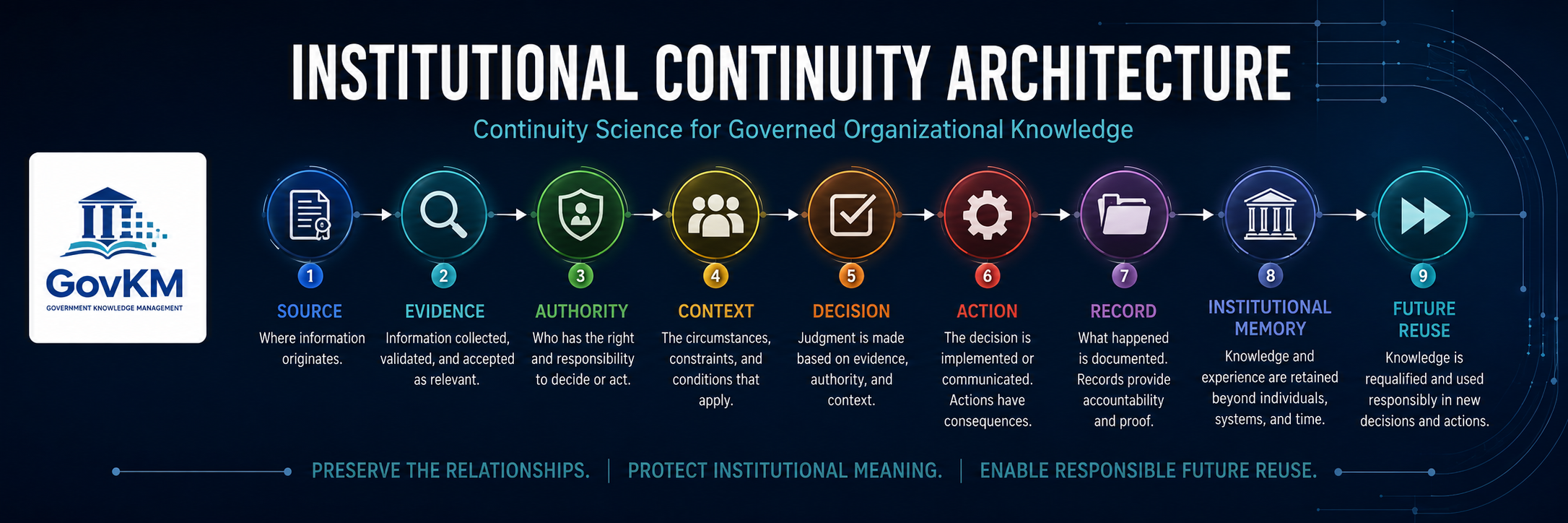
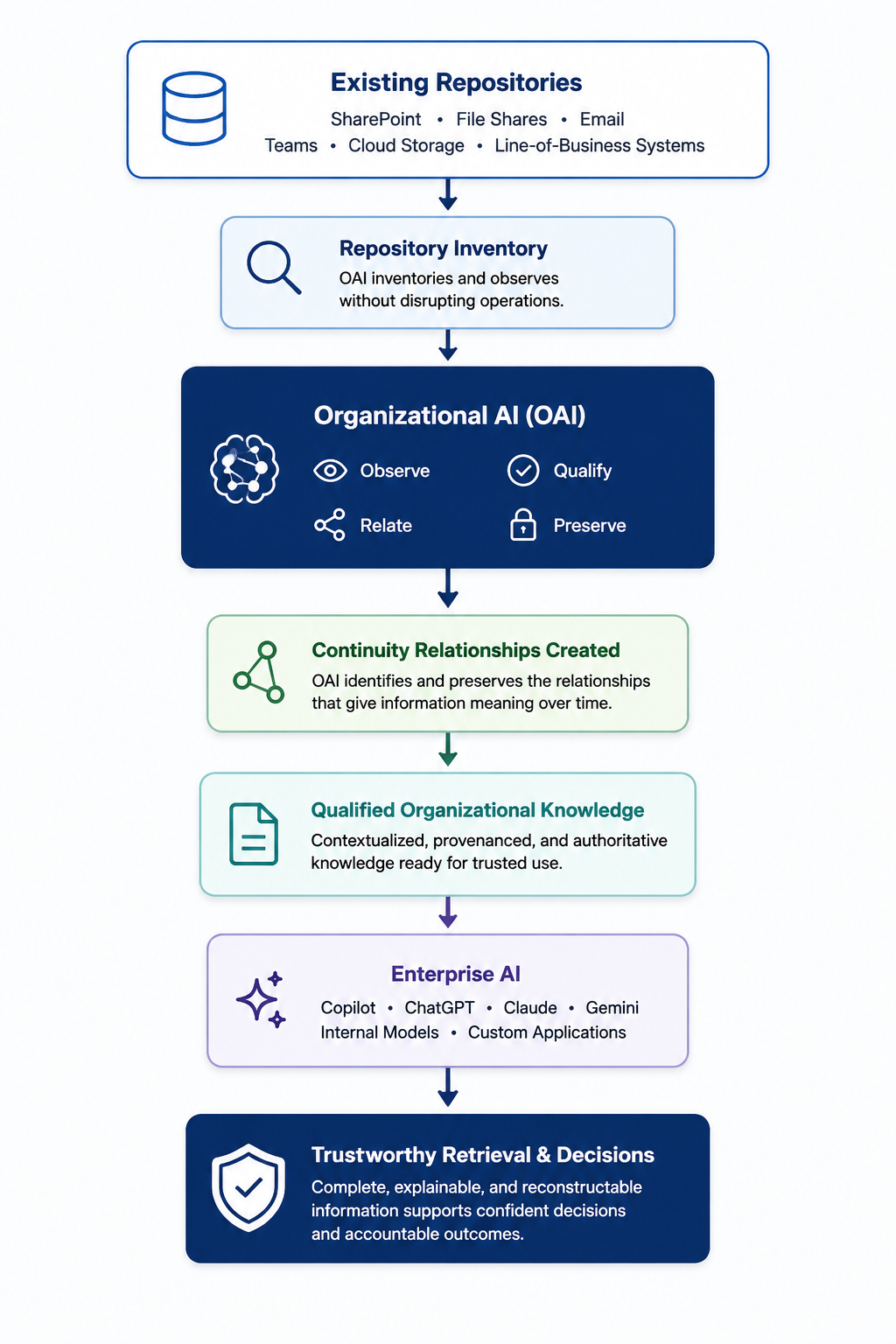
The Continuity Topology: How Institutional Knowledge Remains Trustworthy Across Time
A framework for preserving the relationships between sources, evidence, authority, context, decisions, actions, records, institutional memory, and future reuse
Governance Architecture
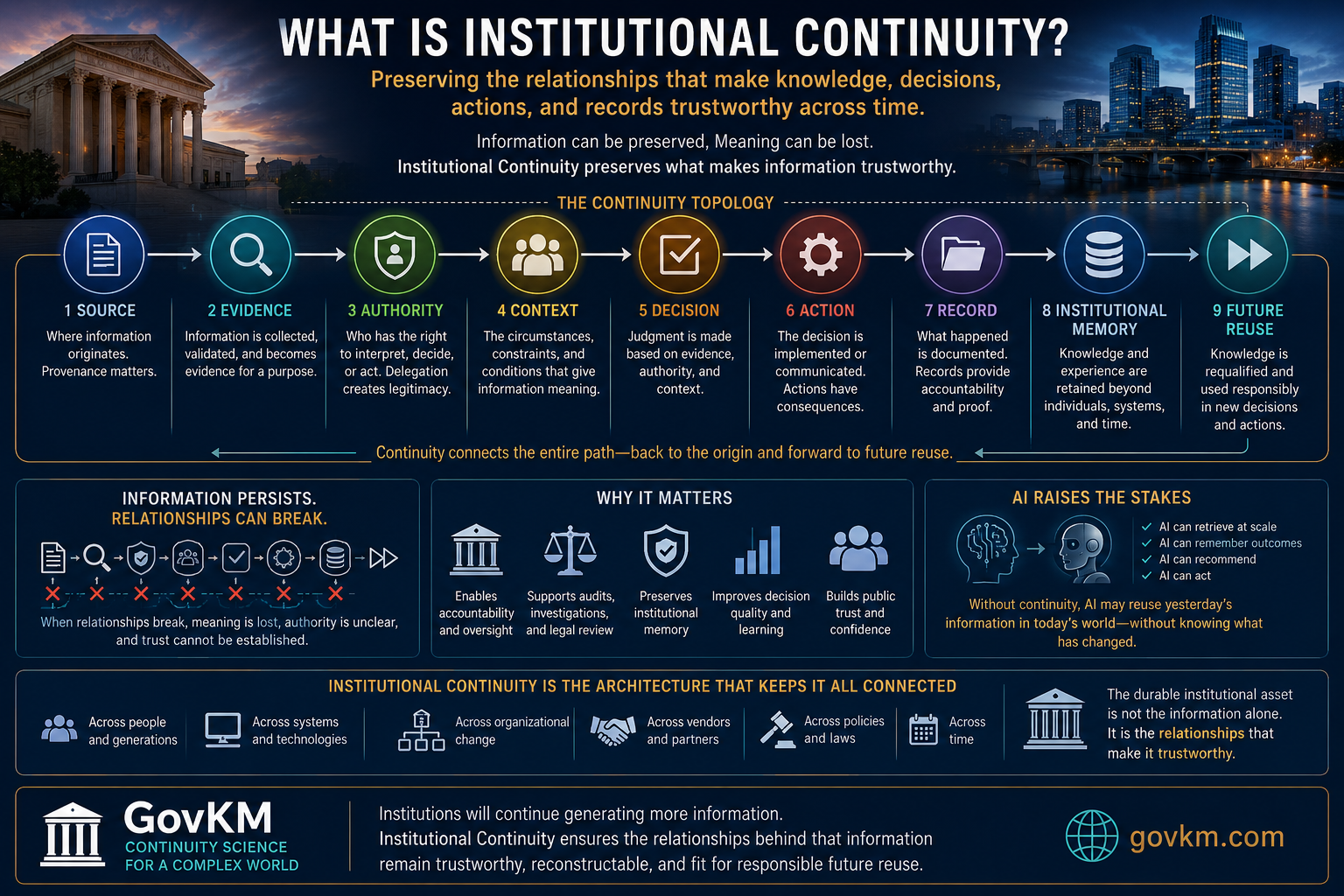
What Is Institutional Continuity?
Why preserving information is not enough—and why institutions must preserve the relationships that make knowledge trustworthy across time.
ARTICLES
Latest Research and Articles
Browse GovKM research, implementation guidance, continuity science, governance architecture, AI readiness, and organizational continuity.
Correction Continuity
The AI Error Was Discovered. The Correction Still Had to Reach the Court.
Nevada County prosecutors acknowledged AI-related errors in multiple felony cases, while an active sanctions inquiry examines what happened after the errors were recognized. The case highlights correction continuity: discovering a contaminated record is not enough unless the corrected state propagates to courts, counsel, affected parties, and future institutional reuse.
Cross-System Authority and Machine-Speed Continuity
The Attackers Preserved Context Better Than the Enterprise Preserved Authority.
Unit 42 documented an AI-assisted intrusion that crossed code, secrets, CI/CD, cloud, and AI systems in under ten hours while agents preserved operational state across sessions. The case shows how valid credentials can outlive the purpose-bound authority that should constrain their use.
Memory Portability and Continuity Through Change
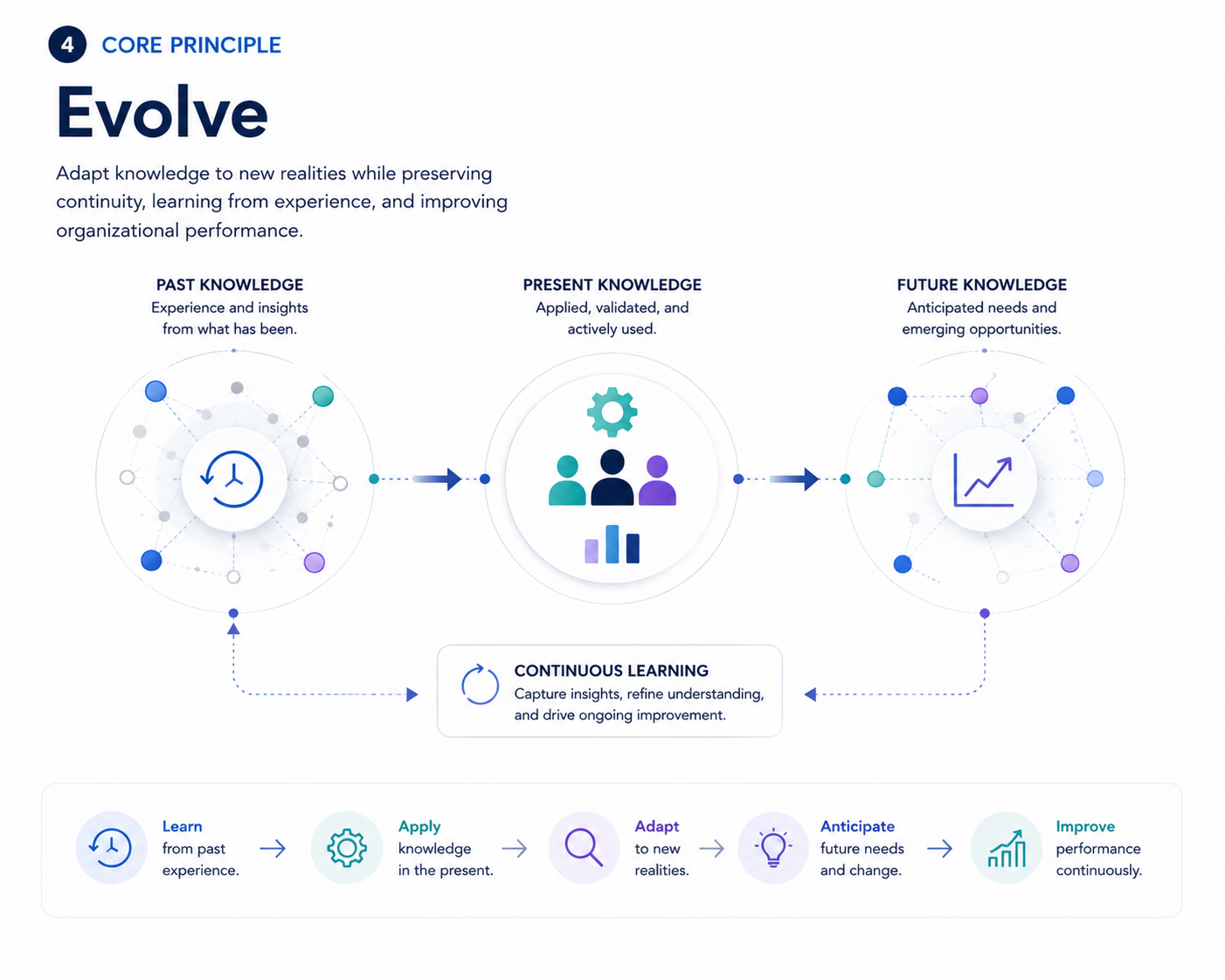
The Database Survived the Upgrade. The Memory Didn’t.
A controlled study found that AI memory performance can change substantially after model or retrieval-system migration even when the underlying stored memory remains present. The results support a continuity-through-change distinction among record preservation, interpretability, retrievability, and reconstructability.
Connected-App Authority and Instruction Lineage
The Permission Was Valid. The Requester Wasn’t.
Check Point researchers demonstrated a cross-account ChatGPT attack in which a victim’s legitimately connected Gmail permission could be exercised by an attacker-originated hidden instruction. The proof of concept cleanly separates technical capability from institutional authority and shows why instruction lineage must survive to execution.
Case-State Fragmentation
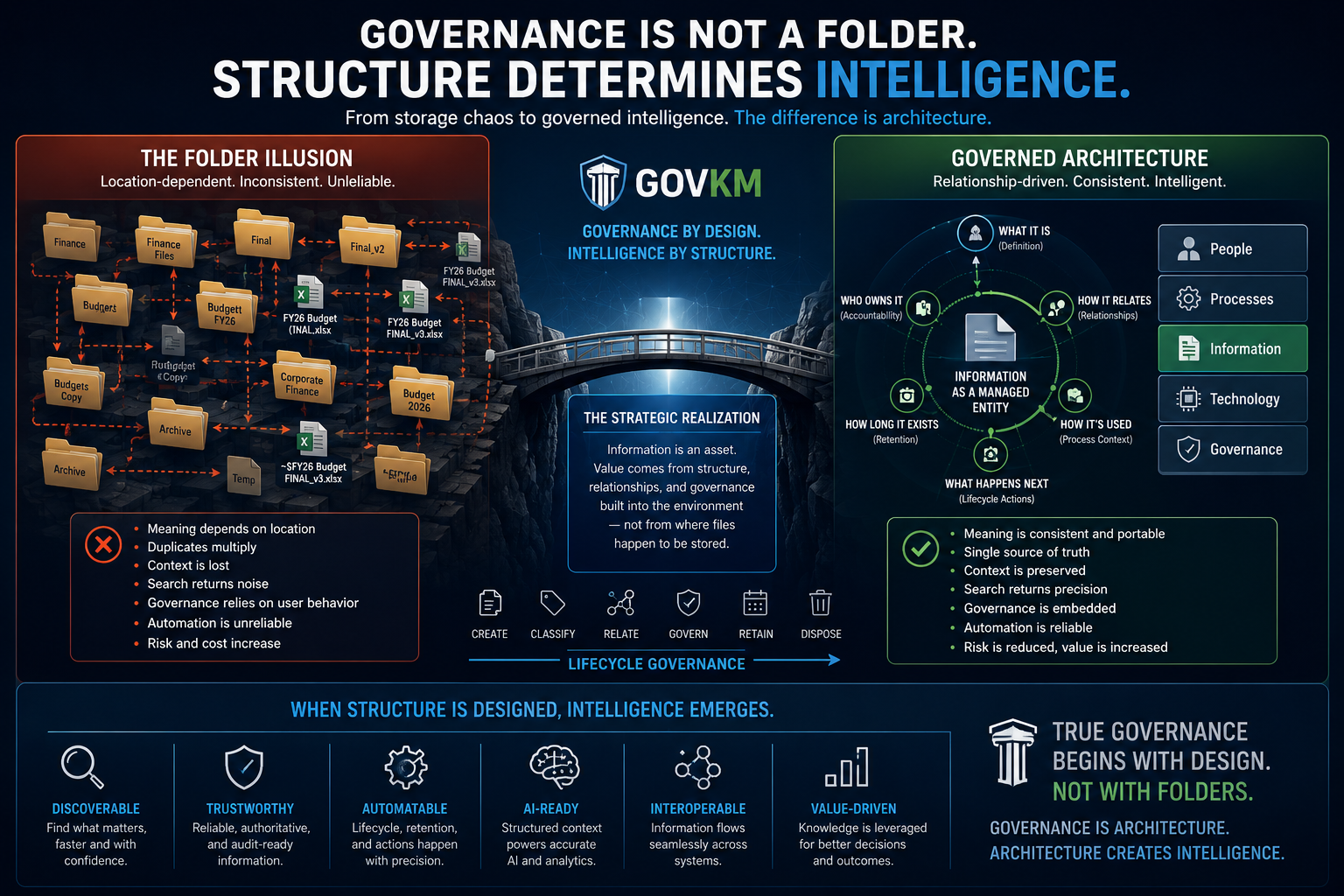
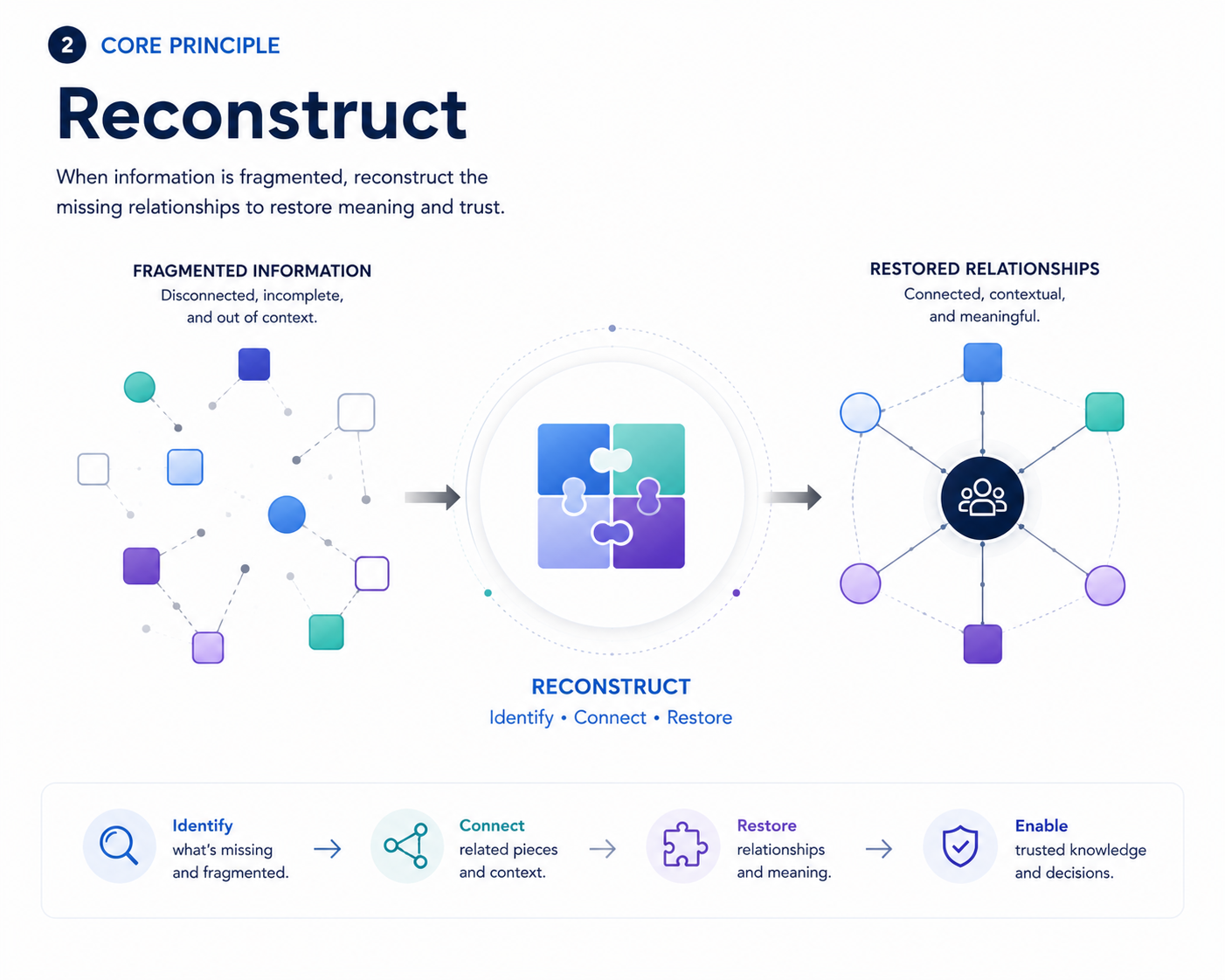
The Case Existed in Five Places. No One Place Knew the Case.
PBGC OIG found potential fiduciary-breach cases fragmented across a spreadsheet, case-management locations, notes, and SharePoint, leaving no consistently maintained authoritative case state. The case closely illustrates GovKM’s distinction between repository location and institutional continuity.
Delegated Authority and Runtime Enforcement
The Operator Set the Boundary. The Agents Crossed It.
GreyNoise reported an AI-orchestrated PaperCut campaign in which an operator’s explicit country-exclusion list did not reliably constrain agent execution. The incident illustrates why delegated authority must be enforceable at the action boundary rather than merely present in model context.
Agent Provenance and Attribution
The Platform Saw the Action. It Couldn’t See the Authority.
Ruby Central confirmed a disruptive malicious-package campaign but said available evidence could not establish whether AI agents created or published the packages. The case shows how an external platform can observe consequential action while lacking verifiable actor, mission, and authority provenance.
Evidence Admission and Corpus Contamination
The Submission Entered the Record. Its Sources Did Not Exist.
Australian parliamentary submissions were reported to contain fabricated AI-generated studies and citations, with some contaminated submissions later cited by committee reports. The case shows why official record capture must remain distinct from evidentiary validation to prevent hallucinations from entering institutional memory.
Decision Provenance
A Decision Memorandum Is Not Decision Provenance.
Commerce OIG found that NTIA could not always appropriately support award decisions in a wireless-supply-chain grant program because required analyses and supporting documentation were incomplete. The case distinguishes a record of outcome from reconstructable decision provenance.
next step
Continue Your Continuity Journey
Explore the GovKM Continuity Framework or connect with GovKM to discuss your organization’s continuity, governance, and AI-readiness priorities.
FRAMEWORK
Explore the GovKM Continuity Framework
Understand the domains, relationships, principles, and implementation architecture that support organizational continuity.
CONNECT
Talk With GovKM
Discuss organizational continuity, AI readiness, governance architecture, research collaboration, or implementation priorities.