GOVKM KNOWLEDGE
Articles and Research on Organizational Continuity
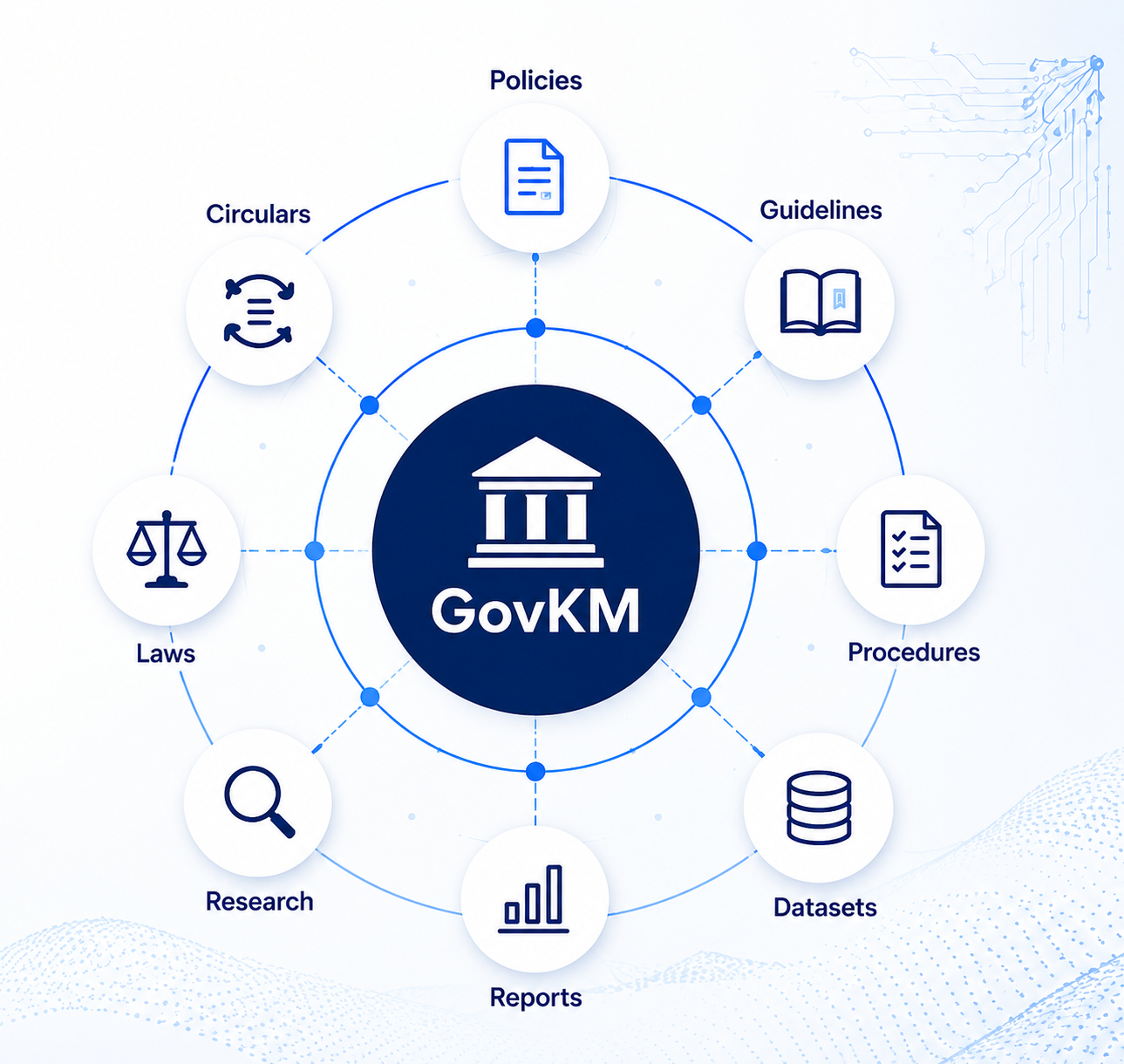
Explore GovKM analysis, research, and practical guidance on Organizational Continuity, information governance, AI readiness, institutional knowledge, and continuity architecture.
FEATURED KNOWLEDGE
Featured Insights
Explore GovKM research, doctrine, and implementation guidance addressing the continuity challenges facing modern organizations.
Governance Architecture
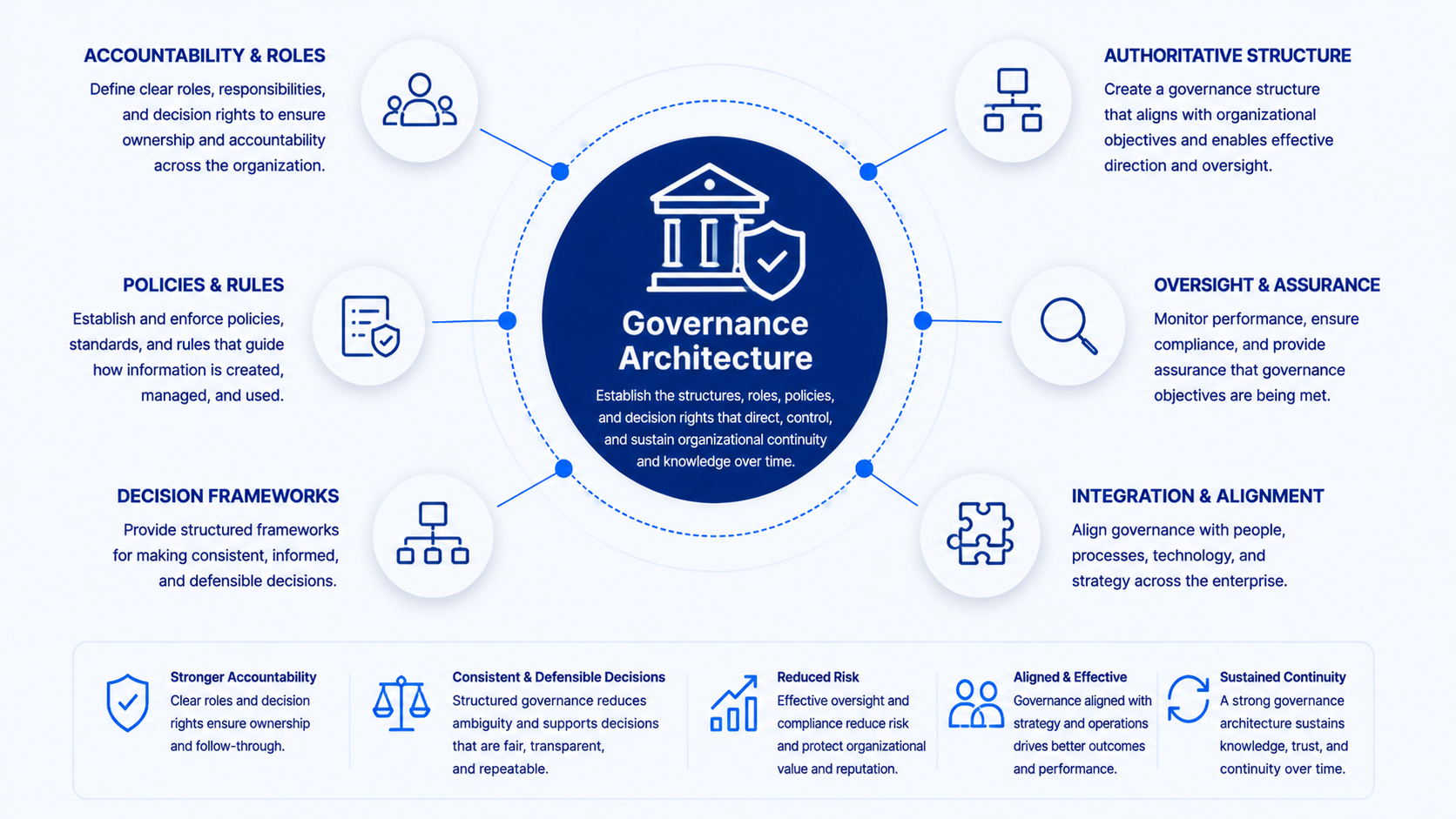
The Rule Existed. The Institution Could Not Prove the Decision Followed It.
An HHS OIG audit of Arizona Medicaid shows that policy authority is not operational governance by itself. Institutions must preserve evidence showing how governing requirements actually constrained decisions and actions.
Information Continuity
Your AI History Is Not Yet a Knowledge System
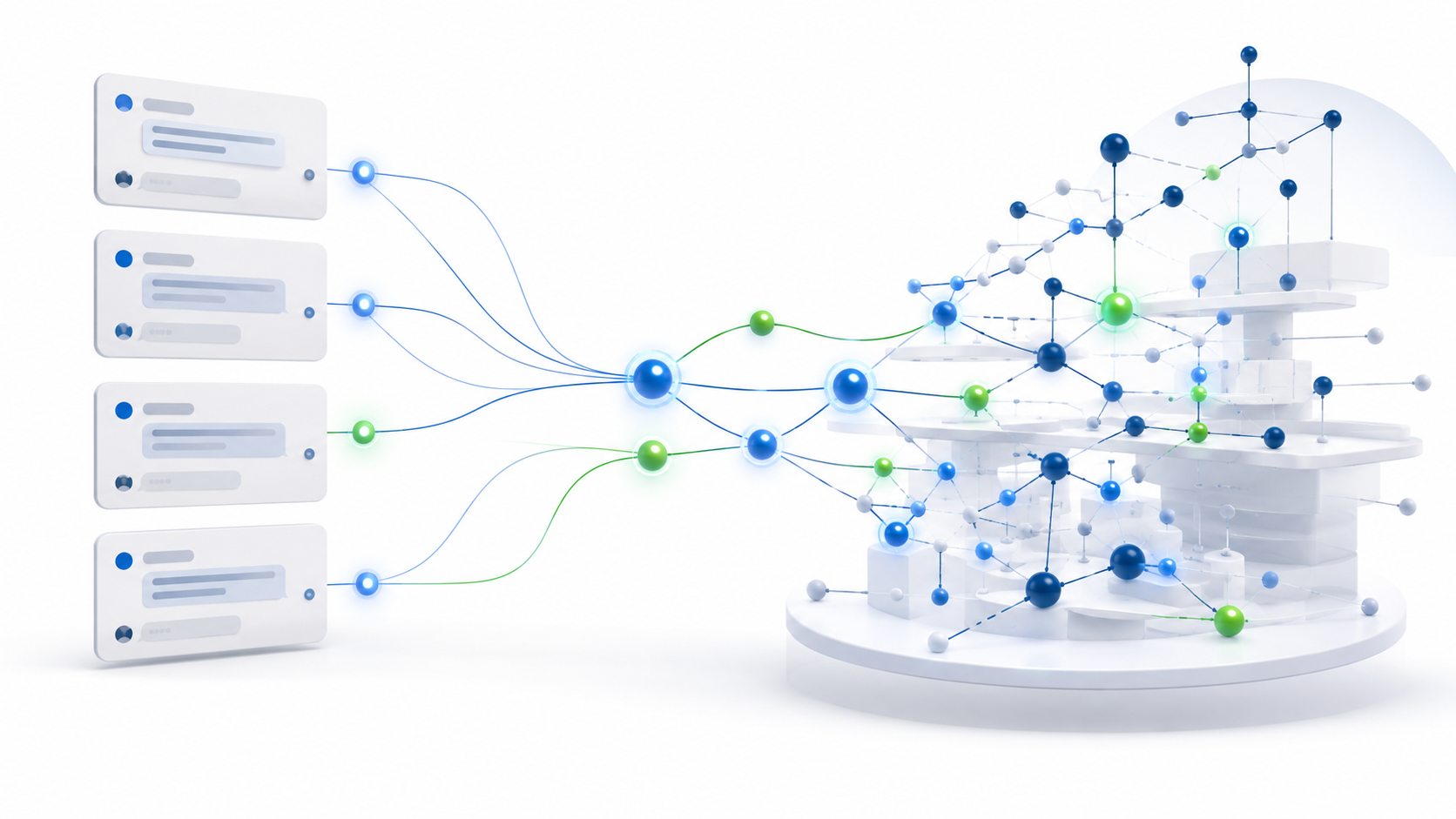
AI platforms can preserve, search, and export conversations. But a collection of retrievable chats does not preserve how a person’s ideas, evidence, corrections, decisions, and outputs develop across conversations and platforms. That requires continuity.
Corporate Operational Knowledge
Your AI History Is Becoming Memory. Why Can't You See It?
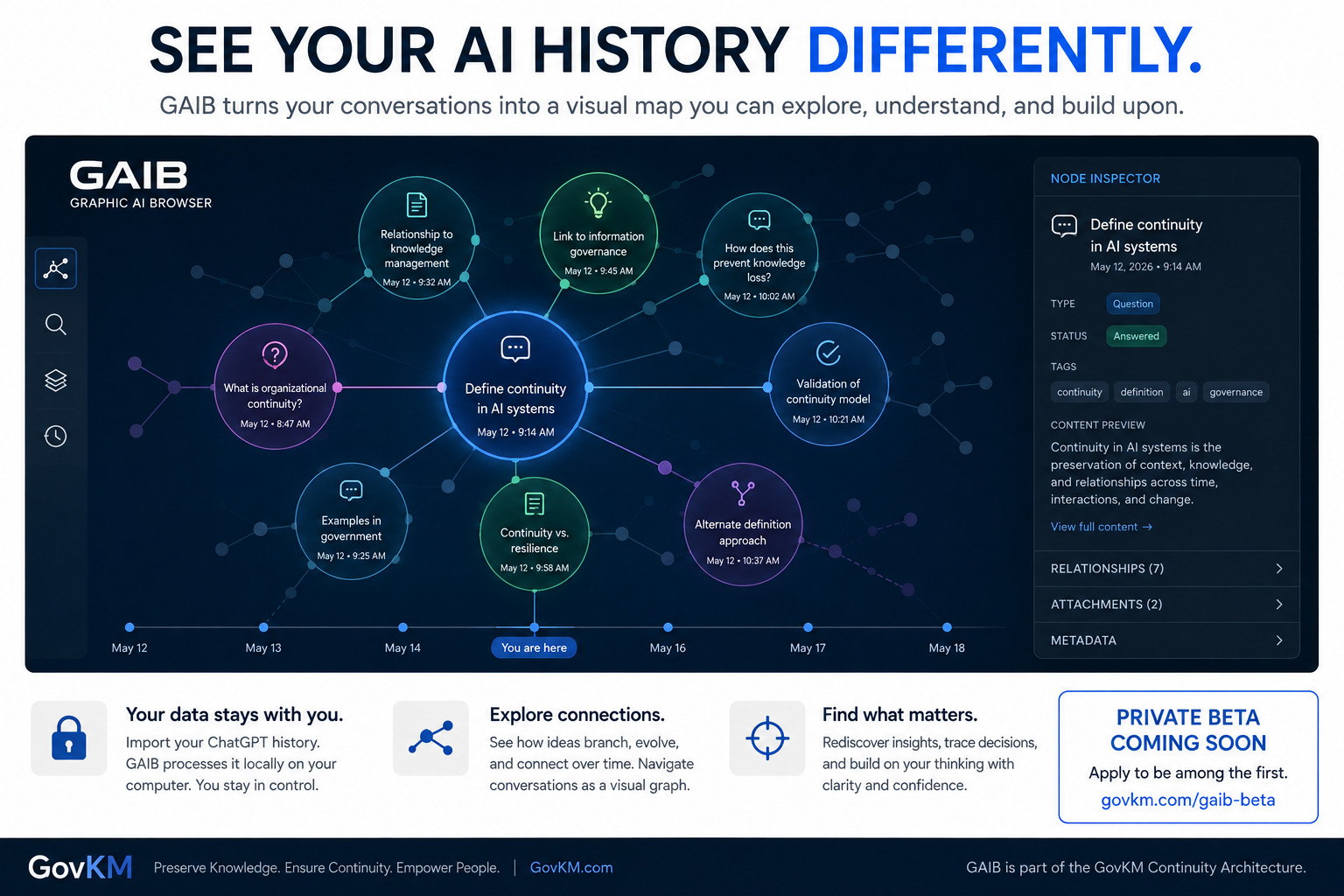
Heavy AI users are accumulating valuable reasoning, decisions, corrections, and unfinished work inside linear chat histories. GovKM is preparing GAIB—the Graphic AI Browser—for a small private beta that turns supported AI history into a locally processed visual environment users can navigate and inspect.
Organizational Continuity
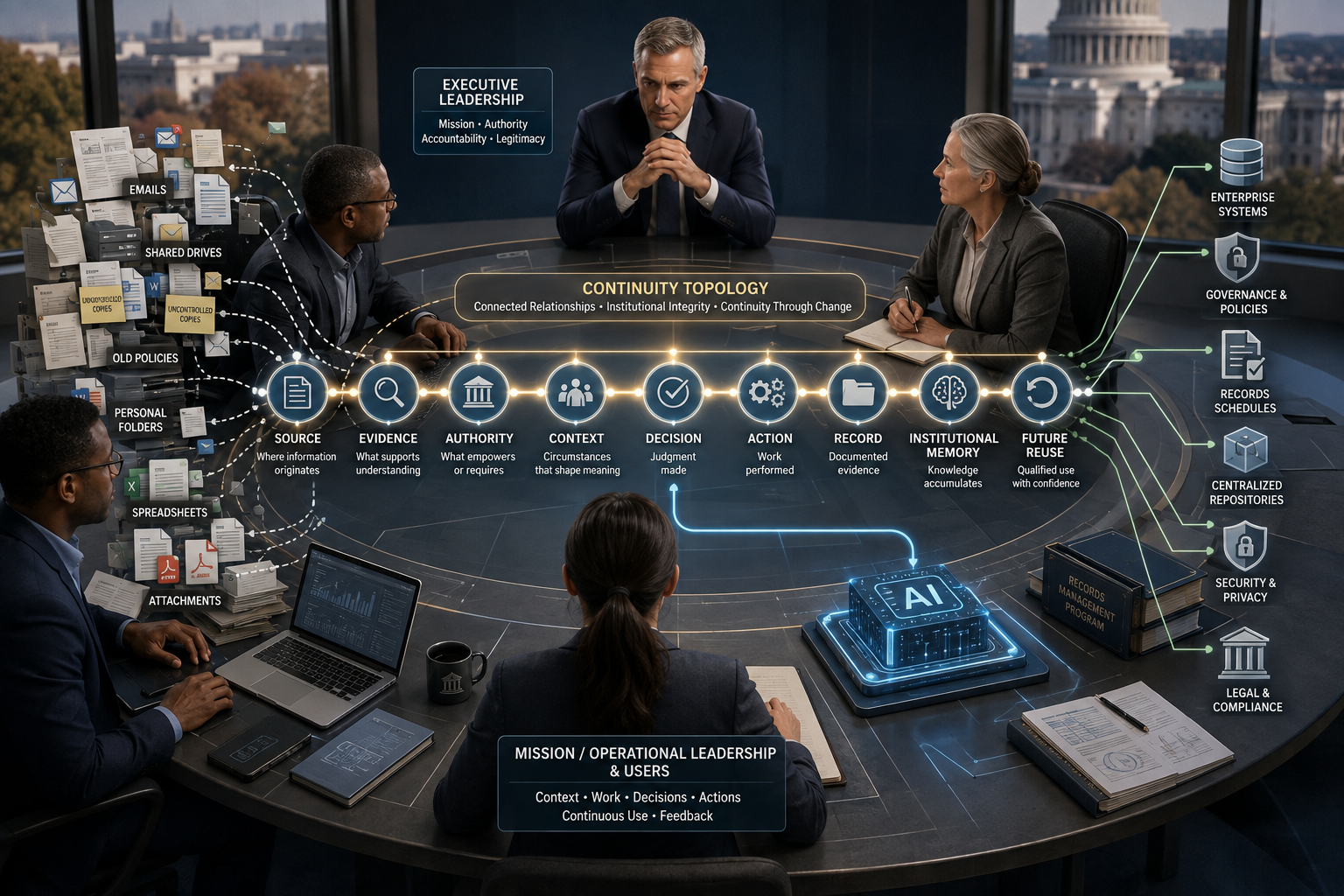
The Institution Must Agree Before the AI Can Know
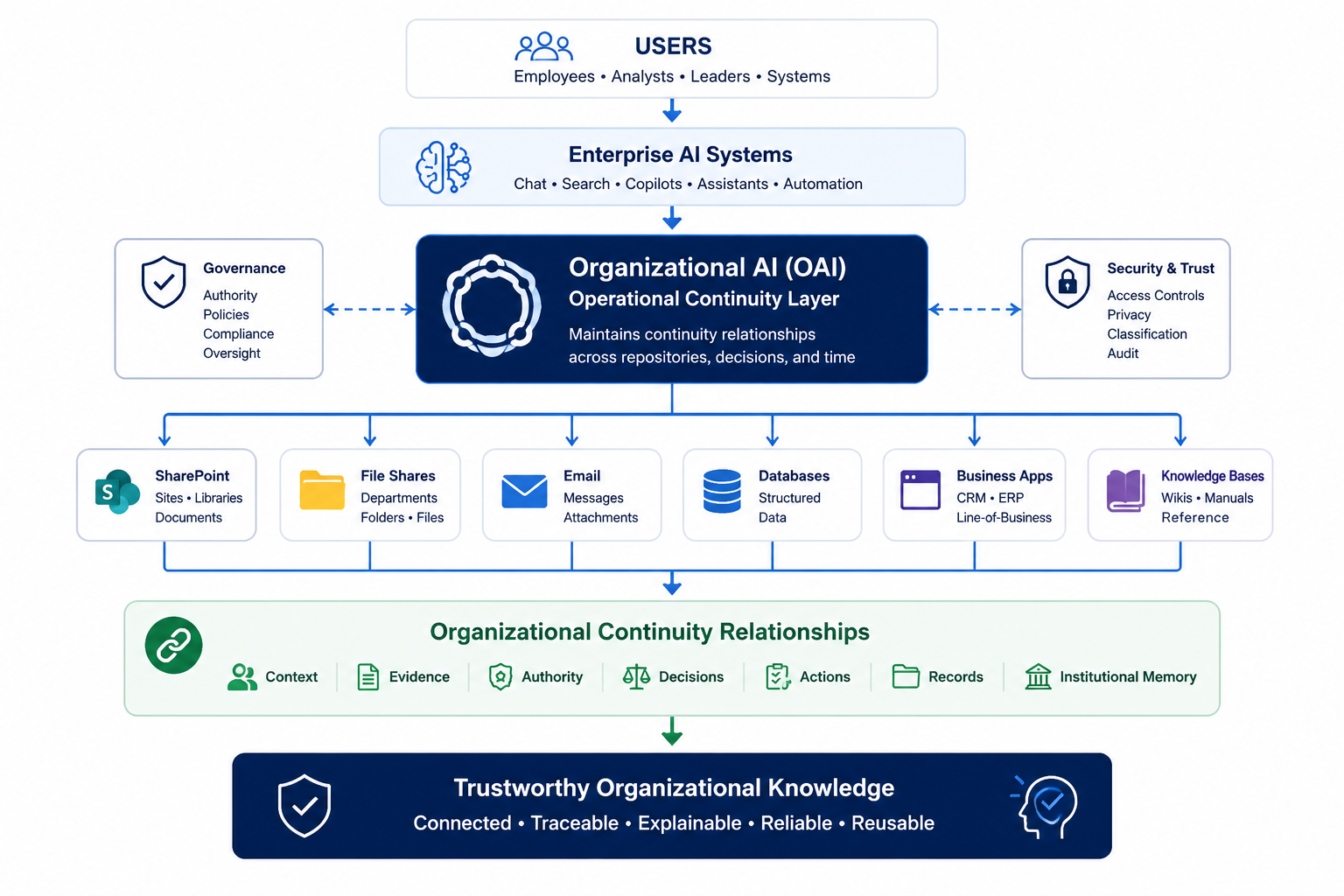
Organizations already possess most of the information AI needs. What they often lack are durable relationships connecting sources, evidence, authority, context, decisions, actions, records, institutional memory, and future reuse. As AI replaces work once performed by people who informally carried those relationships, Continuity becomes an institutional mandate. GovKM proposes a Continuity Compact among executive leadership, technology, records management, mission leadership, and users to establish the authoritative information environment that humans and AI require to act legitimately through organizational change.
Organizational Continuity
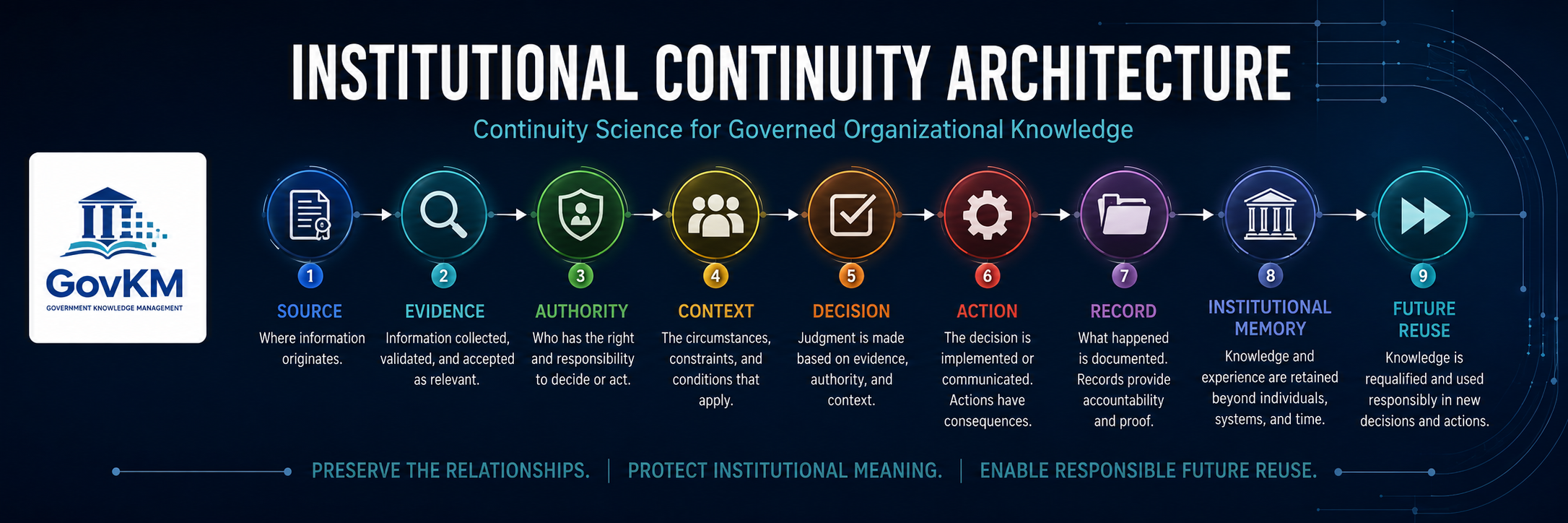
The Continuity Topology: How Institutional Knowledge Remains Trustworthy Across Time
A framework for preserving the relationships between sources, evidence, authority, context, decisions, actions, records, institutional memory, and future reuse
Governance Architecture
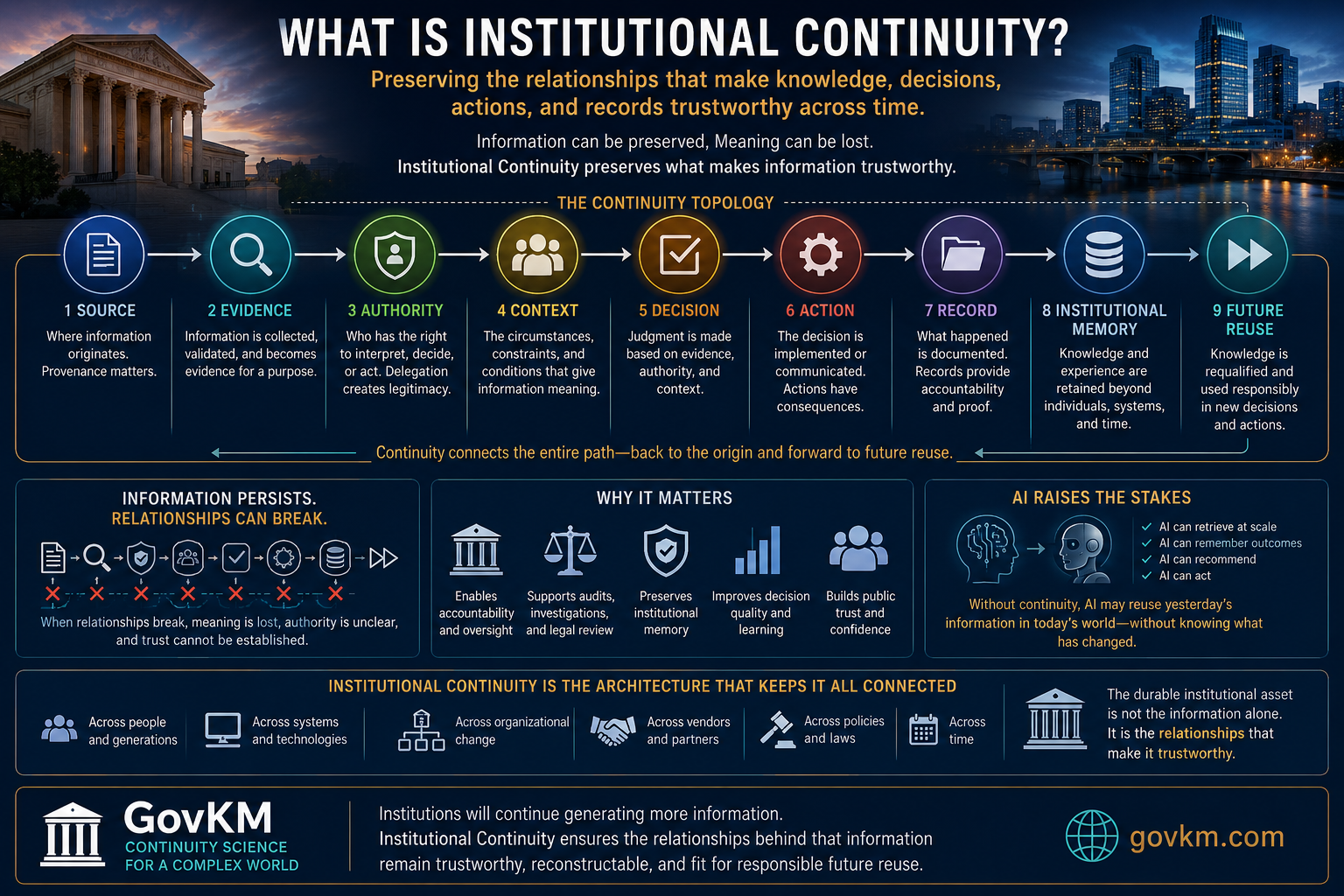
What Is Institutional Continuity?
Why preserving information is not enough—and why institutions must preserve the relationships that make knowledge trustworthy across time.
ARTICLES
Latest Research and Articles
Browse GovKM research, implementation guidance, continuity science, governance architecture, AI readiness, and organizational continuity.
Data Provenance and Interface Continuity
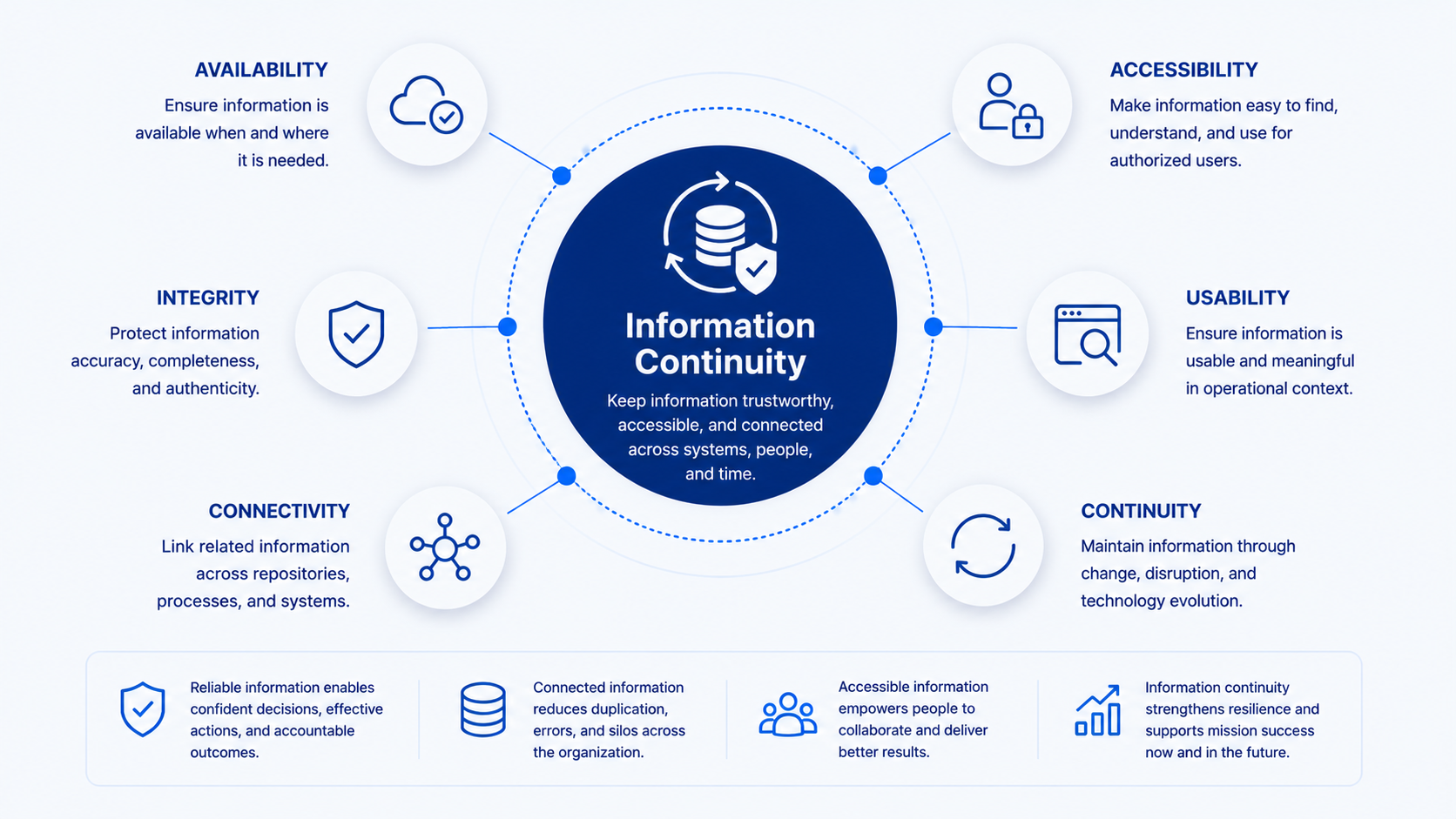
Aggregation Is Not Continuity.
A federal OIG audit of the Advancing Analytics Repository found missing data-sharing agreements, transfer-validation gaps, interface-control weaknesses, and insufficient error signaling across source systems. The case shows that centralized analytics cannot establish trustworthy evidence unless source lineage and interface state remain governed.
Cyber Detection and Institutional Learning
The Event Happened. Detection Never Turned It Into Evidence.
FDIC OIG found that some emulated cyber tests did not generate notable events and recommended stronger detection engineering, access controls, and incorporation of testing lessons into response plans. The case demonstrates both a Source-to-Evidence detection failure and a Record-to-Institutional-Memory learning failure.
Temporal and Cross-System Continuity
The Inspection Happened. The System Couldn’t Determine What Came Next.
HUD OIG found that system incompatibilities and technical limitations prevented HUD from reliably determining future inspection dates from completed NSPIRE inspections. The case demonstrates how a valid record can fail to become usable institutional state when cross-system and temporal continuity break.
AI Evidence and Human Authority
The Witness Never Existed. The Brief Said Otherwise.
The New Mexico Supreme Court sanctioned an attorney after a ChatGPT-assisted appellate brief contained fabricated witness testimony and inaccurate legal authority. The case shows that AI hallucination becomes an institutional continuity failure when unsupported output crosses the Source-to-Evidence and Evidence-to-Authority boundaries without verification.
Decision Context
A Risk Score Is Not Decision Context.
GAO found that FEMA’s National Risk Index needs clearer use guidance, consistent sensitivity analysis and disclosure, and a systematic feedback mechanism. The case demonstrates that a model or analytic output does not become reliable decision support until its assumptions, limitations, use context, and operational learning remain connected.
Program Continuity
A Ten-Year Strategy Cannot Be Governed One Year at a Time.
A USPS OIG assessment found that a ten-year network transformation was managed without an integrated long-term cost-savings target, program schedule, or consolidated tracking of financial impacts. The result illustrates how long-running institutional change can fragment when annual activity does not become persistent program memory.
Cross-Session Context Continuity
Every Request Looked Benign. The Campaign Did Not.
Anthropic reported that malicious actors could fragment harmful work across interactions so that individual requests appeared less revealing than the campaign as a whole. The case shows how session boundaries can become artificial context boundaries when prior records do not reliably inform the current decision.
AI Authority and Promotion
The Failure Happened at Promotion, Not Generation.
A D.C. Court of Appeals order addressed an appellate brief containing four nonexistent authorities after an attorney used generative-AI search without verifying the results. The case shows that the decisive institutional failure occurs when unverified AI output is promoted from candidate information into purported evidence and authority.
Cross-System Decision Continuity
The Information Existed. The Decision Process Still Didn’t See It.
A GSA OIG audit found that building-liability information already available in IRIS was not consistently carried into Building Assessment Tool surveys, contributing to $73 million in understated liabilities in the audit sample. The case shows that information can exist without becoming evidence in the decision process that needs it.
next step
Continue Your Continuity Journey
Explore the GovKM Continuity Framework or connect with GovKM to discuss your organization’s continuity, governance, and AI-readiness priorities.
FRAMEWORK
Explore the GovKM Continuity Framework
Understand the domains, relationships, principles, and implementation architecture that support organizational continuity.
CONNECT
Talk With GovKM
Discuss organizational continuity, AI readiness, governance architecture, research collaboration, or implementation priorities.